
What Does “Acrostic” Mean?
Quick Definition
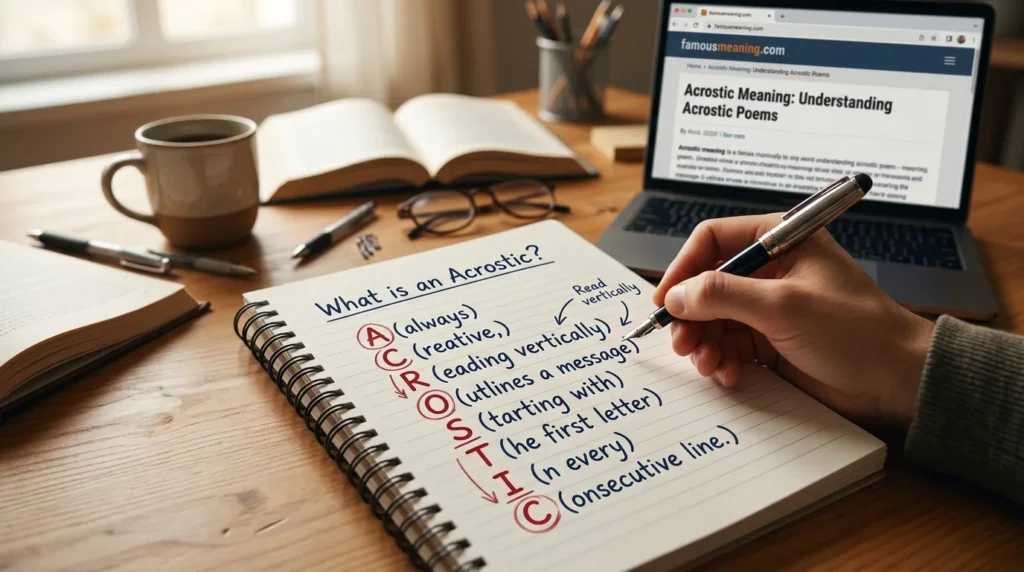
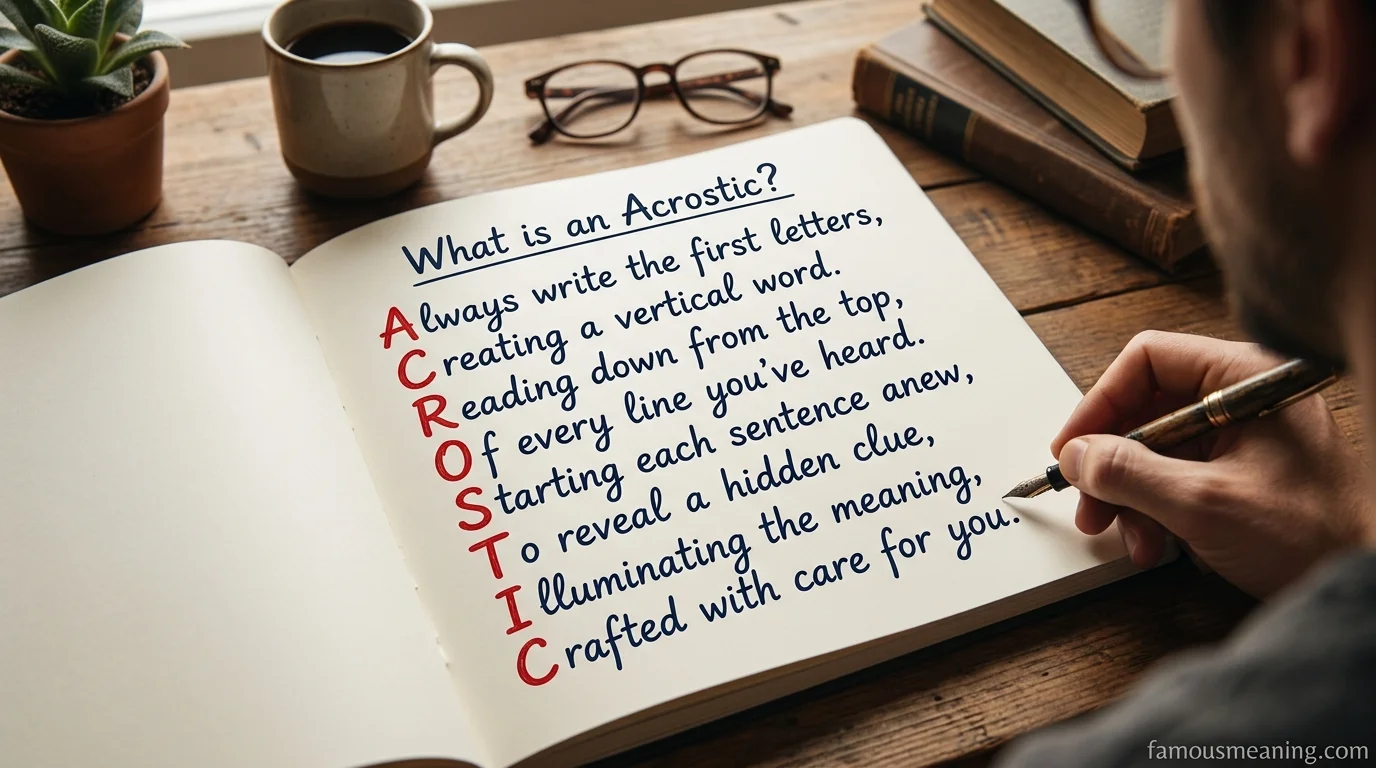
An acrostic is a poem, passage, or composition in which certain letters—usually the first letter of each line—combine to spell a word, name, or hidden message.
Literal Meaning
The word acrostic comes from the Greek words:
- Akros = highest or outermost
- Stichos = line or verse
Together, they describe a composition where letters at the beginning of lines create another word or phrase.
Most Common Meaning
Today, an acrostic usually refers to:
- Acrostic poems
- Classroom writing activities
- Word puzzles
- Hidden messages
- Creative literary techniques
What Does Acrostic Mean in Different Contexts?
Poetry
The most common use of an acrostic is in poetry.
Each line begins with a letter that spells a word vertically.
Example using the word SUN:
Shining brightly every day
Uplifting everyone with warmth
Never failing to light the sky
Reading the first letters vertically spells SUN.
Education
Teachers often assign acrostic poems because they help students:
- Learn vocabulary
- Improve creativity
- Practice descriptive writing
- Remember concepts
- Develop spelling skills
Literature
Authors have used acrostics for centuries to:
- Hide names
- Include secret messages
- Honor important people
- Add artistic structure to poems
Some ancient religious and literary texts also use acrostic patterns.
Word Puzzles
Puzzle creators sometimes design acrostics where solving clues reveals hidden words or phrases using specific letters.
Personal Writing
People often write acrostics for:
- Birthdays
- Weddings
- Greeting cards
- Classroom projects
- Family keepsakes
- Holiday celebrations
Origin and History of Acrostic
Where Does the Word Come From?
The word acrostic comes from Ancient Greek and has been used in literature for thousands of years.
Greek poets were among the earliest writers to experiment with this literary technique.
Historical Uses
Acrostics have appeared in:
- Ancient Greek poetry
- Hebrew literature
- Medieval manuscripts
- Religious writings
- Renaissance poetry
- Modern creative writing
Some historical works used acrostics to hide the author’s name or deliver secret messages.
Modern Usage
Today, acrostics remain popular in:
- Schools
- Poetry competitions
- Children’s books
- Writing workshops
- Puzzle books
- Greeting cards
Types of Acrostics
Traditional Acrostic
The first letter of each line spells a word.
Double Acrostic
Both the first and last letters of each line form words or phrases.
Telestich
Instead of the first letters, the last letter of each line forms the hidden word.
Mesostic
The hidden word appears through letters positioned in the middle of each line rather than at the beginning.
How People Actually Use Acrostics
Most people use acrostics in educational or creative settings.
You’ll often see them in:
- School projects
- Poetry books
- Creative writing assignments
- Greeting cards
- Classroom decorations
- Language learning activities
Many teachers also use acrostics as memory aids because they’re easy to remember.
Real Examples of Acrostics
Example 1: LOVE
Laugh often
Open your heart
Value kindness
Every day matters
Example 2: FAMILY
Forever together
Always supportive
Making memories
Inspiring one another
Loving unconditionally
You belong here
Example 3: DREAM
Dare to imagine
Reach higher
Embrace challenges
Always believe
Move forward
Example 4: SCHOOL
Study every day
Create new ideas
Help classmates
Open your mind
Overcome obstacles
Learn continuously
Example 5: FRIEND
Friendly
Reliable
Inspiring
Encouraging
Noble
Dependable
How to Write an Acrostic
Writing an acrostic is simple.
Step 1
Choose a word.
Example:
NATURE
Step 2
Write one letter vertically.
N
A
T
U
R
E
Step 3
Create a sentence beginning with each letter.
Example:
Never stop exploring.
Appreciate every tree.
Take care of wildlife.
Understand the environment.
Respect the Earth.
Every action matters.
Step 4
Read the first letters vertically.
They spell NATURE.
Common Mistakes and Misunderstandings
Mistake 1: Every Poem Is an Acrostic
Incorrect.
Only poems that intentionally hide a word or message through specific letters are acrostics.
Mistake 2: Acrostics Must Rhyme
False.
Most acrostics don’t need to rhyme.
The hidden word is what defines the form.
Mistake 3: Only the First Letters Can Form an Acrostic
Not necessarily.
Some acrostics use middle or last letters instead.
Mistake 4: Acrostics Are Only for Children
Incorrect.
Professional poets, authors, educators, and puzzle designers also use acrostics.
Similar Literary Terms
| Term | Meaning | Difference |
|---|---|---|
| Acrostic | Hidden word formed by letters | Focuses on letter placement |
| Poem | Literary composition | Broader category |
| Haiku | Three-line Japanese poem | Fixed syllable pattern |
| Sonnet | Fourteen-line poem | Specific poetic form |
| Rhyme | Similar ending sounds | Sound pattern rather than hidden letters |
| Alliteration | Repeated beginning sounds | Focuses on sound |
| Acronym | Word formed from initial letters | Not a poem |
| Mnemonic | Memory aid | Helps remember information |
| Puzzle | Brain-teasing activity | Broader category |
| Verse | A line or section of poetry | Building block of poems |
Internal linking opportunities: poem meaning, acronym meaning, alliteration meaning, haiku meaning, sonnet meaning.
Is Acrostic Positive, Negative, or Neutral?
The word acrostic is neutral.
It simply describes a literary technique.
Common Positive Uses
- Classroom learning
- Creative writing
- Poetry
- Greeting cards
- Educational activities
- Memory exercises
There is no negative meaning associated with the word itself.
Should You Write an Acrostic?
Yes, If You Want To
- Improve creative writing skills.
- Teach vocabulary in a fun way.
- Create personalized poems.
- Make memorable greeting cards.
- Practice descriptive language.
- Design educational activities.
Keep These Tips in Mind
- Choose meaningful words.
- Begin each line with the correct letter.
- Focus on creativity rather than rhyme.
- Make each line connect to the overall theme.