
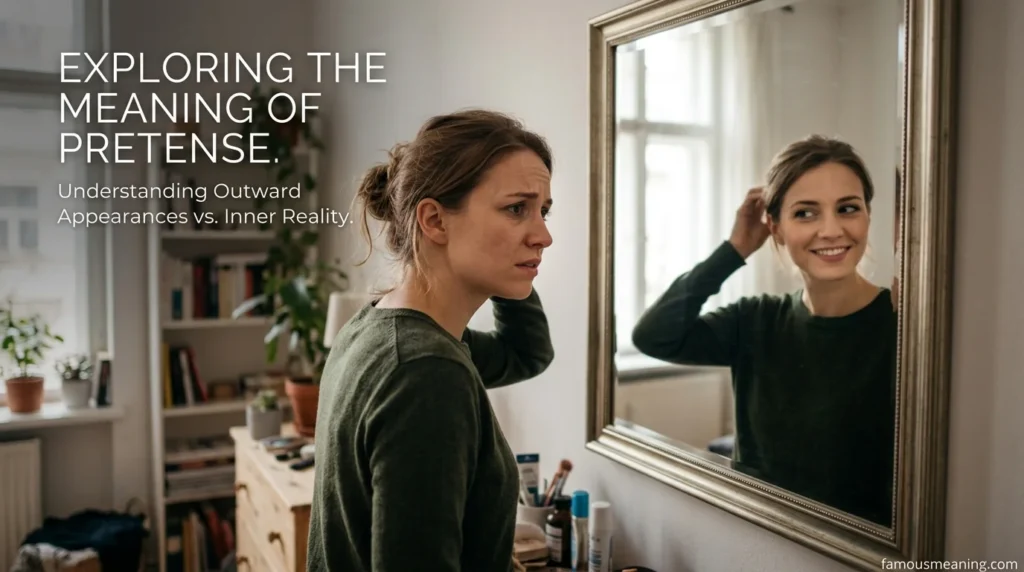

What Does “Pretense” Mean?
Quick Definition
Pretense means a false appearance, false claim, or act of pretending that hides the truth.
Literal Meaning
The word refers to pretending, making believe, or creating a misleading impression about something.
Most Common Meaning
Today, pretense commonly refers to:
- A false excuse
- A fake appearance
- Pretending to be something you’re not
- A dishonest claim
- Concealing true intentions
- Acting insincerely
What Does Pretense Mean in Different Contexts?
Everyday English
In daily conversations, pretense often describes behavior that isn’t genuine.
Examples:
- He smiled out of pretense, not happiness.
- Her confidence was only a pretense.
Relationships
People may use the word when discussing dishonesty or hidden emotions.
Examples include:
- Pretending everything is fine.
- Acting interested without genuine feelings.
- Hiding true emotions behind a smile.
Business
In professional settings, pretense may refer to:
- False promises
- Misleading claims
- Pretending to have experience
- Creating an unrealistic public image
Law
Legal discussions sometimes use pretense in phrases such as false pretenses, referring to obtaining money or property through deception or fraudulent claims.
Literature
Authors often use pretense to develop characters who:
- Hide secrets
- Wear emotional masks
- Pretend to be someone else
- Conceal their true motives
Origin and History of Pretense
Where Does the Word Come From?
The word pretense comes from the Latin praetendere, meaning to stretch before, put forward, or allege. It entered English through Old French and eventually came to describe false appearances or misleading claims.
American vs. British Spelling
There are two accepted spellings:
- Pretense – American English
- Pretence – British English
Both words have the same meaning.
Pronunciation of Pretense
Pronunciation
Pretense
Phonetic spelling: pri-TENS
The stress falls on the second syllable.
How People Actually Use Pretense
Most people use pretense when describing behavior that isn’t sincere.
You’ll often hear phrases like:
- Under the pretense of helping
- False pretense
- Without pretense
- A pretense of confidence
- A pretense of innocence
- Living a life of pretense
These expressions usually suggest that someone’s words or actions don’t reflect the truth.
Real Examples of Pretense in Conversations
Example 1
Person A: Why did he attend the meeting?
Person B: Under the pretense of offering advice.
Meaning: He claimed one reason but had another motive.
Example 2
Person A: She seems confident.
Person B: It may just be a pretense.
Meaning: The confidence might not be genuine.
Example 3
Person A: Why did they enter the building?
Person B: They gained access under false pretenses.
Meaning: They used deception.
Example 4
Person A: Is he really happy?
Person B: His smile feels like a pretense.
Meaning: His happiness may not be genuine.
Example 5
Person A: Why is she being so friendly?
Person B: It could be a pretense to gain trust.
Meaning: Her friendliness may have a hidden purpose.
Example 6
Person A: He acted like an expert.
Person B: It was all pretense.
Meaning: He was pretending to have knowledge.
Example 7
Person A: Why didn’t they tell the truth?
Person B: They kept up the pretense to avoid conflict.
Meaning: They continued pretending.
Example 8
Person A: Is honesty important in relationships?
Person B: Absolutely. Relationships built on pretense rarely last.
Meaning: Genuine honesty is essential.
Example 9
Person A: Why did the company make those claims?
Person B: Some people believe they were merely a pretense to attract investors.
Meaning: The claims may not have reflected reality.
Example 10
Person A: Can someone pretend to be calm?
Person B: Yes, maintaining a calm pretense is common in stressful situations.
Meaning: They appear calm despite feeling anxious.
Common Mistakes and Misunderstandings
Mistake 1: Pretense Always Means Lying
Not exactly.
A pretense often involves deception, but it doesn’t always involve a direct lie. Sometimes it’s simply creating a misleading impression through actions or omissions.
Mistake 2: Pretense Is Always Negative
Usually, but not always.
The word generally has a negative tone because it implies insincerity. However, people sometimes maintain a pretense to protect someone’s feelings or avoid unnecessary conflict.
Mistake 3: Pretense and Pretend Mean the Same Thing
They’re related but different.
- Pretend is usually a verb.
- Pretense is a noun referring to the act or result of pretending.
Mistake 4: False Pretense and Excuse Are Always Identical
Not quite.
An excuse can be truthful or false. A false pretense specifically involves deception or a misleading claim.
Synonyms and Related Words
| Word | Meaning | Difference |
|---|---|---|
| Pretending | Acting as if something is true | General action |
| Deception | Deliberately misleading others | Broader concept |
| Facade | False outward appearance | Focuses on appearance |
| Disguise | Concealing identity or appearance | Often physical |
| Act | Pretended behavior | Informal |
| Sham | Something fake or false | Strong negative meaning |
| Falsehood | Untrue statement | Focuses on lies |
| Cover-up | Hiding the truth | Emphasizes concealment |
| Masquerade | Pretending to be someone else | Often dramatic |
| Hypocrisy | Claiming beliefs not reflected in actions | Focuses on inconsistency |
Internal linking opportunities: pretend meaning, deception meaning, facade meaning, hypocrisy meaning, disguise meaning.
Antonyms of Pretense
Common antonyms include:
- Honesty
- Sincerity
- Authenticity
- Truthfulness
- Openness
- Genuineness
- Frankness
- Transparency
These words describe behavior that is genuine and truthful.
Is Pretense Positive, Negative, or Neutral?
Pretense is generally negative because it suggests dishonesty or insincerity.
Negative Examples
- False pretenses
- Pretending to care
- Misleading appearances
- Hidden motives
Neutral Uses
Occasionally, the word is used more neutrally when discussing literature, psychology, or acting, where pretending is part of the context rather than a moral judgment.
Should You Use the Word “Pretense”?
Use It If
- You’re describing behavior that isn’t genuine.
- You’re writing formally or professionally.
- You’re discussing literature, psychology, law, or relationships.
- You want a precise word for a false appearance or excuse.
Avoid It If
- A simpler word like pretending, excuse, or fake better suits your audience.
- There is no evidence that someone is actually being deceptive.