
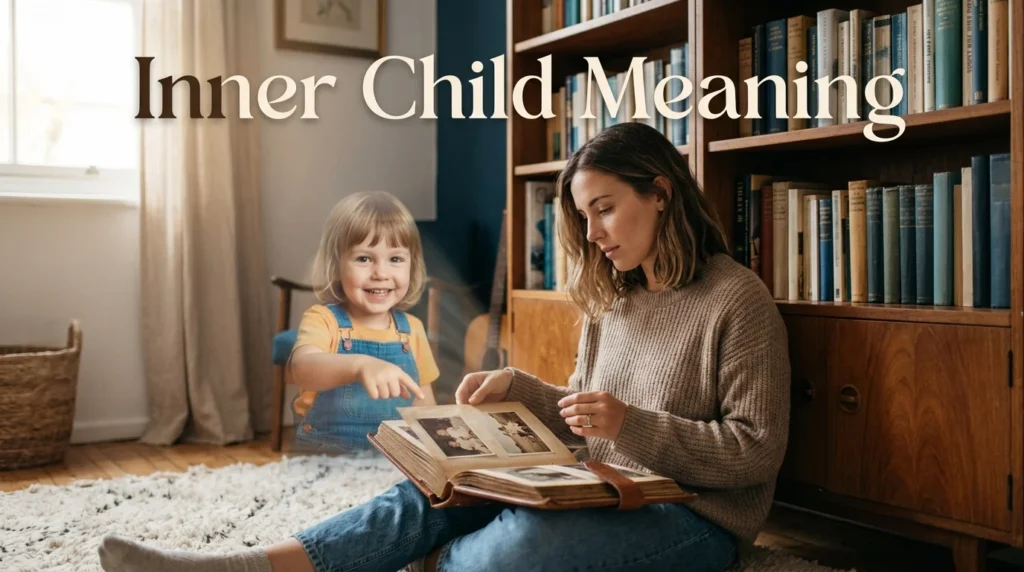

What Does “Inner Child” Mean?
The inner child is a concept used to describe the emotional and psychological aspects of a person that are connected to their childhood.
Quick Definition
Inner child = the part of your emotional experience associated with your childhood memories, feelings, needs, beliefs, and experiences.
The concept can include both positive and difficult childhood experiences.
Your inner child may represent:
- Childhood happiness
- Curiosity
- Creativity
- Playfulness
- Fear
- Loneliness
- Unmet emotional needs
- Childhood beliefs
- Memories
- Feelings of safety or insecurity
- The desire for acceptance and love
What Does “Inner Child” Mean Psychologically?
In psychology and therapy-related conversations, inner child is commonly used as a metaphor for the ways childhood experiences can remain emotionally relevant in adulthood.
It can help people explore questions such as:
- Why does criticism affect me so strongly?
- Why am I afraid of disappointing people?
- Why do I struggle to ask for help?
- Why do certain conflicts make me feel extremely upset?
- Why do I crave approval?
- Why do I feel uncomfortable setting boundaries?
- Why do certain childhood memories still affect me?
The concept can provide a framework for thinking about these reactions without assuming that every adult difficulty comes from childhood.
Is the Inner Child a Real Child Inside You?
No.
The inner child is not literally a separate person or personality living inside an adult.
It is a metaphorical concept that helps people describe emotional patterns and childhood influences.
Different therapeutic approaches may use similar ideas in different ways, so “inner child” does not have one universally agreed scientific definition.
What Is an Inner-Child Wound?
An inner-child wound is a popular self-help and therapy term for emotional pain or unmet needs associated with childhood experiences that may continue to affect someone later in life.
Examples might include experiences involving:
- Rejection
- Criticism
- Neglect
- Bullying
- Abandonment
- Family conflict
- Excessive pressure
- Feeling misunderstood
- Lack of emotional support
- Being expected to act older than one’s age
The phrase does not mean that every difficult adult emotion comes from childhood.
Adult experiences, personality, current relationships, environment, and many other factors can influence emotional reactions.
Common Inner-Child Wounds
People commonly describe inner-child wounds using terms such as:
Abandonment: Fear that people will leave or stop caring.
Rejection: Feeling especially sensitive to being excluded or disliked.
Neglect: Feeling that emotional needs were ignored or unimportant.
Shame: Carrying a deep feeling of being defective or “not good enough.”
Trust: Difficulty feeling safe enough to depend on others.
These labels are useful for reflection, but they should not automatically be treated as clinical diagnoses.
Signs Your Inner Child May Be Hurting
People use the phrase “hurting inner child” to describe emotional patterns that may be connected to unresolved childhood experiences.
You React Strongly to Criticism
A small correction may feel much more painful than expected.
For example, someone might say:
“You could improve this part.”
You may internally hear:
“You’re not good enough.”
That doesn’t necessarily mean childhood experiences caused the reaction, but exploring the connection can sometimes be useful.
You Constantly Seek Approval
You may feel uncomfortable unless other people are happy with you.
This can appear as:
- Constantly asking whether someone is upset
- Over-apologizing
- Fear of disappointing others
- Difficulty saying no
- Trying to keep everyone happy
You Fear Rejection
A delayed text message or canceled plan may trigger disproportionate worry.
You might immediately think:
“They don’t want me anymore.”
The current situation may be harmless, but it can activate older emotional patterns.
You Struggle With Boundaries
You may feel guilty whenever you say no.
For example:
“I can’t help today.”
Instead of feeling comfortable with that boundary, you may experience intense guilt.
You Have Difficulty Expressing Your Needs
Some people learn early that asking for emotional support doesn’t lead to a positive response.
As adults, they may become extremely independent and avoid asking others for help.
You Feel Uncomfortable With Praise
If you grew up receiving frequent criticism or little emotional validation, compliments may sometimes feel uncomfortable or difficult to accept.
You Become Very Emotional During Certain Conflicts
Certain arguments may trigger feelings that seem much bigger than the current situation.
The reaction may involve:
- Anger
- Fear
- Sadness
- Shame
- Withdrawal
- Feeling helpless
Again, this doesn’t automatically prove an inner-child wound. It simply may be an area worth exploring.
What Does “Healing Your Inner Child” Mean?
Healing your inner child is a popular phrase for working through unresolved childhood emotions, recognizing unmet needs, developing healthier beliefs, and learning to respond to yourself with greater compassion.
It doesn’t mean literally going back and changing your childhood.
Instead, it involves changing how you understand and respond to your experiences today.
Common Inner-Child Healing Practices
People may explore:
- Journaling
- Self-compassion
- Therapy
- Reflecting on childhood memories
- Identifying emotional triggers
- Setting healthier boundaries
- Reassuring yourself during difficult moments
- Developing healthier relationship patterns
- Reconnecting with creativity and play
- Learning to express emotional needs
Talking to Your Inner Child
Some self-help practices involve imagining yourself as a child and responding to that younger version of yourself with compassion.
For example, you might imagine your younger self saying:
“Nobody understands me.”
You might respond internally:
“I understand why that hurt. You deserved to feel heard.”
This exercise is intended to encourage self-compassion and emotional reflection.
Inner Child Meaning in Relationships
The inner-child concept is frequently discussed in romantic relationships because childhood experiences can influence how people respond to closeness, conflict, rejection, and affection.
Fear of Abandonment
Someone may become anxious when their partner needs space.
They might think:
“They’re going to leave me.”
The current relationship may be safe, but the situation could activate older fears.
Difficulty Trusting
A person who experienced inconsistent care may find it difficult to believe that another person will remain dependable.
People-Pleasing
Someone may constantly prioritize their partner’s needs because they learned that keeping others happy was necessary for emotional safety.
Avoiding Vulnerability
Another person may do the opposite and avoid emotional closeness because vulnerability feels unsafe.
Overreacting During Arguments
A disagreement about dishes or money might unexpectedly trigger intense emotions.
The argument isn’t necessarily about childhood, but childhood experiences may influence how the person interprets conflict.
Inner Child Meaning in Love
In romantic contexts, inner child often refers to the emotional needs and childhood experiences that can become visible in intimate relationships.
Someone might say:
“My inner child feels safe with you.”
This generally means:
“Being with you gives me a sense of emotional safety, acceptance, comfort, or care that connects with a younger part of me.”
Another person might say:
“My inner child is triggered.”
They may mean that a present situation has activated feelings associated with earlier experiences.
Inner Child and Attachment
People sometimes connect inner-child ideas with attachment styles.
Attachment research examines how relationships and experiences can influence patterns of relating to other people.
However, inner-child language and attachment theory are not identical concepts.
It’s better to treat them as related frameworks rather than interchangeable terms.
Inner Child Meaning From a Girl or Guy
If someone says “my inner child” in a conversation, their gender doesn’t fundamentally change the meaning.
What Does “Inner Child” Mean From a Girl?
A woman might say:
“My inner child is so happy right now.”
This could mean that something reminds her of a joyful childhood experience.
For example:
“My parents surprised me with my favorite childhood snack. My inner child is so happy.”
The phrase expresses nostalgia, happiness, comfort, or emotional excitement.
What Does “Inner Child” Mean From a Guy?
A man might say:
“My inner child is healing.”
He could mean that he’s learning to process childhood experiences or allowing himself to experience emotions and interests that he previously suppressed.
The meaning isn’t inherently different because the speaker is male.
Inner Child Meaning on Social Media
The phrase has become especially common in online self-help, wellness, relationship, and mental-health discussions.
Inner Child on TikTok
TikTok users may use “inner child” when talking about:
- Childhood memories
- Nostalgia
- Family experiences
- Emotional healing
- Relationships
- Self-care
- Childhood hobbies
- Reparenting
For example:
“Buying the toy I wanted as a kid healed my inner child.”
This is usually a figurative expression of nostalgia and emotional satisfaction.
Inner Child on Instagram
Instagram posts may use the phrase in captions such as:
“Doing things my younger self always dreamed about.”
Or:
“My inner child is smiling.”
These posts often focus on self-compassion, nostalgia, personal growth, and emotional healing.
Inner Child on Reddit
On Reddit, people may use the term when discussing:
- Family relationships
- Childhood experiences
- Therapy
- Emotional triggers
- Parenting
- Relationships
- Self-esteem
The meaning can be more serious and personal depending on the community.
Inner Child vs. Inner Child Wound
These terms are related but different.
| Term | Meaning |
|---|---|
| Inner child | Childhood-related emotional experiences and patterns |
| Inner-child wound | Emotional pain or unmet needs associated with childhood |
| Inner-child healing | Working through these experiences and developing healthier responses |
| Reparenting | Providing yourself with supportive care, boundaries, and emotional guidance |
| Childhood trauma | A broader term involving distressing or overwhelming childhood experiences |
Not every inner-child issue involves trauma.
Someone can explore their inner child through ordinary childhood memories, nostalgia, or unmet emotional needs without having experienced severe trauma.
Inner Child vs. Reparenting
Inner-child work and reparenting are closely related but aren’t exactly the same.
Inner-child work often focuses on:
- Understanding childhood emotions
- Recognizing old patterns
- Validating younger emotional needs
Reparenting often focuses on:
- Giving yourself emotional support
- Creating boundaries
- Providing structure
- Practicing self-care
- Learning healthier ways to meet your needs
For example, if you learned as a child that your emotions were unimportant, reparenting might involve learning to recognize and respectfully communicate your feelings as an adult.
Real Examples of Inner Child in Conversations
Example 1: Childhood Toy
Person A: “I bought the toy I wanted when I was six.”
Person B: “Your inner child must be thrilled!”
Meaning: The purchase brought back childhood happiness.
Example 2: Favorite Food
Person A: “Mom made my childhood favorite meal today.”
Person B: “That must have made your inner child happy.”
Meaning: The experience created comfort and nostalgia.
Example 3: Emotional Trigger
Person A: “I don’t know why criticism affects me so much.”
Person B: “Maybe you’re connecting it to your childhood experiences.”
Meaning: The conversation is exploring possible childhood influences.
Example 4: Self-Care
Person A: “I’m taking myself to the amusement park.”
Person B: “Go have fun. Let your inner child enjoy it!”
Meaning: The person is being encouraged to reconnect with playfulness.
Example 5: Relationship
Person A: “I feel completely safe around her.”
Person B: “Sounds like your inner child finally feels safe too.”
Meaning: The speaker is describing a strong feeling of emotional security.
Example 6: Nostalgia
Person A: “I found my old game console.”
Person B: “My inner child would be screaming!”
Meaning: The discovery created excitement and nostalgia.
Example 7: Childhood Dream
Person A: “I finally visited Disneyland.”
Person B: “You made your childhood dream come true!”
Meaning: The adult fulfilled something their younger self wanted.
Example 8: Emotional Growth
Person A: “I used to hide whenever I was upset.”
Person B: “Now you’re learning that it’s okay to express your feelings.”
Meaning: The person is developing healthier emotional responses.
Example 9: Boundaries
Person A: “I said no without feeling guilty.”
Person B: “That’s huge progress.”
Meaning: The person is learning to protect their needs and boundaries.
Example 10: Playfulness
Person A: “I spent all afternoon building Lego.”
Person B: “Your inner child is having the time of its life.”
Meaning: The activity reconnects the adult with childhood enjoyment.
Is Inner Child a Psychological Term?
Inner child is widely used in psychology-adjacent and therapeutic conversations, but it is not a formal mental-health diagnosis.
The concept has roots in psychological and therapeutic traditions, including ideas associated with Carl Jung’s work on childhood aspects of the psyche and later therapeutic approaches.
Different therapists may use inner-child concepts differently.
Some may use the metaphor to help clients explore childhood experiences, emotions, and unmet needs. Others may prefer more specific frameworks based on established psychological theories.
Therefore, “inner child” should generally be understood as a therapeutic or self-reflection concept rather than a medical diagnosis.
Common Misunderstandings About the Inner Child
Mistake 1: Thinking Everyone Has a Damaged Inner Child
Everyone has childhood experiences, but that doesn’t mean everyone has an “inner-child wound.”
The concept is often used to explore both positive and difficult experiences.
Mistake 2: Blaming Every Problem on Childhood
Childhood can influence adult behavior, but it isn’t necessarily the explanation for every emotional reaction.
Current circumstances, relationships, personality, stress, environment, and many other factors matter too.
Mistake 3: Thinking Healing Means Forgetting Childhood
Healing doesn’t mean erasing memories.
It may mean developing a healthier relationship with those memories and the emotions connected to them.
Mistake 4: Assuming Inner-Child Work Is a Substitute for Professional Help
Self-reflection can be useful, but serious emotional distress or trauma may require support from a qualified mental-health professional.
Mistake 5: Believing the Inner Child Is a Literal Personality
The term is metaphorical.
It doesn’t mean there is literally another child living inside your mind.
Is Inner Child Positive or Negative?
The inner child itself is neither inherently positive nor negative.
It can represent positive qualities such as:
- Joy
- Curiosity
- Creativity
- Playfulness
- Imagination
- Wonder
It can also represent difficult experiences such as:
- Fear
- Shame
- Loneliness
- Rejection
- Insecurity
- Unmet needs
This is why people may talk about both a “happy inner child” and a “wounded inner child.”
Should You Explore Your Inner Child?
Exploring childhood experiences can be useful if you’re trying to understand recurring emotional patterns.
It May Be Helpful If:
- Certain situations repeatedly trigger strong emotions.
- You want to understand your relationship patterns.
- You struggle with self-compassion.
- You notice recurring fears or beliefs.
- You want to reconnect with creativity or play.
- You want to understand childhood memories more deeply.
Consider Professional Support If:
- Childhood memories cause significant distress.
- You experience overwhelming emotional reactions.
- Trauma memories interfere with daily life.
- Relationships are repeatedly affected.
- You feel unable to manage difficult emotions on your own.
A qualified therapist can help you explore these issues safely and in context.