

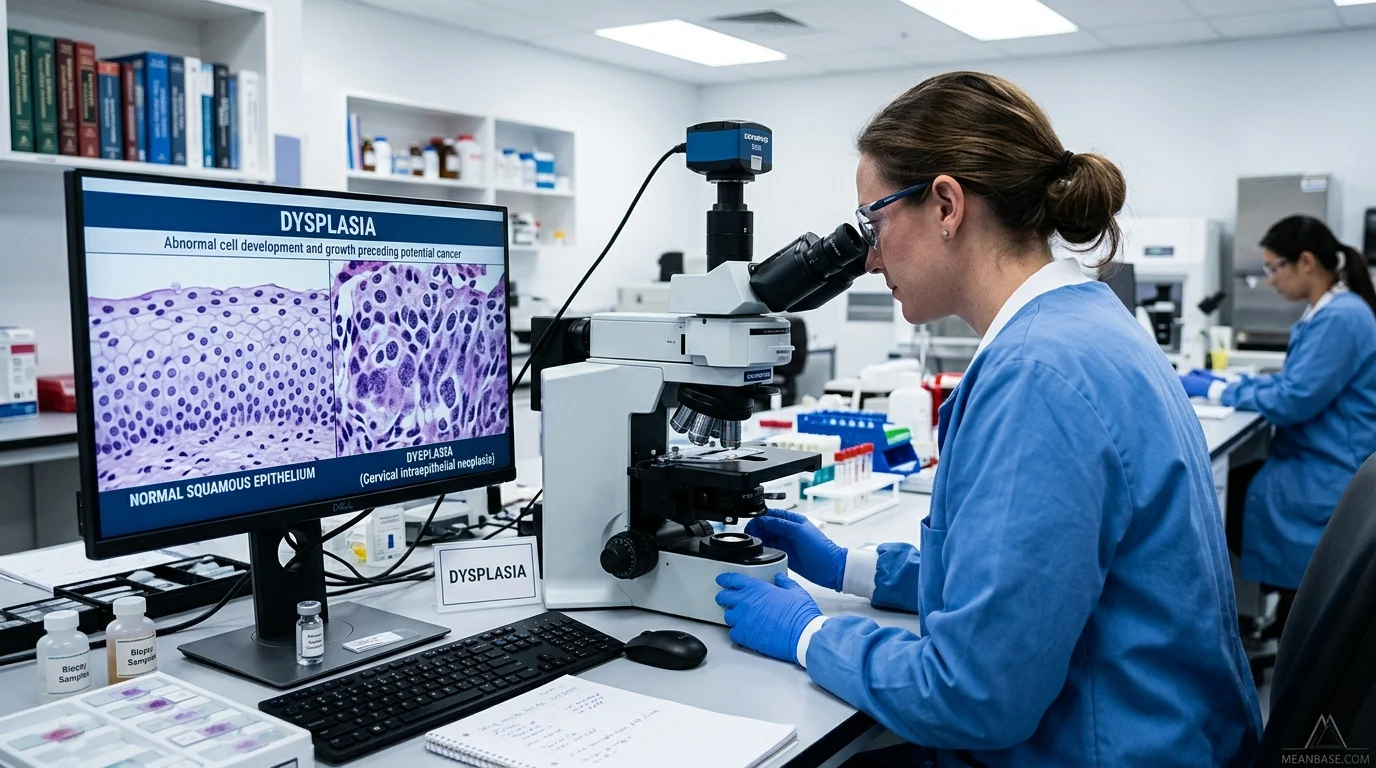
What Does “Dysplasia” Mean?
Dysplasia means abnormal development, growth, or appearance of cells, tissues, or organs.
The word comes from medical terminology describing something that has developed abnormally. Doctors use it in several different situations, so there is no single condition called simply “dysplasia.”
Quick Definition
Dysplasia is abnormal development or abnormal changes in cells, tissues, or organs. The term can describe conditions ranging from developmental abnormalities, such as hip dysplasia, to abnormal cell changes identified through medical testing.
What Does Dysplasia Mean in Simple Words?
In simple terms, dysplasia means something in the body’s cells, tissues, or development is not forming or looking normal.
However, “abnormal” does not always mean cancer.
For example:
- Hip dysplasia involves abnormal development of the hip joint.
- Cervical dysplasia involves abnormal cells on the cervix.
- Skeletal dysplasia involves abnormal bone or cartilage development.
- Epithelial dysplasia describes abnormal changes in certain surface or lining cells.
The meaning becomes clearer when you know which part of the body is affected.
Does Dysplasia Mean Cancer?
No, dysplasia does not automatically mean cancer.
Some forms of dysplasia involve abnormal cells that are not cancerous. However, certain types of cellular dysplasia can represent changes that healthcare professionals monitor because they may have the potential to progress to cancer in some circumstances.
The risk depends on factors such as:
- The type of dysplasia
- Where it occurs
- The severity of the abnormality
- The underlying cause
- The person’s medical history
- Test or biopsy results
This is why a specific diagnosis is much more informative than the word “dysplasia” alone.
What Are the Different Types of Dysplasia?
There are several types of dysplasia because the term can describe abnormalities in different parts of the body.
Cervical Dysplasia
Cervical dysplasia refers to abnormal changes in cells on the surface of the cervix.
It is often identified through cervical screening, such as a Pap test or HPV-related testing, depending on the screening program.
Cervical dysplasia can range from lower-grade changes to higher-grade abnormalities. Healthcare professionals may recommend monitoring, additional testing, or treatment depending on the findings.
Hip Dysplasia
Hip dysplasia occurs when the hip joint does not develop normally.
It is commonly discussed in babies and children, although hip dysplasia can also affect adults.
In developmental hip dysplasia, the hip socket may be too shallow to properly hold the head of the thigh bone.
Possible signs can include:
- Uneven leg length
- Limited movement of one hip
- An unusual walking pattern in older children
- Hip discomfort in some adults
The specific symptoms depend on age and severity.
Skeletal Dysplasia
Skeletal dysplasia refers to a broad group of genetic conditions involving abnormal development of bones and cartilage.
Some skeletal dysplasias affect:
- Bone growth
- Limb length
- Spine development
- Skull development
- Joint structure
There are many different skeletal dysplasias, and they can vary greatly in their effects.
Fibrous Dysplasia
Fibrous dysplasia is a bone disorder in which normal bone tissue is replaced by abnormal fibrous tissue.
It can affect one bone or multiple bones.
Some people have no symptoms, while others may experience:
- Bone pain
- Weak bones
- Fractures
- Changes in bone shape
The condition is different from skeletal dysplasia as a broad category.
Epithelial Dysplasia
Epithelial dysplasia describes abnormal changes in epithelial cells, which form the surface or lining of many parts of the body.
The significance depends on where the abnormal cells are found and how severe the changes are.
In pathology reports, terms such as mild, moderate, or severe dysplasia may be used to describe the degree of abnormality.
What Causes Dysplasia?
There is no single cause of dysplasia because different types have different causes.
Genetic Factors
Some forms of dysplasia are associated with genetic changes.
This is particularly important in certain skeletal dysplasias, many of which are genetic disorders affecting bone or cartilage development.
HPV and Cervical Dysplasia
Certain types of human papillomavirus (HPV) are associated with cervical cell abnormalities.
Persistent infection with high-risk HPV types can cause changes in cervical cells that may develop into cervical precancerous lesions.
Not every HPV infection causes dysplasia, and many HPV infections clear naturally.
Developmental Factors
Some forms develop because a body part does not form normally during development.
Hip dysplasia is an example of a developmental abnormality involving the structure of the hip joint.
Other Factors
Depending on the type, abnormal tissue or cell development may be associated with:
- Genetic changes
- Chronic irritation
- Certain infections
- Environmental factors
- Developmental abnormalities
- Other underlying medical conditions
The cause should therefore be considered in relation to the specific type of dysplasia.
What Are the Symptoms of Dysplasia?
There is no universal set of symptoms because dysplasia can affect many different tissues.
Cervical Dysplasia Symptoms
Cervical dysplasia often does not cause noticeable symptoms.
It may be discovered through routine cervical screening.
This is one reason recommended screening can be important: cell changes may be detected before a person notices anything unusual.
Hip Dysplasia Symptoms
Depending on age and severity, hip dysplasia may cause:
- Limited hip movement
- Uneven leg positioning
- Hip pain
- A limp
- A feeling of instability
Babies may have no obvious symptoms, which is why physical examinations can be important.
Skeletal Dysplasia Symptoms
Symptoms vary significantly between conditions.
They may include differences in:
- Height
- Bone growth
- Limb proportions
- Spine shape
- Joint structure
Because skeletal dysplasia includes many different conditions, one person’s symptoms may be very different from another’s.
How Is Dysplasia Diagnosed?
The diagnostic process depends on the type.
Medical Examination
A healthcare professional may begin with a physical examination and medical history.
For developmental conditions, doctors may examine movement, joint structure, growth, or physical development.
Imaging Tests
Imaging may be used for conditions involving bones or organs.
Possible tests include:
- X-rays
- Ultrasound
- MRI
- CT scans
The appropriate test depends on the suspected condition.
Screening Tests
Some types of dysplasia are identified through screening.
For example, cervical cell abnormalities may be detected through cervical screening.
Biopsy
When abnormal cells are suspected, a biopsy may sometimes be performed.
A pathologist examines the tissue under a microscope and reports the cellular changes.
The exact terminology in a pathology report can be important because terms such as low-grade, high-grade, or other classifications may carry different clinical meanings.
What Does Mild, Moderate, or Severe Dysplasia Mean?
When dysplasia describes abnormal cells, healthcare professionals may use terms that indicate the degree of abnormality.
Mild Dysplasia
Mild dysplasia generally means the cellular changes are relatively limited.
Depending on the specific condition, mild abnormalities may sometimes be monitored rather than immediately treated.
Moderate Dysplasia
Moderate dysplasia indicates a greater degree of abnormal cellular change.
The appropriate management depends on the location, cause, test results, and clinical guidelines.
Severe Dysplasia
Severe dysplasia indicates more significant abnormal cellular changes.
It does not automatically mean invasive cancer, but it can represent a more serious abnormality requiring appropriate medical evaluation and management.
Because these terms are used differently across conditions, the exact report should be interpreted by the healthcare professional who ordered the test.
Real Examples of “Dysplasia” in Medical Contexts
Here are examples showing how the word may appear.
Example 1
“The biopsy showed cervical dysplasia.”
Meaning: The tissue sample contained abnormal cervical cells.
Example 2
“The baby was evaluated for hip dysplasia.”
Meaning: Doctors were checking whether the baby’s hip joint had developed abnormally.
Example 3
“The patient has skeletal dysplasia.”
Meaning: The person has a condition involving abnormal development of bones or cartilage.
Example 4
“The pathology report described low-grade dysplasia.”
Meaning: The report identified a relatively lower degree of abnormal cellular change.
Example 5
“Imaging was performed to evaluate possible hip dysplasia.”
Meaning: Imaging was used to examine the structure of the hip joint.
Example 6
“The doctor recommended follow-up for the abnormal cells.”
Meaning: The healthcare team wants to monitor or further evaluate the cellular changes.
Example 7
“The child was diagnosed with a skeletal dysplasia.”
Meaning: The child has a specific condition affecting normal skeletal development.
Example 8
“The screening test detected cervical cell abnormalities.”
Meaning: Testing found changes in cervical cells that may require follow-up.
Common Mistakes and Misunderstandings
Mistake 1: Thinking Dysplasia Always Means Cancer
This is one of the most important misconceptions.
Dysplasia and cancer are not automatically the same thing.
Dysplasia refers to abnormal development or abnormal cellular changes. Some forms can be associated with an increased risk of cancer, but the word itself does not mean that a person has cancer.
Mistake 2: Thinking All Dysplasia Is the Same
There are many types.
Hip dysplasia and cervical dysplasia are very different conditions.
One affects the development of a joint, while the other involves abnormal cervical cells.
Mistake 3: Assuming Dysplasia Always Causes Symptoms
Some forms can be difficult to notice without medical testing.
For example, cervical dysplasia often does not produce obvious symptoms.
Mistake 4: Treating “Dysplasia” as a Complete Diagnosis
The word alone does not tell you:
- Where the abnormality is
- How severe it is
- What caused it
- What treatment is needed
- What the long-term outlook is
The specific type and medical findings matter.
Mistake 5: Confusing Dysplasia With Hyperplasia
These terms sound similar but have different meanings.
Dysplasia involves abnormal development or abnormal cell appearance.
Hyperplasia generally means an increase in the number of cells in a tissue, causing it to enlarge.
They are not interchangeable.
Dysplasia vs. Similar Medical Terms
| Term | Meaning | Main Difference |
|---|---|---|
| Dysplasia | Abnormal development or cellular changes | Broad term covering several types of abnormalities |
| Hyperplasia | Increase in the number of cells | Focuses on cell number |
| Metaplasia | Change from one mature cell type to another | Describes a change in cell type |
| Neoplasia | Abnormal new growth of tissue | Refers to abnormal tissue growth |
| Aplasia | Failure of an organ or tissue to develop | Involves absent or severely underdeveloped tissue |
| Hypoplasia | Incomplete or underdevelopment | Indicates insufficient development |
| Cancer | Malignant disease involving uncontrolled abnormal cells | A specific disease process, not a synonym for dysplasia |
Dysplasia vs. Hyperplasia
Dysplasia describes abnormal development or abnormal cellular appearance.
Hyperplasia means an increase in the number of cells.
For example, a tissue can become larger because it contains more cells, which is hyperplasia. That does not automatically mean the cells are dysplastic.
Dysplasia vs. Cancer
Dysplasia is not synonymous with cancer.
Some types of cellular dysplasia can be considered precancerous or associated with cancer risk, depending on the location and grade. But dysplasia itself does not automatically mean invasive cancer.
Dysplasia vs. Hypoplasia
These words describe different developmental patterns.
Hypoplasia means something has not developed fully or is smaller than expected because of incomplete development.
Dysplasia generally refers to abnormal development or abnormal structure.
Is Dysplasia Serious?
The seriousness of dysplasia depends entirely on the type, location, severity, and underlying cause.
For example, developmental hip dysplasia has different implications from a high-grade cellular abnormality found in a pathology report.
Some forms may require simple monitoring, while others may need treatment or specialist care.
If the word appears in your medical report, it is better to ask the healthcare professional who ordered the test what it means in your specific case rather than assuming the general definition applies directly to you.
How Is Dysplasia Treated?
There is no single treatment for dysplasia.
Treatment depends on the type and severity.
Treatment for Hip Dysplasia
Management can vary by age and severity and may include:
- Monitoring
- Positioning or bracing in infants
- Physical therapy
- Surgical procedures in selected cases
Treatment for Cervical Dysplasia
Management may involve:
- Follow-up testing
- Repeat screening
- Colposcopy
- Removal or treatment of abnormal tissue when appropriate
The exact approach depends on the severity and clinical findings.
Treatment for Skeletal Dysplasia
Management depends on the specific genetic or skeletal condition.
Care may involve several medical specialists and focus on managing growth, bones, joints, mobility, or related complications.