
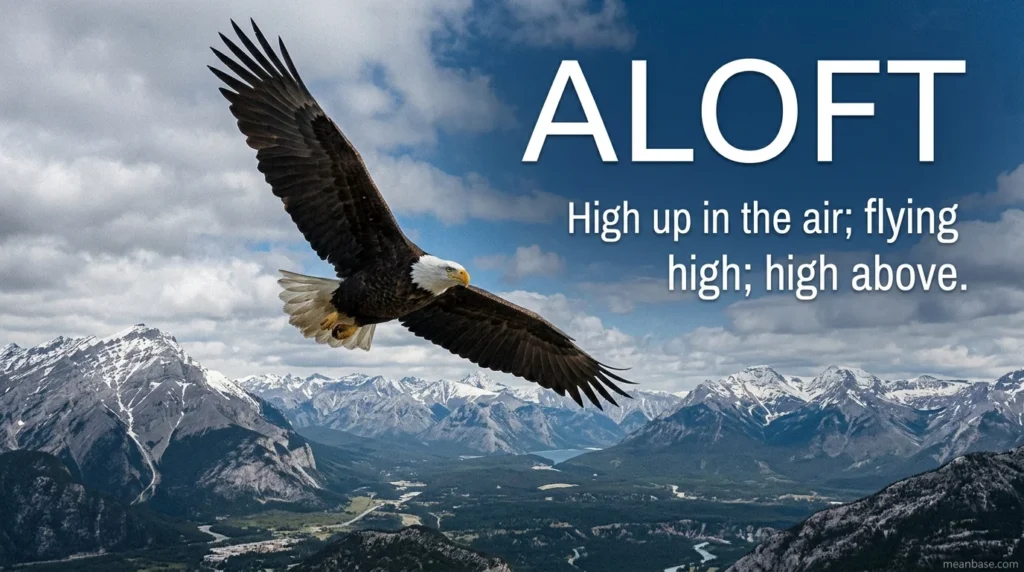

What Does “Aloft” Mean?
Aloft means high in the air, above the ground, or in a raised position.
It is commonly used as an adverb and sometimes appears in descriptive or literary writing.
Simple Aloft Definition
The easiest way to understand aloft is:
Aloft = up in the air or high above the ground.
For example:
The bird flew aloft.
This means the bird flew upward into the air or remained high in the air.
Another example is:
She held the flag aloft.
This means she held the flag high in the air.
Aloft Meaning in Simple English
In simple English, aloft can usually be understood as:
- Up in the air
- High above
- Up high
- Raised upward
- Above the ground
The exact translation depends on the sentence.
Is Aloft a Positive or Negative Word?
Aloft is generally a neutral word. It simply describes a position or movement that is high in the air.
The word itself does not normally express happiness, sadness, approval, or disapproval.
For example:
The balloon floated aloft.
This simply tells us where the balloon was.
However, writers may use aloft in a poetic or uplifting context, which can give the sentence a more elegant feeling.
How Do You Pronounce Aloft?
Aloft is commonly pronounced:
uh-LOFT
The second syllable receives the main stress.
Aloft Pronunciation
Aloft: /əˈlɔːft/ in many British pronunciations and /əˈlɔːft/ or a closely similar pronunciation in American English.
You can think of it as:
uh + loft
The word has two syllables:
a-loft
Is Aloft an Adjective or Adverb?
Aloft is primarily an adverb.
It describes where something is or where something moves.
For example:
The eagle soared aloft.
Here, aloft describes the eagle’s position.
It can also appear in expressions such as:
He held the book aloft.
In this sentence, aloft tells us how or where the book was held.
What Is the Origin of the Word Aloft?
The word aloft has an old English history.
It developed from Middle English forms related to the idea of being “on high” or “in a high position.” The word is connected with the older expression “on loft,” where loft referred to a high place or upper area.
Over time, the expression developed into the single word aloft.
The connection with loft is useful because a loft is traditionally an elevated space. Therefore, the historical idea behind aloft is closely related to being high or above.
Today, the word remains in English but is more common in literary, descriptive, nautical, poetic, and formal writing than in everyday casual conversation.
How Is Aloft Used in a Sentence?
Aloft can describe something that is physically high in the air or something that has been raised upward.
Aloft for Something in the Air
The kite remained aloft for several minutes.
The kite stayed high in the air.
Aloft for Something Being Held Up
The crowd held their signs aloft.
The people held their signs high above themselves.
Aloft for Birds
The eagle circled aloft above the mountains.
The eagle was flying high in the air.
Aloft for Flags
The flag waved proudly aloft.
The flag was raised high and was moving in the air.
Aloft in Nautical Language
Aloft can also be used when describing something high on a ship, particularly around masts, sails, or rigging.
For example:
The sailor climbed aloft to inspect the sails.
This means the sailor climbed to a high position on the ship.
Real Examples of Aloft in Conversations and Writing
Here are several examples that show how aloft works naturally in different situations.
Example 1: Holding Something
He held the trophy aloft after winning the match.
Meaning: He held the trophy high above his head.
Example 2: A Bird
The eagle soared aloft over the valley.
Meaning: The eagle flew high in the sky.
Example 3: A Flag
The flag was raised aloft during the ceremony.
Meaning: The flag was raised high.
Example 4: A Balloon
The balloon drifted aloft into the blue sky.
Meaning: The balloon moved upward into the air.
Example 5: A Crowd
Fans held their phones aloft to record the performance.
Meaning: Fans held their phones high in the air.
Example 6: A Torch
The runner lifted the torch aloft.
Meaning: The runner raised the torch high.
Example 7: A Kite
The kite remained aloft despite the strong wind.
Meaning: The kite stayed in the air.
Example 8: A Sailor
The sailor climbed aloft to repair the rope.
Meaning: The sailor climbed to a high place on the ship.
Example 9: A Flag in the Wind
The colorful banners fluttered aloft above the street.
Meaning: The banners were raised high above the street.
Example 10: A Child
The father lifted his child aloft.
Meaning: The father lifted the child high into the air.
Example 11: A Hand
She raised her hand aloft to get the teacher’s attention.
Meaning: She raised her hand high.
Example 12: A Celebration
The players lifted the championship cup aloft.
Meaning: The players raised the cup high in celebration.
Aloft vs. Above
Aloft and above can sometimes have similar meanings, but they are not always interchangeable.
Above is much more common and can describe something at a higher position.
The picture is above the sofa.
Aloft usually suggests something high in the air or raised upward.
He held the flag aloft.
You would not normally say:
He held the flag above.
That sentence does not communicate the same natural meaning.
Simple Difference
- Above = at a higher position than something else.
- Aloft = high in the air or raised upward.
Aloft vs. Overhead
Overhead usually means directly or generally above you.
A plane flew overhead.
Aloft emphasizes being high in the air or being raised.
The flag flew aloft.
The two words can overlap, but their typical usage is different.
Simple Difference
Overhead: directly above or over your head.
Aloft: high up in the air or in a raised position.
Aloft vs. Upward
Upward usually describes movement or direction toward a higher position.
The balloon moved upward.
Aloft usually describes being high in the air or in a raised position.
The balloon floated aloft.
Therefore:
- Upward = toward a higher place.
- Aloft = high up or in the air.
Aloft vs. High
High is a very common adjective and adverb with many meanings.
The plane is flying high.
You could also say:
The plane is flying aloft.
However, aloft sounds more literary or formal.
In everyday conversation, most people would naturally say:
The plane is flying high.
rather than:
The plane is flying aloft.
Synonyms for Aloft
Several words can have a similar meaning to aloft, depending on context.
| Synonym | Meaning |
|---|---|
| Above | At a higher position |
| Up | Toward or in a higher position |
| High | Far above the ground |
| Overhead | Above or over your head |
| Upward | Toward a higher position |
| Elevated | Raised to a higher level |
| Skyward | Toward the sky |
| Up high | In a high position |
| In the air | Suspended or flying above the ground |
| Raised | Lifted to a higher position |
Not every synonym can replace aloft in every sentence. The best choice depends on the context and grammatical structure.
Antonyms of Aloft
The opposite of aloft generally involves being low, down, or near the ground.
Common opposites include:
- Down
- Below
- Grounded
- Low
- Downward
- On the ground
- Beneath
For example:
The bird flew aloft.
The opposite idea would be:
The bird landed on the ground.
Common Expressions With Aloft
Aloft appears in several common or traditional expressions.
Hold Something Aloft
Hold something aloft means to hold something high in the air.
The protesters held their signs aloft.
This expression is common in formal, literary, historical, and descriptive writing.
Raise Something Aloft
Raise something aloft means to lift something high.
She raised the flag aloft.
Climb Aloft
Climb aloft means to climb upward to a high position.
This expression is especially associated with ships and nautical writing.
The sailor climbed aloft to inspect the mast.
Remain Aloft
Remain aloft means to stay high in the air.
The helicopter remained aloft for another hour.
Common Mistakes When Using Aloft
Mistake 1: Thinking Aloft Means Simply “Above”
Although aloft can sometimes be translated as above, it usually carries the stronger idea of being high up or in the air.
Mistake 2: Using Aloft in Every Situation
Aloft is somewhat formal or literary. In everyday speech, words like up, high, or above may sound more natural.
For example:
The bird is high in the sky.
sounds more conversational than:
The bird is aloft.
Both can be correct depending on the context.
Mistake 3: Confusing Aloft With “A Loft”
Aloft is one word.
A loft is a noun phrase referring to a type of upper room or elevated space.
For example:
The bird flew aloft.
But:
She lives in a loft.
These are completely different uses.
Mistake 4: Thinking Aloft Always Means Movement
Aloft can describe something that is already high in the air.
The kite remained aloft.
It does not necessarily mean the kite is moving upward.
Is Aloft Formal or Casual?
Aloft is more formal, literary, poetic, or descriptive than casual.
You may encounter it in:
- Books
- Poetry
- Historical writing
- News descriptions
- Speeches
- Nautical writing
- Formal descriptions
- Songs
- Fiction
In everyday conversation, people usually choose simpler alternatives such as:
- Up
- High
- Above
- In the air
For example, instead of:
He held the photograph aloft.
a person might casually say:
He held the photograph up.
Both communicate a similar basic idea.