

Quick Answer: What Does the Prefix “Hypo-” Mean?
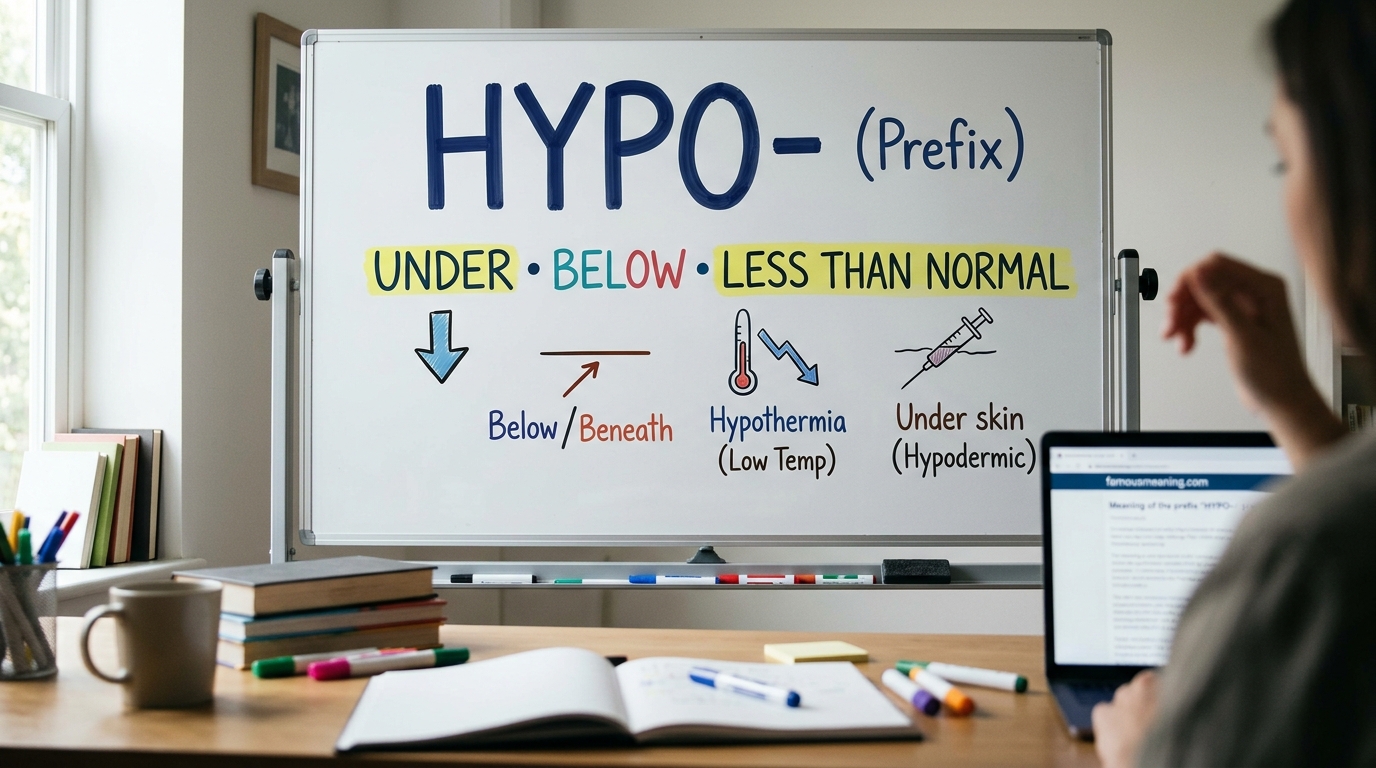
The prefix hypo- means “under,” “below,” “beneath,” or “less than normal.” It comes from Greek and appears in many English words, especially medical and scientific terms. For example, hypoglycemia refers to low blood sugar, while hypothermia means an unusually low body temperature.
What Is the Definition of the Prefix “Hypo-”?
Quick Definition
Hypo- is a prefix meaning:
- Under
- Below
- Beneath
- Less than normal
- Deficient
- Lower than an expected level
It is commonly used to describe something that is lower, underneath, or insufficient compared with a reference point.
What Does Hypo- Mean in Medical Terms?
In medical terminology, hypo- often indicates that something is below normal or deficient.
Examples include:
- Hypoglycemia — abnormally low blood glucose
- Hypotension — abnormally low blood pressure
- Hypothermia — abnormally low body temperature
- Hypothyroidism — reduced production of thyroid hormones
- Hypovolemia — abnormally low blood volume
The prefix itself does not diagnose a condition. It simply provides a clue about the meaning of the word.
What Does Hypo- Mean in Science?
In science, hypo- can indicate something that is beneath, lower, or less than another reference point.
For example, in chemistry, hypochlorite refers to a chemical ion containing less oxygen than chlorite within a particular naming system.
In anatomy, hypodermic literally relates to something situated beneath the skin.
Where Does the Prefix “Hypo-” Come From?
Greek Origin of Hypo-
The prefix hypo- comes from the Ancient Greek preposition hypó, meaning “under,” “beneath,” or “below.”
It entered scientific and medical vocabulary through Greek-based terminology.
The related prefix hyper- comes from Greek and generally means “over,” “above,” “beyond,” or “excessive.”
This creates a useful contrast:
Hypo- = below or less
Hyper- = above or more
For example:
- Hypoglycemia = low blood glucose
- Hyperglycemia = high blood glucose
This hypo/hyper distinction is especially useful when learning medical vocabulary.
How Does the Prefix “Hypo-” Work?
A prefix is a group of letters added to the beginning of a word to modify its meaning.
For example:
hypo- + thermia → hypothermia
The prefix hypo- contributes the idea of being below or low.
Another example:
hypo- + tension → hypotension
The resulting term refers to unusually low blood pressure.
Learning common prefixes is an effective way to understand unfamiliar vocabulary without memorizing every word separately.
Common Words That Begin With Hypo-
Hypoglycemia
Hypoglycemia means an abnormally low level of glucose in the blood.
Breakdown:
- hypo- = low or below
- glyc- = sugar
- -emia = blood condition
So the word relates to low sugar in the blood.
Hypotension
Hypotension means abnormally low blood pressure.
The word can be broken down conceptually as:
- hypo- = below or low
- tension = pressure
Hypothermia
Hypothermia refers to an abnormally low body temperature.
The prefix hypo- provides the idea of something being below the expected level.
Hypothyroidism
Hypothyroidism is a condition involving insufficient production of thyroid hormones.
The hypo- portion conveys the idea of reduced or insufficient activity.
Hypodermic
Hypodermic literally relates to something situated beneath the skin.
The word comes from Greek elements associated with:
- hypo- = under
- derm- = skin
A hypodermic needle, for example, is designed to pass through the skin.
Hypovolemia
Hypovolemia refers to an abnormally low volume of blood or circulating fluid in the body.
Here again, hypo- contributes the meaning of “low” or “below normal.”
Hypoplasia
Hypoplasia refers to incomplete or underdevelopment of a tissue or organ.
The hypo- component contributes the idea of being underdeveloped or insufficient.
Hypotonic
Hypotonic generally means having lower osmotic pressure or a lower concentration of dissolved substances relative to another solution, depending on context.
It is commonly encountered in biology and chemistry.
Hypo- vs. Hyper-
One of the easiest ways to remember hypo- is to compare it with hyper-.
| Prefix | Basic Meaning | Example | General Idea |
|---|---|---|---|
| Hypo- | Under, below, low | Hypoglycemia | Below normal |
| Hyper- | Over, above, high | Hyperglycemia | Above normal |
| Sub- | Under, below | Subcutaneous | Under the skin |
| Super- | Above, over | Superstructure | Above or beyond |
| Infra- | Below | Infrared | Below |
| Supra- | Above | Suprarenal | Above |
Although some prefixes overlap in meaning, they are not always interchangeable. Their exact use depends on the terminology and word they form.
What Is the Difference Between Hypo- and Hyper-?
Hypo-
Hypo- generally indicates something below, under, low, or deficient.
Example:
Hypoglycemia = low blood glucose.
Hyper-
Hyper- generally indicates something above, excessive, or unusually high.
Example:
Hyperglycemia = high blood glucose.
A useful memory trick is:
Hypo = low
Hyper = high
This is not a complete definition of either prefix in every context, but it works well for many common medical terms.
What Is the Difference Between Hypo- and Sub-?
Both hypo- and sub- can relate to something being below or underneath, but they are used differently.
Sub- often means under, below, or beneath in a physical or positional sense.
For example:
Subcutaneous = beneath the skin.
Hypo- can also mean under or beneath, but in medical terminology it frequently conveys lower than normal, deficient, or insufficient.
For example:
Hypoglycemia = abnormally low blood glucose.
The prefixes should therefore not automatically be treated as interchangeable.
Examples of Hypo- in Everyday Vocabulary
Although hypo- appears frequently in specialized terminology, some words containing it are familiar outside professional settings.
Hypoallergenic
Hypoallergenic describes something designed or formulated to have a reduced likelihood of causing an allergic reaction.
The word is commonly seen in descriptions of:
- Cosmetics
- Skincare
- Jewelry
- Fabrics
- Pet products
Importantly, hypoallergenic does not mean completely allergy-proof. It generally suggests a lower potential for causing an allergic reaction.
Hypodermic
The word hypodermic is also familiar in everyday medical language.
For example:
“The medication was administered with a hypodermic needle.”
Here, the term relates to something beneath the skin.
How to Remember the Meaning of Hypo-
A simple memory trick is:
Hypo = low or under
Think of something hypo as being below a normal line.
For example:
- Hypoglycemia → low glucose
- Hypotension → low blood pressure
- Hypothermia → low body temperature
- Hypothyroidism → reduced thyroid function
Then remember the opposite:
Hyper = high or excessive
For example:
- Hyperglycemia → high glucose
- Hypertension → high blood pressure
- Hyperthermia → excessively high body temperature
Common Mistakes About the Hypo- Prefix
Mistake 1: Thinking Hypo- Always Means “Low”
“Low” is a useful shortcut, especially for medical terminology, but the broader meaning of hypo- is under or below.
For example, hypodermic refers to something beneath the skin rather than simply something that is “low.”
Mistake 2: Confusing Hypo- With Hyper-
These prefixes often appear in opposite terms.
Remember:
Hypo- → below/low
Hyper- → above/high
Mistake 3: Assuming Every Word Beginning With “Hypo” Has the Same Meaning
Not every word that begins with the letters hypo necessarily uses the Greek prefix in the same way.
The word’s etymology and context matter.
Mistake 4: Treating Prefixes as Complete Definitions
A prefix gives you a clue, not always the complete meaning.
For example, knowing that hypo- means “low” does not tell you everything about hypothyroidism. You also need to understand the rest of the word.
How Is Hypo- Used in a Sentence?
The prefix itself is not normally used as an independent word in ordinary sentences. Instead, it appears as part of a larger word.
Here are examples:
Example 1
“The doctor explained that hypoglycemia means low blood glucose.”
Example 2
“The patient was treated for hypothermia after prolonged exposure to cold.”
Example 3
“The medication was administered using a hypodermic needle.”
Example 4
“The textbook explains the difference between hypotension and hypertension.”
Example 5
“The researcher studied hypoplasia in developing tissue.”
In each case, recognizing hypo- provides a useful clue to the word’s meaning.
Why Is Learning Prefixes Useful?
Learning prefixes can make difficult vocabulary easier to understand.
Instead of memorizing an unfamiliar word as a single unit, you can break it into smaller pieces.
For example:
Hypothermia
→ hypo- = below
→ therm = heat
→ -ia = condition
This suggests a condition involving unusually low body temperature.
Similarly:
Hypoglycemia
→ hypo- = low
→ glyc = sugar
→ -emia = blood condition
This points toward a condition involving low blood sugar.
This approach is especially useful for students studying:
- Biology
- Medicine
- Nursing
- Anatomy
- Physiology
- Chemistry
- Health sciences
Hypo Prefix Meaning in Medical Terminology
Medical terminology contains many words built from Greek and Latin roots.
The prefix hypo- is particularly useful because it frequently signals:
- Low levels
- Reduced activity
- Insufficient amounts
- Underdevelopment
- A position beneath something
Examples include:
| Medical Term | Meaning of Hypo- | General Meaning |
|---|---|---|
| Hypoglycemia | Low | Low blood glucose |
| Hypotension | Low | Low blood pressure |
| Hypothermia | Low/below | Abnormally low body temperature |
| Hypothyroidism | Reduced | Reduced thyroid hormone production |
| Hypovolemia | Low | Low circulating blood volume |
| Hypoplasia | Under | Incomplete development |
| Hypodermic | Under | Beneath the skin |
The prefix is therefore a valuable clue, but the rest of each medical term must also be understood.
Is Hypo- a Word or a Prefix?
Hypo- is a prefix.
A prefix is attached to the beginning of another word or word root.
For example:
hypo- + tension = hypotension
The prefix changes or adds to the meaning of the base word.
It is not normally used as a standalone English word in the same way that words such as “under” or “low” are.