
What Does Denominator Mean in Math?
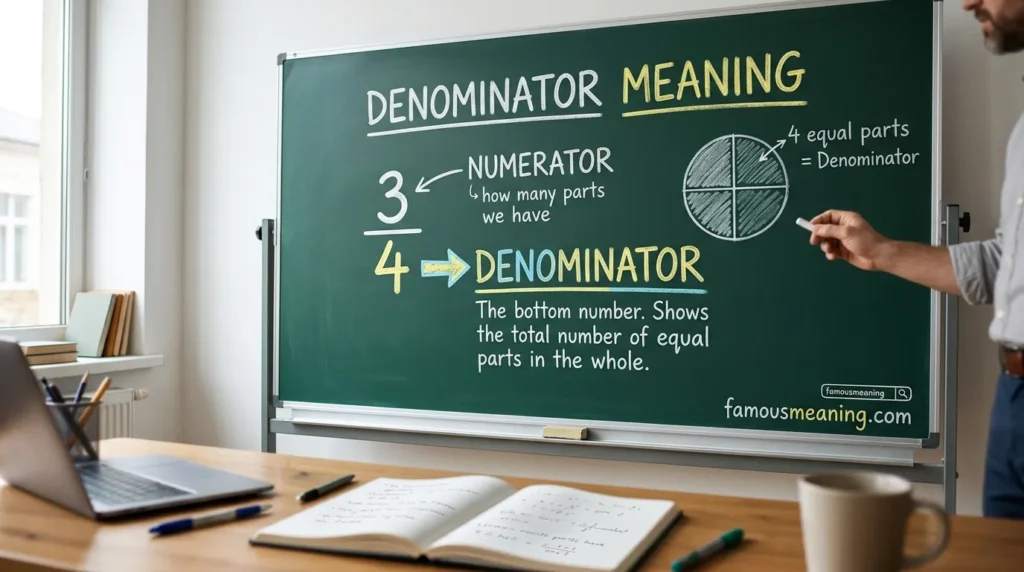
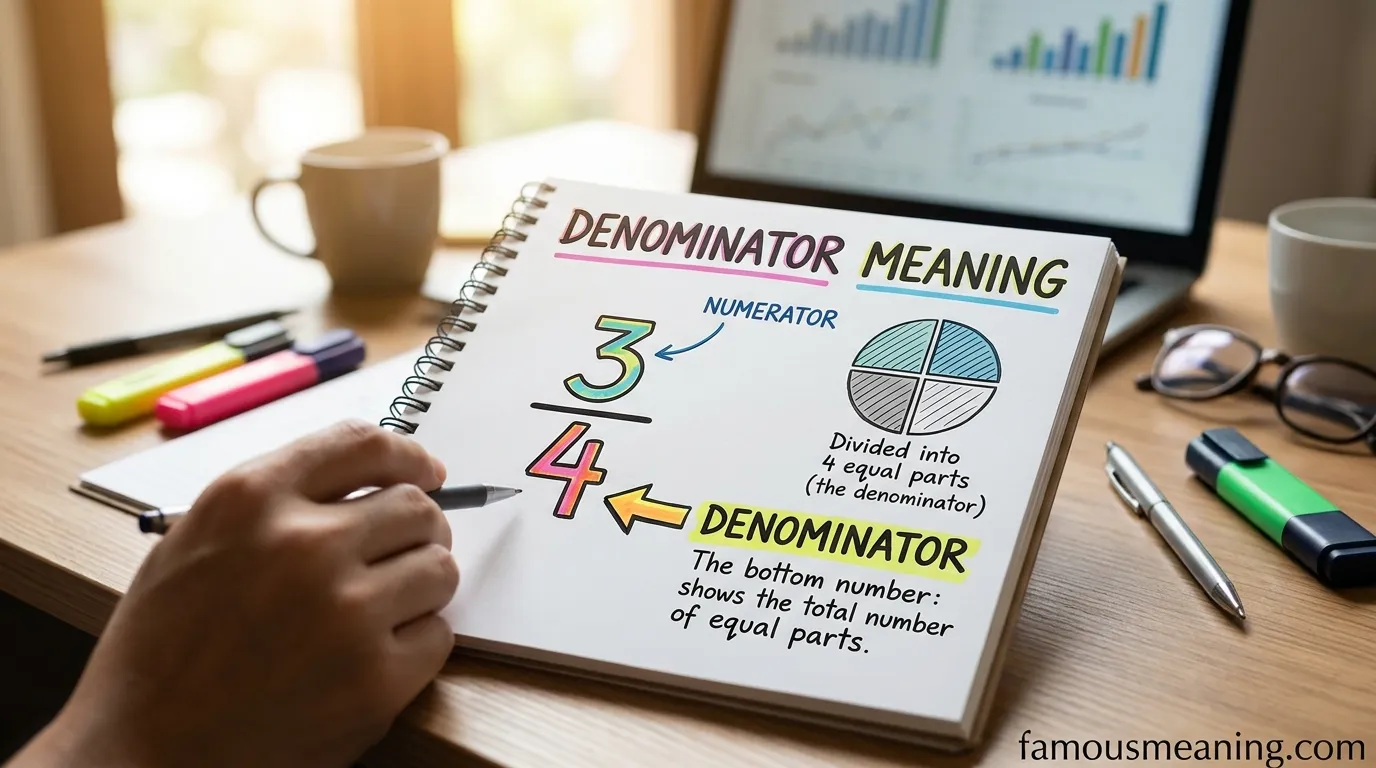
A denominator is the number written below the line in a fraction. It shows the total number of equal parts into which a whole is divided.
For example:
In this fraction:
3 is the numerator (top number).
5 is the denominator (bottom number).
The denominator tells us that the whole has been divided into five equal parts, while the numerator tells us that three of those parts are being considered.
Quick Definition
Term | Meaning |
|---|---|
Denominator | Bottom number of a fraction |
Numerator | Top number of a fraction |
Function | Shows the total number of equal parts |
Example | In 2/7, the denominator is 7 |
Easy Examples of Denominator
Let’s understand the concept with some simple fractions.
Example 1: Fraction 1/2
Numerator = 1
Denominator = 2
The whole is divided into two equal parts, and one part is being considered.
Example 2: Fraction 2/3
Numerator = 2
Denominator = 3
The whole is divided into three equal parts, and two parts are being considered.
Example 3: Fraction 3/4
Numerator = 3
Denominator = 4
The whole is divided into four equal parts, and three parts are being considered.
Example 4: Fraction 5/8
Numerator = 5
Denominator = 8
The whole is divided into eight equal parts, and five parts are being considered.
Denominator vs. Numerator: What’s the Difference?
The numerator and denominator are the two main parts of a fraction. They have different jobs.
Numerator | Denominator |
|---|---|
Written at the top | Written at the bottom |
Shows how many parts are selected | Shows the total equal parts in the whole |
Example: 3 in 3/5 | Example: 5 in 3/5 |
Tells how many parts we have | Tells how many equal parts make one whole |
Easy way to remember:
Numerator = Number of parts you have.
Denominator = Total equal parts.
For example, if a cake is divided into 6 equal slices and you take 2 slices, your fraction is 2/6. The numerator is 2, and the denominator is 6.
How to Find the Denominator in a Fraction
Finding the denominator is very simple. Follow these steps:
Look at the fraction.
Identify the horizontal line.
Find the number written below the line.
That number is the denominator.
For example:
The number 9 is below the fraction line, so 9 is the denominator.
Here are a few more examples:
Fraction | Denominator |
|---|---|
1/3 | 3 |
2/5 | 5 |
4/7 | 7 |
5/9 | 9 |
7/10 | 10 |
8/12 | 12 |
What Happens When the Denominator Changes?
The denominator affects the size of the equal parts in a fraction when the whole is the same.
For example:
1/2 means one out of two equal parts.
1/4 means one out of four equal parts.
1/8 means one out of eight equal parts.
When the numerator is the same and the denominators are positive, a larger denominator means smaller individual parts.
For example:
This is because dividing the same whole into more equal parts makes each part smaller.
What Is a Common Denominator?
A common denominator is a denominator shared by two or more fractions.
For example:
Both fractions have 4 as their denominator, so they have a common denominator.
Common denominators are useful when adding or subtracting fractions.
For example:
When fractions have different denominators, you may need to find a common denominator before adding or subtracting them.
What Is a Denominator in Everyday Life?
Although denominator is a mathematical term, the concept is used in many everyday situations.
1. Sharing Food
If you divide a pizza into 8 equal slices, the denominator is 8.
2. Dividing Money
If you divide an amount of money equally among 4 people, the number of equal shares is 4.
3. Measuring Ingredients
If a recipe requires 1/2 cup of milk, the denominator is 2.
4. Sharing Objects
If a chocolate bar has 10 equal pieces, the denominator in a fraction describing those pieces is 10.
These examples show how fractions help us understand equal sharing and measurement.
Common Mistakes When Understanding Denominators
1. Confusing the Numerator With the Denominator
Remember that the numerator is the top number, while the denominator is the bottom number.
2. Thinking the Denominator Shows Selected Parts
The denominator represents the total number of equal parts in the whole, not the number of parts selected.
3. Assuming a Bigger Denominator Always Means a Bigger Fraction
This is not true when comparing fractions with the same positive numerator. For example, 1/8 is smaller than 1/4.
4. Forgetting That Fractions Represent Equal Parts
A fraction describes equal parts of a whole. If the parts are not equal, the fraction does not accurately represent those parts.