
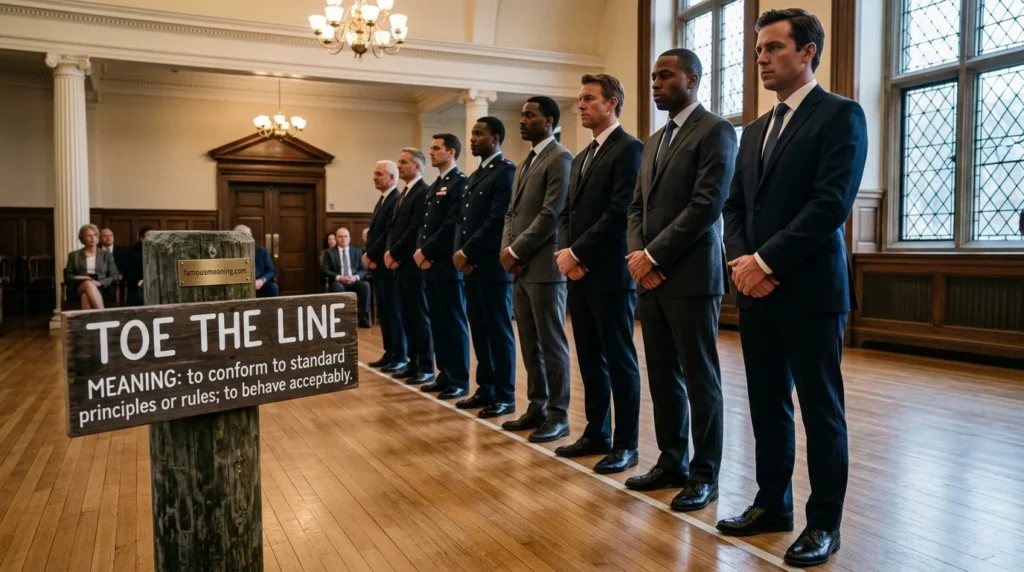
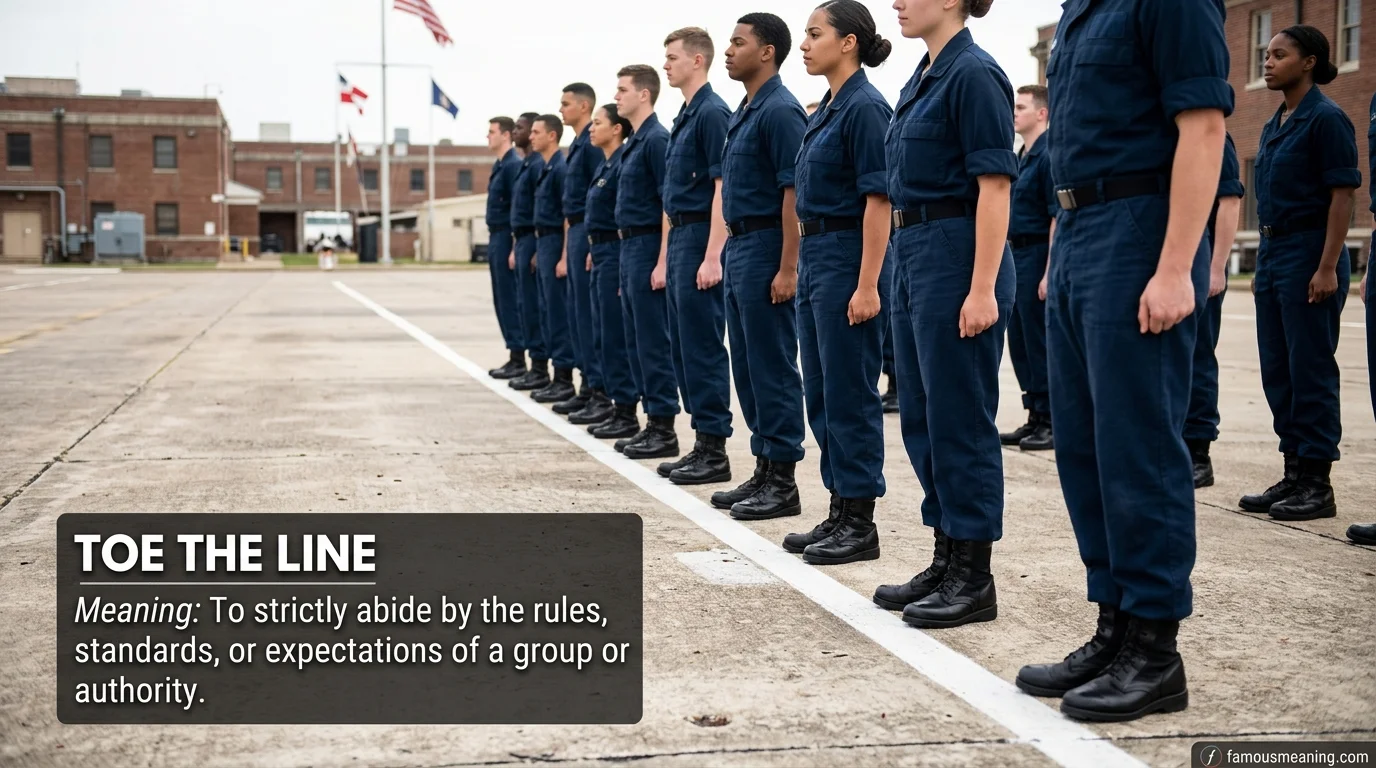
What Does “Tow the Line” Mean?
The phrase tow the line is usually an incorrect spelling of toe the line.
Quick Definition
Tow the line meaning: A common misspelling of toe the line, an idiom meaning to follow rules, obey authority, or meet expectations.
What Does “Toe the Line” Actually Mean?
When someone toes the line, they:
- Follow rules carefully.
- Obey authority figures.
- Meet expectations.
- Stay within accepted boundaries.
- Avoid causing trouble.
For example:
- “Employees are expected to toe the line and follow company policies.”
- “Athletes must toe the line before the race begins.”
In both examples, the phrase refers to following rules or complying with expectations.
What Tone Does It Convey?
Depending on the context, the phrase can sound:
- Neutral
- Professional
- Serious
- Encouraging
- Slightly critical (when implying someone should obey)
What Does “Tow the Line” Mean on Different Platforms?
Text Messages
People occasionally write tow the line in texts, but they almost always mean toe the line.
Example:
“You need to tow the line if you want to keep your job.”
Correct form:
“You need to toe the line if you want to keep your job.”
Snapchat
The phrase is uncommon on Snapchat but may appear in captions about school, work, or relationships where someone is expected to follow rules.
On Instagram, users often quote the idiom in motivational or workplace posts. You’ll also find many instances of the misspelled version, “tow the line.”
TikTok
TikTok creators sometimes use the expression when discussing strict parents, workplace expectations, or celebrity controversies.
Discord
In gaming communities, someone might say a player needs to toe the line by following server rules or respecting moderators.
Reddit discussions frequently point out that tow the line is a common eggcorn—a mistaken phrase that sounds correct but isn’t.
Dating Apps
Although uncommon, someone may jokingly tell a match to toe the line if they’re teasing about following relationship “rules.”
Origin and History of “Toe the Line”
One reason people search for tow the line meaning is because the correct version seems surprising.
The accepted idiom is toe the line, and its origins are generally linked to the practice of placing one’s toes behind a marked line before the start of a race, military drill, or inspection.
Over time, the expression came to mean:
- Following instructions
- Staying within limits
- Meeting expectations
- Complying with authority
Because tow and toe sound identical, many English speakers naturally substitute the more familiar verb “tow.” This type of language mistake is known as an eggcorn—a word or phrase that sounds right but changes the original meaning.
Modern dictionaries and style guides overwhelmingly recognize toe the line as the correct idiom, while tow the line is treated as a common misspelling.
How People Actually Use “Toe the Line”
Although many people search for tow the line meaning, the correct expression is toe the line. In everyday English, you’ll hear it in workplaces, politics, sports, schools, and even family conversations.
Most people use the phrase when talking about someone who is expected to follow rules or meet certain standards.
Common Situations
People often say someone is “toeing the line” when they:
- Follow company policies.
- Obey a manager or supervisor.
- Respect school rules.
- Comply with government regulations.
- Follow team instructions.
- Behave according to social expectations.
When to Use It
Use toe the line when talking about:
- Following instructions.
- Obeying authority.
- Meeting expectations.
- Staying within accepted limits.
Example:
- “New employees are expected to toe the line during their probation period.”
- “The players toed the line and followed the coach’s strategy.”
When Not to Use It
Avoid using tow the line in formal writing because it’s considered a spelling mistake.
Also avoid using toe the line when you actually mean:
- Pulling something (tow)
- Transporting a vehicle
- Dragging an object
Those situations require the verb tow, not the idiom.
Real Examples of “Toe the Line” in Conversations
Example 1
Person A: Why did everyone suddenly start following the new rules?
Person B: The manager told everyone to toe the line.
Meaning: Employees were expected to obey.
Example 2
A: Will the new player fit into the team?
B: As long as he toes the line, he’ll be fine.
Meaning: He needs to follow team rules.
Example 3
A: Why wasn’t he promoted?
B: Management felt he didn’t toe the line.
Meaning: He didn’t follow company expectations.
Example 4
A: Did your brother stop breaking curfew?
B: Yeah, he’s finally toeing the line.
Meaning: He’s following family rules now.
Example 5
A: What happened after the warning?
B: Everyone started toeing the line.
Meaning: People became more obedient.
Example 6
A: Why was the politician criticized?
B: Some people thought he refused to toe the party line.
Meaning: He didn’t follow party policies.
Example 7
A: How’s your first week at work?
B: I’m just trying to toe the line until I learn everything.
Meaning: Following workplace expectations.
Example 8
A: Did the students behave?
B: Most of them toed the line after the principal spoke.
Meaning: They followed the rules.
Example 9
A: Why did she apologize?
B: She wanted to toe the line and avoid more problems.
Meaning: She wanted to comply.
Example 10
A: Do employees have much freedom?
B: Yes, but they still need to toe the line.
Meaning: Freedom exists within company rules.
Example 11
A: Why did everyone wear the same uniform?
B: The company expects everyone to toe the line.
Example 12
A: Did the rookie listen to the coach?
B: Absolutely. He toed the line from day one.
Common Mistakes and Misunderstandings
The biggest mistake is writing tow the line instead of toe the line.
Here are a few common misunderstandings:
Mistake 1: Using “Tow” Instead of “Toe”
❌ Tow the line
✅ Toe the line
Remember:
- Tow = pull something.
- Toe = part of your foot.
Mistake 2: Thinking Both Spellings Are Correct
They are not interchangeable.
Most dictionaries, editors, and style guides recommend toe the line.
Mistake 3: Assuming It Refers to Pulling a Rope
Many people imagine someone literally towing a line.
That’s not the origin of the idiom.
Instead, it refers to standing with your toes behind a marked line.
Similar Idioms and Related Expressions
| Phrase | Meaning | Difference |
|---|---|---|
| Follow the rules | Obey regulations | Plain-language version |
| Fall in line | Conform to expectations | Similar meaning |
| Stick to the rules | Follow guidelines | Less idiomatic |
| Play by the rules | Behave fairly | Focuses on fairness |
| Keep in line | Maintain discipline | Often used for groups |
| Stay on track | Continue correctly | About progress |
| Mind the rules | Pay attention to regulations | More direct |
| Walk the straight and narrow | Behave morally | Stronger moral emphasis |
| Follow orders | Obey commands | More authoritative |
| Stay within the lines | Avoid crossing limits | Figurative expression |
Is “Toe the Line” Positive, Negative, or Neutral?
The expression is generally neutral, but its tone depends on context.
Positive
- Following safety rules.
- Respecting workplace policies.
- Being disciplined.
Neutral
- Meeting expectations.
- Complying with procedures.
Negative
Sometimes it suggests blind obedience or a lack of independence.
For example:
“Employees were expected to toe the line without asking questions.”
Should You Use “Toe the Line”?
Use It If:
- You’re writing professionally.
- You’re discussing rules or expectations.
- You want to use the correct idiom.
Avoid It If:
- You actually mean pulling or hauling something.
- You’re writing tow the line instead of toe the line.
- Your audience may misunderstand the idiom.