
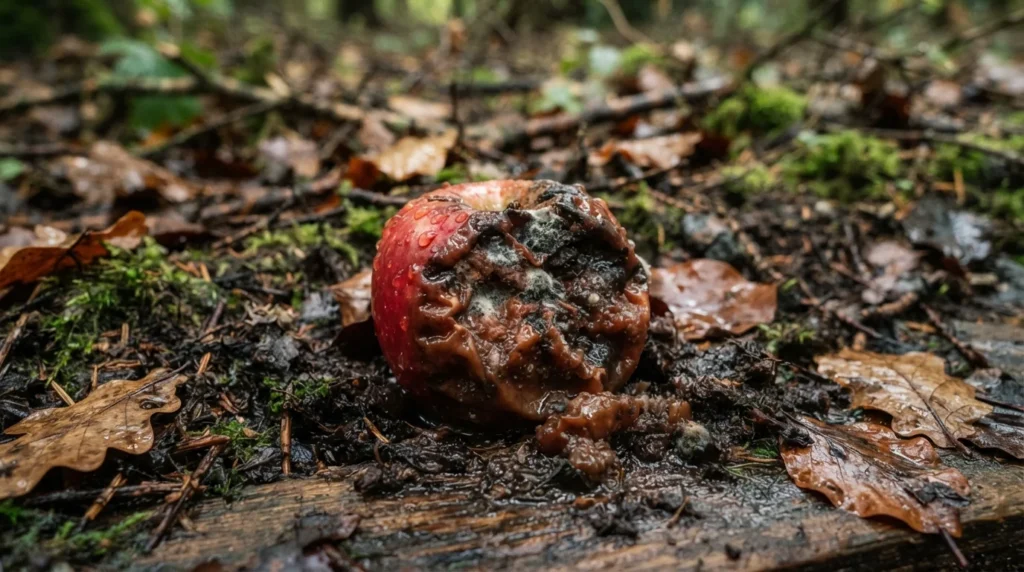

What Does “Rot” Mean?
Quick Definition
Rot means:
- To decay naturally.
- To decompose over time.
- To spoil.
- To deteriorate gradually.
- Worthless or foolish talk (informal).
Dictionary Meaning
As a verb, rot means:
To decay naturally through the action of bacteria, fungi, moisture, or time.
As a noun, rot refers to:
- The process of decay.
- A disease causing decay in plants or wood.
- Nonsense or foolish statements (informal British English).
Literal Meaning
The literal meaning of rot is physical decay.
Examples include:
- Rotten fruit
- Rotting leaves
- Wood rot
- Tooth decay caused by rot
- Plant root rot
This process happens naturally when organic material breaks down.
Figurative Meaning
People also use rot figuratively to describe:
- Moral decline
- Poor management
- Corruption
- Declining quality
- Worthless ideas
Example:
“The company began to rot from the inside because of poor leadership.”
Here, rot doesn’t describe physical decay. Instead, it symbolizes gradual deterioration.
What Does “Rot” Mean in Text and Online?
Unlike many internet abbreviations, rot usually keeps its standard English meaning.
However, online it may appear in several ways.
Text Messages
Friends might say:
“The bananas will rot if you don’t eat them.”
Meaning:
The bananas will spoil.
Sometimes:
“That’s complete rot.”
Meaning:
“I don’t believe that.”
or
“That’s nonsense.”
Snapchat
On Snapchat, rot often appears in captions like:
“Forgot my lunch in my locker… it’s probably rotting now.”
It can also be used humorously.
Examples include:
- Food before it rots.
- Plant care tips to prevent root rot.
- Fashion trends that “need to rot.”
Some creators also use brain rot, a modern internet slang phrase discussed below.
TikTok
On TikTok, you’ll frequently encounter:
Brain Rot
This popular slang refers to spending so much time watching repetitive or low-quality content that someone jokingly claims their brain is “rotting.”
Example:
“This meme gave me brain rot.”
Meaning:
The content was so repetitive, addictive, or silly that it felt mentally overwhelming.
The phrase is humorous and shouldn’t be taken literally.
Discord
Gamers sometimes say:
“Our strategy completely rotted.”
Meaning:
The plan gradually failed.
Others use brain rot when talking about memes or inside jokes.
On Reddit, rot often appears in discussions about:
- Gardening
- Composting
- Home repairs
- Gaming
- Politics
- Internet memes
Depending on the subreddit, it may describe either actual decay or figurative decline.
Origin and History of “Rot”
The word rot has ancient Germanic origins.
It comes from Old English rotian, meaning:
- To decay
- To become corrupt
- To decompose
Related forms appear in several Germanic languages, showing that the word has been part of English for well over a thousand years.
Originally, it mainly referred to physical decomposition. Over time, English speakers expanded its meaning to include moral corruption, declining quality, and eventually informal expressions like “What rot!”, meaning “What nonsense!”
In modern internet culture, phrases such as brain rot have given the word a new humorous meaning.
Different Types of Rot
Food Rot
Occurs when food spoils because of bacteria or fungi.
Examples:
- Rotten apples
- Moldy bread
- Spoiled vegetables
Wood Rot
Wood exposed to moisture can decay over time.
Common causes include:
- Rain
- Poor ventilation
- Fungus
Root Rot
A common plant disease caused by excessive watering or poor drainage.
Signs include:
- Yellow leaves
- Soft roots
- Wilting
Tooth Rot
People sometimes use tooth rot informally to describe severe tooth decay caused by bacteria.
Dry Rot
Despite its name, dry rot is caused by a fungus that damages wooden structures.
How People Actually Use “Rot”
Most people use rot in one of three ways.
1. Talking About Decay
“The fruit started to rot.”
Meaning:
The fruit spoiled.
2. Describing Decline
“The neighborhood slowly rotted after businesses closed.”
Meaning:
Conditions gradually became worse.
3. Calling Something Nonsense
“That’s absolute rot.”
Meaning:
“I completely disagree.”
or
“That’s ridiculous.”
This usage is more common in British English than American English.
Brain Rot Meaning
One of the newest uses of rot online is the phrase brain rot.
What Is Brain Rot?
Brain rot is internet slang describing the feeling that you’ve consumed so much repetitive, silly, or addictive online content that your mind feels overwhelmed.
People commonly use it after:
- Watching endless TikTok videos
- Repeating viral memes
- Following absurd internet jokes
- Spending hours scrolling social media
It’s a humorous exaggeration rather than a medical term.
Example:
“I’ve watched this meme 200 times. I officially have brain rot.”
Real Examples of “Rot” in Conversations
Example 1
Person A: Don’t leave the strawberries outside.
Person B: Why?
Person A: They’ll rot in the heat.
Meaning: The strawberries will spoil.
Example 2
Person A: Did you clean the basement?
Person B: No, the old boxes are starting to rot.
Meaning: They are deteriorating because of age or moisture.
Example 3
Person A: I heard aliens built the pyramids.
Person B: Oh, what rot!
Meaning: “I don’t believe that.”
Example 4
Person A: I’ve watched that meme all week.
Person B: Same. Total brain rot.
Meaning: They jokingly feel mentally overloaded by repetitive online content.
Example 5
Person A: Why is your plant dying?
Person B: I think it has root rot.
Meaning: The roots have begun to decay.
Example 6
Person A: This wooden deck feels soft.
Person B: That’s probably wood rot.
Meaning: Moisture has caused the wood to decay.
Example 7
Person A: That rumor isn’t true.
Person B: Exactly. It’s complete rot.
Meaning: The rumor is nonsense.
Example 8
Person A: Did you throw away the old potatoes?
Person B: Yes, they had already started to rot.
Meaning: The potatoes had spoiled.
Example 9
Person A: Why are the leaves turning yellow?
Person B: Too much water can cause root rot.
Meaning: Excess watering has damaged the roots.
Example 10
Person A: I’ve been scrolling TikTok for six hours.
Person B: That’s pure brain rot.
Meaning: A humorous comment about excessive social media consumption.
Common Mistakes and Misunderstandings
Mistake 1: Thinking Rot Only Applies to Food
While food commonly rots, the word also applies to wood, plants, teeth, leaves, and other organic materials.
Mistake 2: Assuming Rot Always Means Something Physical
Not always. It can also describe declining morals, worsening situations, or ideas considered foolish.
Mistake 3: Confusing “Rot” with “Rust”
Rust affects metal, while rot affects organic materials such as wood, plants, and food.
Mistake 4: Taking “Brain Rot” Literally
“Brain rot” is a humorous internet expression. It doesn’t refer to an actual medical condition.
Similar Words and Related Terms
| Word | Meaning | Difference |
|---|---|---|
| Decay | To gradually break down | A broader scientific term for deterioration |
| Decompose | To break down naturally | Often used in biology and environmental science |
| Spoil | To become unfit to eat | Usually refers to food |
| Deteriorate | To become worse over time | Can describe physical objects or situations |
| Corrupt | To become morally dishonest | Refers mainly to ethics or institutions |
| Mold | Fungal growth on organic matter | A common cause or sign of rot |
| Wilt | To droop from lack of water or disease | Applies mainly to plants |
| Wither | To dry up or shrivel | Often caused by age, drought, or disease |
| Rust | Corrosion of metal | Affects metal, not organic materials |
| Perish | To die or spoil | Often used for food or living things |
Internal linking opportunities:
- Decay meaning
- Rotten meaning
- Rust meaning
- Brain rot meaning
- Decompose meaning
- Mold meaning
- Spoil meaning
- Corruption meaning
- Compost meaning
- Root rot meaning
Is “Rot” Positive, Negative, or Neutral?
The meaning of rot depends on the context, but it is usually negative.
Negative Uses
Most often, rot refers to:
- Food going bad
- Wood decaying
- Plant diseases
- Declining quality
- Corruption
- Worthless or foolish ideas
Example:
“The fence is rotting because of water damage.”
Neutral Uses
In science, biology, and gardening, rot is simply a descriptive term.
Examples include:
- Root rot
- Wood rot
- Fruit rot
- Composting
In these contexts, the word isn’t emotional—it just describes a natural process.
Humorous Uses
Modern internet slang often uses brain rot jokingly.
Example:
“I’ve watched the same funny video 100 times. I have brain rot!”
This isn’t meant literally. It’s a humorous way of saying someone has spent too much time consuming repetitive online content.
Should You Use “Rot”?
Use it if:
- You’re describing natural decay or decomposition.
- You’re discussing gardening, biology, or home maintenance.
- You’re referring to figurative decline in writing or conversation.
- You’re joking about brain rot in casual online discussions.
Avoid using it if:
- You mean rust on metal.
- You’re writing formal scientific content that requires a more specific term, such as decompose or deteriorate.
- You’re unsure whether the audience will understand internet slang like brain rot.
Key Takeaways
- Rot means to decay, decompose, or deteriorate naturally.
- It commonly refers to food, wood, plants, and other organic materials.
- Figuratively, rot can describe declining quality, corruption, or moral deterioration.
- In British English, rot may also mean nonsense.
- In modern internet slang, brain rot humorously describes feeling mentally overloaded by repetitive online content.
- The meaning depends on the context, so it’s important to consider how the word is being used.