
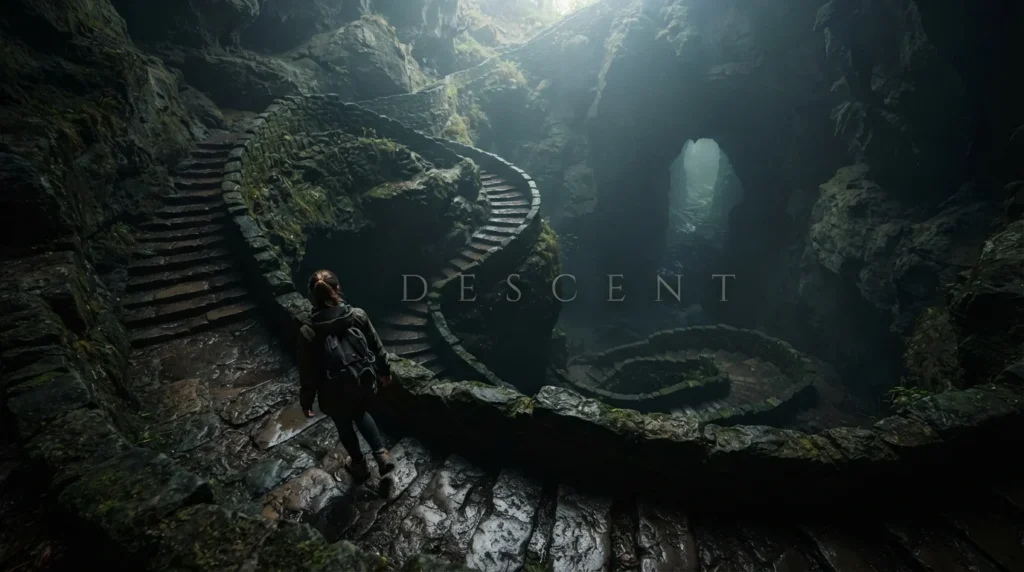

What Does “Descent” Mean?
The word descent has several related meanings, but they all involve the idea of moving from one state or position to another.
The three most common meanings are:
- Moving downward from a higher place.
- Family origin or ancestry.
- A decline in quality, condition, or behavior.
The intended meaning depends entirely on the context.
Quick Definition
Descent (noun):
- The act of moving downward.
- A person’s family background or ancestry.
- A gradual decline into a worse condition.
Literal Meaning
The literal meaning of descent is the act of going down.
Examples include:
- An airplane descending toward an airport.
- A hiker walking down a mountain.
- A skier traveling downhill.
- A staircase leading to a lower level.
Example:
“The descent from the mountain took three hours.”
Meaning:
The hikers spent three hours coming down the mountain.
Meaning Related to Family and Ancestry
Another common meaning of descent refers to a person’s family origin or ethnic heritage.
Examples:
- African descent
- European descent
- Asian descent
- Native American descent
- Irish descent
Example:
“She is of Italian descent.”
Meaning:
Her family originally comes from Italy.
This usage appears frequently in history books, biographies, genealogy research, census records, and cultural discussions.
Figurative Meaning
Descent can also describe a gradual decline or movement toward a worse condition.
Examples include:
- Descent into poverty
- Descent into violence
- Descent into addiction
- Descent into madness
- Descent into chaos
Example:
“The novel follows the hero’s descent into despair.”
Meaning:
The character gradually experiences increasing emotional suffering.
What Does Descent Usually Mean in Everyday English?
In daily conversations, descent usually refers to one of these situations:
Traveling Downward
Examples:
- The plane has started its descent.
- The elevator’s descent was smooth.
- The road has a steep descent.
Talking About Family Background
Examples:
- She’s of Mexican descent.
- He’s of Chinese descent.
- They’re of Scottish descent.
Describing a Decline
Examples:
- The company’s descent into bankruptcy.
- His descent into crime.
- The town’s economic descent.
Descent vs. Decent vs. Dissent
These three words sound similar but have completely different meanings.
| Word | Meaning | Example |
|---|---|---|
| Descent | Going down or ancestry | The plane began its descent. |
| Decent | Good, respectable, acceptable | She found a decent job. |
| Dissent | Disagreement or opposition | One judge wrote a dissenting opinion. |
Easy Way to Remember
- Descent → Downward or family line.
- Decent → Good enough or respectable.
- Dissent → Disagreement.
These are among the most commonly confused words in English.
What Tone Does It Convey?
The tone of descent depends on the context.
Neutral
“The airplane began its descent.”
Simply describing movement.
Positive
“He is of Japanese descent.”
Describing ancestry without judgment.
Serious
“The country’s descent into civil war.”
Suggesting worsening conditions.
Dramatic
“The villain’s descent into madness.”
Often used in literature and movies to describe psychological decline.
What Does Descent Mean in Different Contexts?
In Geography
Geographers use descent to describe movement from higher elevations to lower ones.
Examples:
- Mountain descent
- Valley descent
- Steep descent
- River descent
In Aviation
Pilots frequently use the word.
Examples:
“The captain announced our descent.”
Meaning:
The aircraft is beginning to lower its altitude before landing.
Passengers often hear:
“Ladies and gentlemen, we have started our descent.”
In Hiking
Outdoor enthusiasts often discuss difficult descents.
Example:
“The descent was harder than the climb.”
Although climbing requires strength, descending can sometimes place more strain on the knees and ankles.
In Genealogy
Genealogy researchers use descent to describe family lineage.
Examples:
- French descent
- Korean descent
- Egyptian descent
The phrase “of … descent” is widely used in historical and cultural writing.
In Literature
Authors often use descent metaphorically.
Examples:
- Descent into fear
- Descent into darkness
- Descent into corruption
- Descent into obsession
These expressions describe gradual emotional or moral decline rather than physical movement.
In Everyday Conversation
People also use the word when talking about roads, staircases, elevators, or hills.
Examples:
- “Watch your step during the descent.”
- “The descent was slippery after the rain.”
Origin and History of Descent
The word descent comes from the Latin verb descendere, meaning “to climb down” or “to go down.”
It later entered Middle English through Old French, where it retained the idea of downward movement.
Over time, the meaning expanded beyond physical movement.
By the Middle Ages, descent was also used to describe family lineage, inheritance, and ancestry because descendants “came down” through generations from earlier ancestors.
Later still, writers began using the word figuratively to describe gradual decline.
Today, all three meanings remain common:
- Downward movement
- Family origin
- Decline
Is the Origin Certain?
Yes.
Unlike many internet slang terms, the origin of descent is well documented through Latin, Old French, and Middle English. Linguists generally agree on its historical development and evolution.
How People Actually Use “Descent”
Although dictionaries provide several definitions, most people encounter descent in just a few everyday situations.
Most People Use It When…
- Talking about family heritage.
- Describing an airplane landing.
- Discussing hiking or mountain climbing.
- Explaining someone’s ethnic background.
- Describing a gradual decline in behavior or circumstances.
- Writing historical or literary analysis.
You’ll Often See It In…
- Travel guides
- Aviation announcements
- Genealogy websites
- News articles
- History books
- Literature reviews
- Government reports
- Academic writing
Real Examples of “Descent” in Conversations
Understanding the descent meaning becomes much easier when you see it used naturally.
Example 1: Air Travel
Flight Attendant: Ladies and gentlemen, we’ve started our descent into New York.
Passenger: Great, we’ll be landing soon.
Meaning: The aircraft is lowering its altitude.
Example 2: Hiking
Friend 1: Was the hike difficult?
Friend 2: The descent was even harder than the climb.
Meaning: Walking downhill required more effort.
Example 3: Family History
Person A: Where is your family originally from?
Person B: I’m of Lebanese descent.
Meaning: Their ancestors came from Lebanon.
Example 4: Literature Class
Teacher: What does the character’s descent into greed represent?
Student: It shows how power changed his personality.
Meaning: A gradual moral decline.
Example 5: Road Trip
Driver: Be careful—the descent ahead is steep.
Passenger: I’ll slow down.
Meaning: The road slopes sharply downward.
Example 6: History Discussion
Student: The museum highlights people of Indigenous descent.
Teacher: Yes, it focuses on their history and cultural contributions.
Meaning: Referring to ancestry or heritage.
Example 7: News Report
Reporter: Economists warned about the country’s descent into recession.
Meaning: A gradual worsening of economic conditions.
Why it was used: To describe decline.
Example 8: Mountain Climbing
Climber: We reached the summit before noon, but the descent took much longer because the trail was icy.
Meaning: The trip back down the mountain.
Why it was used: Describing physical movement downward.
Real Examples of “Descent” in Conversations (Continued)
Example 9: Workplace Conversation
Employee: Why is everyone worried about sales?
Manager: We’ve seen a steady descent in revenue over the past six months.
Meaning: Revenue has been gradually declining.
Why it was used: To describe a negative trend.
Example 10: Family Reunion
Person A: Your family celebrates a lot of Irish traditions.
Person B: That’s because we’re of Irish descent.
Meaning: Their ancestors came from Ireland.
Why it was used: To explain cultural heritage.
Example 11: Novel Discussion
Reader: The ending was heartbreaking.
Friend: Yes, the main character’s descent into loneliness felt very realistic.
Meaning: A gradual emotional decline.
Why it was used: Literary analysis.
Example 12: Ski Resort
Instructor: Control your speed during the descent.
Student: I’ll keep my weight balanced.
Meaning: Traveling downhill on skis.
Why it was used: Safety instruction.
Example 13: Medical Discussion
Doctor: During the baby’s descent through the birth canal, we’ll continue monitoring both mother and baby closely.
Meaning: The baby’s movement downward during labor.
Why it was used: Medical terminology.
Example 14: Elevator
Passenger: That elevator’s descent was incredibly smooth.
Friend: I barely noticed we were moving.
Meaning: Downward movement.
Why it was used: Everyday conversation.
Example 15: Documentary
Narrator: The documentary explores the empire’s descent from prosperity to collapse.
Meaning: A gradual decline over time.
Why it was used: Historical context.
Common Mistakes and Misunderstandings
Although descent is a common English word, it’s often confused with similar-sounding words or misunderstood in context.
Mistake #1: Confusing “Descent” with “Decent”
This is the most common mistake.
Incorrect:
She is of Italian decent.
Correct:
She is of Italian descent.
Remember:
- Descent = ancestry or downward movement.
- Decent = respectable, acceptable, or good.
Mistake #2: Confusing “Descent” with “Dissent”
Dissent means disagreement or opposition.
Example:
The judge wrote a dissenting opinion.
This has nothing to do with family history or moving downward.
Mistake #3: Assuming “Descent” Only Means Going Down
Many learners only know the physical meaning.
However, descent also refers to:
- Family lineage
- Ethnic heritage
- Gradual decline
- Historical succession
Mistake #4: Thinking It Always Has a Negative Meaning
The word isn’t always negative.
Examples:
- Of Indian descent ✅
- Safe descent of the aircraft ✅
These are completely neutral uses.
Mistake #5: Using “Descent” Instead of “Descendant”
These words are related but different.
- Descent = ancestry or downward movement.
- Descendant = a person who comes from a particular ancestor.
Example:
She is a descendant of the family.
Not:
She is a descent of the family.
Similar Words and Related Terms
| Word | Meaning | Difference |
|---|---|---|
| Descent | Downward movement, ancestry, or decline | Main keyword |
| Descend | To move downward | Verb form |
| Descendant | A person related through ancestry | Refers to people |
| Ancestry | Family origin | Focuses on lineage |
| Heritage | Cultural background | Broader than ancestry |
| Lineage | Family line | Often historical |
| Origin | Starting point or source | More general |
| Decline | Becoming worse | Doesn’t imply ancestry |
| Slope | Inclined surface | Physical landscape |
| Genealogy | Study of family history | Academic field |
Internal Linking Opportunities
- Descend Meaning
- Descendant Meaning
- Ancestry Meaning
- Heritage Meaning
- Genealogy Explained
- Decent Meaning
- Dissent Meaning
- Decline Meaning
- Lineage Definition
- Ethnicity vs Nationality
Is “Descent” Positive, Negative, or Neutral?
The emotional tone of descent depends entirely on how it’s used.
Neutral
Most uses are neutral.
Examples:
- Plane descent
- Mountain descent
- African descent
- European descent
Positive
Sometimes the word appears in positive discussions about family history and cultural identity.
Example:
She proudly celebrates her Mexican descent.
Negative
When describing decline, descent often has a negative tone.
Examples:
- Descent into violence
- Descent into corruption
- Descent into addiction
- Descent into bankruptcy
Overall
Descent is generally a neutral word whose emotional tone comes from the surrounding context.
Should You Use the Word “Descent”?
Yes. Descent is a standard English word used in academic writing, journalism, travel, history, healthcare, and everyday conversation.
Use It If:
- You’re describing movement downward.
- You’re referring to someone’s ancestry or heritage.
- You’re discussing a gradual decline.
- You’re writing formally or academically.
- You’re explaining genealogy or history.
Avoid It If:
- You actually mean decent (good or respectable).
- You mean dissent (disagreement).
- A simpler word like downhill or family background fits your audience better.
Choosing the correct word improves clarity and prevents common spelling mistakes.