
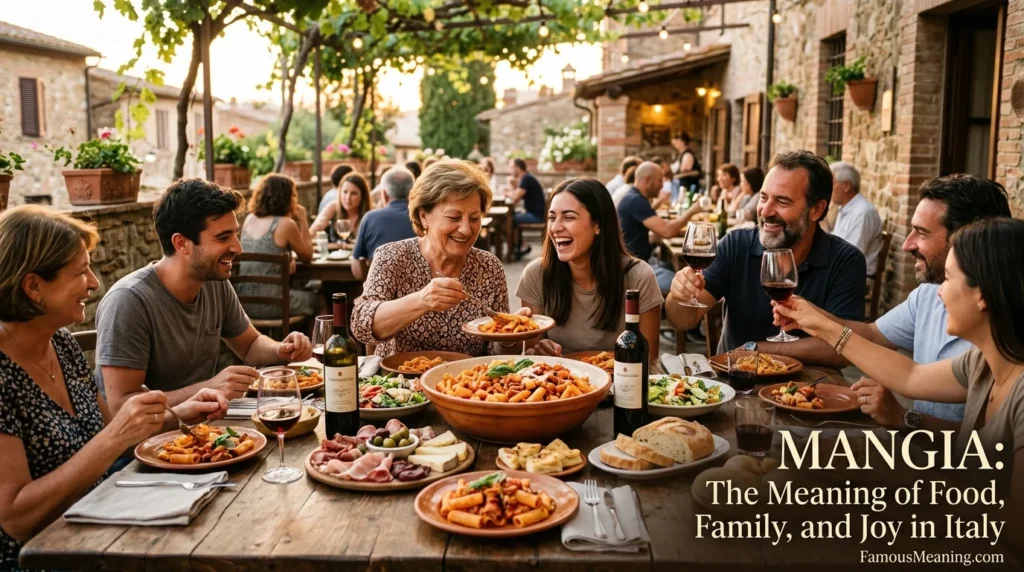
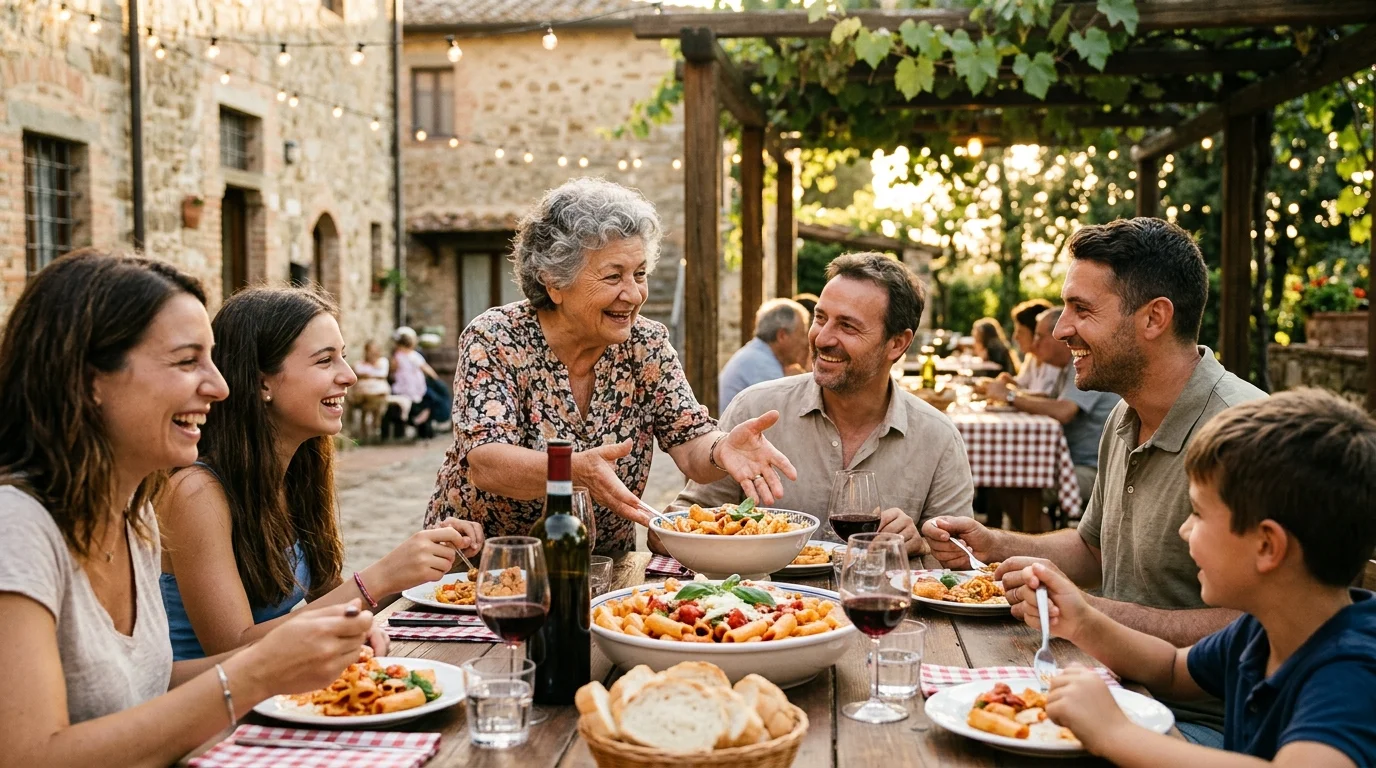
What Does “Mangia” Mean?
Quick Definition
Mangia is the Italian imperative form of the verb mangiare, meaning “eat.” It’s commonly used to encourage someone to start eating or enjoy more food.
Literal Meaning
The literal translation of mangia is:
- Eat
- Go ahead and eat
- Eat up
Most Common Meaning
Today, people usually use mangia to say:
- Come eat!
- Enjoy your meal!
- Have another bite!
- Don’t be shy—eat more!
It’s often spoken with affection rather than as a strict command.
What Does Mangia Mean in Different Contexts?
Everyday Italian Conversations
In Italy, family members frequently say mangia! before or during meals.
Example:
“Mangia, il cibo si sta raffreddando!”
Translation:
“Eat, your food is getting cold!”
Italian-American Culture
Among Italian-American families, mangia! has become a symbol of hospitality and family tradition.
Grandparents and parents may say:
- Mangia!
- Mangia, mangia!
- Mangia bene!
These expressions warmly encourage guests to eat more.
Restaurants
Many Italian restaurants use Mangia! in:
- Restaurant names
- Menus
- Decorations
- Advertising slogans
The word creates a welcoming atmosphere.
Social Media
On Instagram, TikTok, and Facebook, you’ll often see mangia in posts about:
- Homemade pasta
- Pizza
- Italian cooking
- Family dinners
- Food photography
- Travel in Italy
The tone is cheerful and inviting.
Origin and History of Mangia
Where Does the Word Come From?
Mangia comes from the Italian verb mangiare, which means “to eat.”
Italian belongs to the Romance language family, which developed from Latin. The modern word evolved over centuries as the language changed from its Latin roots.
Cultural Importance
Food plays a central role in Italian culture.
Meals are often viewed as opportunities to:
- Bring families together
- Celebrate holidays
- Welcome guests
- Strengthen friendships
- Preserve traditions
Because of this, mangia has become associated with generosity and affection rather than simply eating.
Global Popularity
As Italian immigrants settled around the world, especially in the United States, Canada, Argentina, and Australia, the word mangia became widely recognized even by people who don’t speak Italian.
How People Actually Use Mangia
Most people use mangia as a friendly invitation.
You’ll often hear it:
- At family dinners
- During holiday meals
- At Italian restaurants
- While serving homemade food
- When encouraging someone to try a dish
People may also repeat it for emphasis:
- Mangia!
- Mangia, mangia!
- Mangia bene!
The repeated version sounds even warmer and more affectionate.
How to Pronounce Mangia
The standard Italian pronunciation is:
MAHN-jah
The “gia” sounds similar to the “ja” in the English word jar.
Phonetic pronunciation:
MAHN-jah
Real Examples of Mangia in Conversations
Example 1
Person A: I’m not very hungry.
Person B: Mangia! I made your favorite pasta.
Meaning: Encouraging someone to eat.
Example 2
Person A: This smells amazing.
Person B: Mangia before it gets cold!
Meaning: Start eating immediately.
Example 3
Grandmother: Mangia, mangia!
Grandchild: Okay, just one more serving.
Meaning: Loving encouragement to eat more.
Example 4
Person A: Thank you for dinner.
Person B: Mangia! There’s plenty left.
Meaning: Offering more food.
Example 5
Person A: Should I order dessert?
Person B: Mangia! You’re on vacation.
Meaning: Enjoy yourself.
Example 6
Person A: The pizza is incredible.
Person B: Mangia while it’s hot!
Meaning: Eat before it cools down.
Example 7
Person A: I don’t usually eat this much.
Person B: In this house, everyone mangia!
Meaning: Everyone is expected to enjoy the meal.
Example 8
Person A: Why does everyone keep saying “mangia”?
Person B: It’s Italian for “eat.”
Meaning: Explaining the translation.
Example 9
Person A: I love Italian family dinners.
Person B: There’s always someone saying “Mangia!”
Meaning: Referring to Italian hospitality.
Example 10
Person A: What’s the first Italian word you learned?
Person B: Mangia!
Meaning: One of the most common Italian words recognized internationally.
Common Mistakes and Misunderstandings
Mistake 1: Mangia Means “Food”
Incorrect.
Mangia means “eat,” not “food.”
Mistake 2: It’s an English Slang Word
No.
It’s a genuine Italian word that has become familiar in English-speaking countries.
Mistake 3: It’s Rude
Not at all.
In most situations, mangia is warm, friendly, and welcoming.
Mistake 4: It Always Means “Eat More”
Not necessarily.
It can simply mean:
- Eat
- Enjoy your meal
- Go ahead and start eating
The exact meaning depends on the conversation.
Similar Italian Words and Related Expressions
| Italian Word | Meaning | Difference |
|---|---|---|
| Mangiare | To eat | Infinitive verb |
| Mangia | Eat | Imperative command |
| Mangiamo | Let’s eat | Includes the speaker |
| Buon appetito | Enjoy your meal | Standard dining expression |
| Cibo | Food | Refers to food itself |
| Cena | Dinner | Evening meal |
| Pranzo | Lunch | Midday meal |
| Cucina | Kitchen or cuisine | Place or style of cooking |
| Delizioso | Delicious | Describes taste |
| Grazie | Thank you | Expression of gratitude |
Internal linking opportunities: buongiorno meaning, ciao meaning, grazie meaning, buon appetito meaning, Italian phrases.
Is Mangia Positive, Negative, or Neutral?
The word mangia is almost always positive.
Positive Uses
- Welcoming guests
- Family meals
- Celebrations
- Restaurant hospitality
- Sharing homemade food
Neutral Uses
- Giving a simple instruction to eat.
- Translating the word in language lessons.
Negative Uses
Very rarely. The word itself isn’t negative, although the tone could sound demanding if spoken harshly. In most real-life situations, however, it’s affectionate and encouraging.
Should You Use “Mangia”?
Use It If
- You’re sharing an Italian meal with friends or family.
- You want to add an authentic Italian touch to a food-related conversation.
- You’re discussing Italian culture or cuisine.
- You’re encouraging someone to enjoy their meal in a casual setting.
Avoid It If
- Your audience may not understand Italian.
- You’re writing in a formal or professional document where plain English is more appropriate.
- You’re unsure whether the cultural reference fits the situation.