
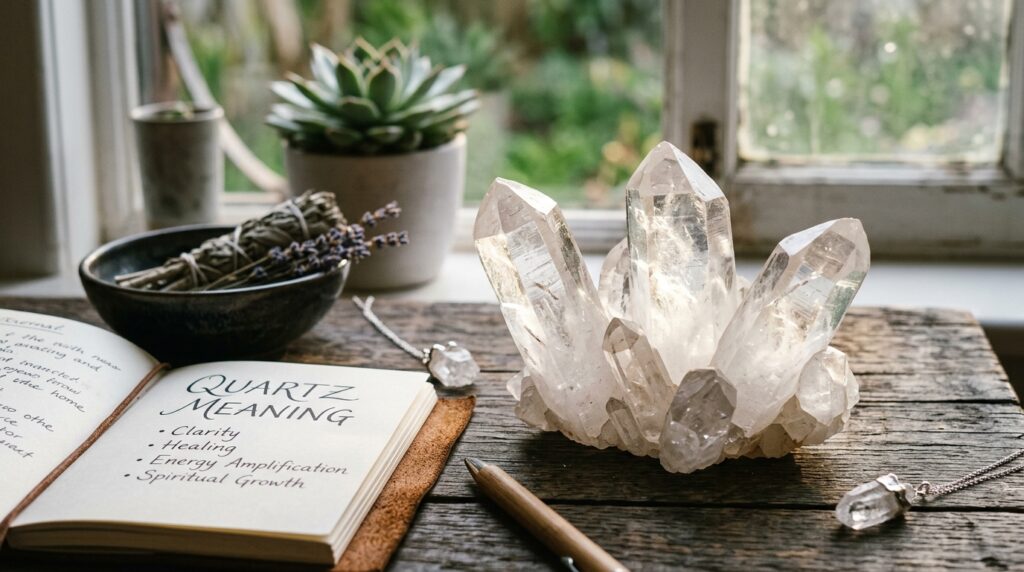
What Does “Quartz” Mean?
Quick Definition
Quartz is a hard, naturally occurring mineral composed mainly of silicon dioxide (SiO₂). It forms crystals in many shapes and colors and is used in everything from jewelry and countertops to electronics and watches.
Literal Meaning
The word quartz refers to the mineral itself. It is not a slang term or abbreviation.
Most Common Meaning
Today, quartz commonly refers to:
- A natural crystal or gemstone
- A mineral used in jewelry
- Quartz countertops
- Quartz watches
- Industrial quartz used in electronics
- Decorative crystals
What Does Quartz Mean in Different Contexts?
Geology
In geology, quartz is one of the Earth’s most abundant minerals. It is found in many types of rocks, including:
- Granite
- Sandstone
- Quartzite
- Pegmatite
Quartz is known for its hardness and resistance to weathering.
Jewelry
Quartz is widely used in jewelry because it comes in many attractive varieties.
Popular examples include:
- Clear Quartz
- Rose Quartz
- Smoky Quartz
- Amethyst
- Citrine
Some of these gemstones are naturally colored, while others may be heat-treated or enhanced.
Watches
A quartz watch uses a tiny quartz crystal that vibrates at a precise frequency when electricity passes through it. This helps keep highly accurate time.
Construction
Quartz is commonly found in:
- Engineered stone countertops
- Tiles
- Flooring
- Decorative surfaces
Its durability makes it a popular building material.
Spiritual and Symbolic Meaning
Many spiritual traditions associate quartz with:
- Mental clarity
- Balance
- Focus
- Inner peace
- Positive intentions
These meanings come from cultural and spiritual practices rather than scientific research.
Origin and History of Quartz
Where Does the Word Come From?
The English word quartz comes from the German word Quarz, which has been used for centuries to describe the mineral.
The exact linguistic origin before German is uncertain, and scholars continue to debate its earliest roots.
Historical Uses
Quartz has been used throughout history for:
- Jewelry
- Decorative carvings
- Tools
- Religious objects
- Trade
- Timekeeping technology in modern history
Ancient civilizations admired quartz for both its beauty and durability.
Modern Importance
Today, quartz plays a significant role in industries such as:
- Electronics
- Telecommunications
- Construction
- Glass manufacturing
- Jewelry
- Scientific instruments
How People Actually Use the Word “Quartz”
Most people use quartz in one of these ways:
- Talking about kitchen countertops
- Buying jewelry
- Describing crystals
- Discussing watches
- Collecting minerals
- Decorating homes
You’ll also see the word frequently in online discussions about gemstones, interior design, geology, and wellness.
Common Types of Quartz
Clear Quartz
Transparent and colorless, clear quartz is one of the most common varieties and is often used in jewelry and decorative items.
Rose Quartz
Known for its soft pink color, rose quartz is popular in jewelry and is traditionally associated with love and compassion in crystal symbolism.
Smoky Quartz
This variety ranges from light gray to deep brown and is frequently used in gemstones and ornamental carvings.
Amethyst
Amethyst is a purple variety of quartz that has been prized for centuries as a gemstone.
Citrine
Citrine is a yellow to orange variety of quartz, valued for its warm color and use in fine jewelry.
How Quartz Is Used
Quartz has countless practical applications.
Common uses include:
- Jewelry
- Kitchen countertops
- Bathroom surfaces
- Watches
- Electronic devices
- Glass production
- Optical equipment
- Construction materials
- Decorative sculptures
- Scientific instruments
Its hardness, chemical stability, and piezoelectric properties make it valuable across many industries.
Real Examples of Quartz in Conversations
Example 1
Person A: What are your countertops made of?
Person B: They’re engineered quartz.
Meaning: Referring to quartz-based countertop material.
Example 2
Person A: I love your necklace.
Person B: It’s clear quartz.
Meaning: The gemstone is quartz.
Example 3
Person A: Why is my watch so accurate?
Person B: It uses a quartz movement.
Meaning: The watch is powered by a quartz crystal oscillator.
Example 4
Person A: Is this a real crystal?
Person B: Yes, it’s natural rose quartz.
Meaning: Identifying the mineral.
Example 5
Person A: What’s one of the most common minerals on Earth?
Person B: Quartz.
Meaning: Scientific definition.
Example 6
Person A: Why is quartz used in electronics?
Person B: Its unique electrical properties help regulate precise frequencies.
Meaning: Referring to quartz’s role in technology.
Example 7
Person A: I’m decorating my kitchen.
Person B: Quartz countertops are very popular.
Meaning: Building material.
Example 8
Person A: I collect minerals.
Person B: Quartz is a great place to start.
Meaning: Mineral collecting.
Example 9
Person A: What crystal is that?
Person B: Smoky quartz.
Meaning: Naming a quartz variety.
Example 10
Person A: Why do people like quartz crystals?
Person B: Some appreciate their beauty, while others value their symbolic meaning.
Meaning: Referring to both decorative and cultural uses.
Common Mistakes and Misunderstandings
Mistake 1: Quartz Is a Type of Rock
Not exactly.
Quartz is a mineral, although it is a major component of many rocks.
Mistake 2: All Quartz Is Clear
Incorrect.
Quartz occurs naturally in many colors, including pink, purple, yellow, gray, brown, and nearly black.
Mistake 3: Quartz Is Rare
False.
Quartz is one of the most abundant minerals on Earth.
Mistake 4: Spiritual Meanings Are Scientifically Proven
Not necessarily.
Many people value quartz for symbolic or spiritual reasons, but claims about healing or energy are based on personal beliefs and cultural traditions rather than established scientific evidence.
Similar Minerals and Related Terms
| Term | Meaning | Difference |
|---|---|---|
| Crystal | Solid with an ordered atomic structure | Broader category |
| Quartz | Silicon dioxide mineral | Specific mineral |
| Granite | Igneous rock containing quartz | Rock, not mineral |
| Quartzite | Metamorphic rock made mostly of quartz | Rock formed from sandstone |
| Amethyst | Purple variety of quartz | Specific gemstone |
| Citrine | Yellow variety of quartz | Quartz gemstone |
| Rose Quartz | Pink variety of quartz | Decorative gemstone |
| Smoky Quartz | Brown or gray quartz | Colored variety |
| Silicon Dioxide | Chemical composition of quartz | Scientific formula |
| Gemstone | Mineral used in jewelry | General category |
Internal linking opportunities: crystal meaning, gemstone meaning, amethyst meaning, citrine meaning, granite meaning.
Is Quartz Positive, Negative, or Neutral?
The word quartz is generally neutral.
Positive Associations
- Beauty
- Durability
- Precision
- Natural elegance
- Decorative appeal
Neutral Uses
- Scientific discussions
- Geology
- Construction
- Manufacturing
- Electronics
Symbolic Associations
In many traditions, quartz symbolizes:
- Clarity
- Calmness
- Balance
- Growth
- Positive intentions
These interpretations vary across cultures and belief systems.
Should You Use Quartz?
Use Quartz If
- You’re choosing durable countertops or surfaces.
- You’re interested in mineral collecting or geology.
- You enjoy gemstone jewelry.
- You’re discussing watches, electronics, or scientific topics.
Consider the Context
If you’re referring to symbolic or spiritual meanings, it’s helpful to present them as cultural or personal beliefs rather than established scientific facts.