

What Does Allele Mean?
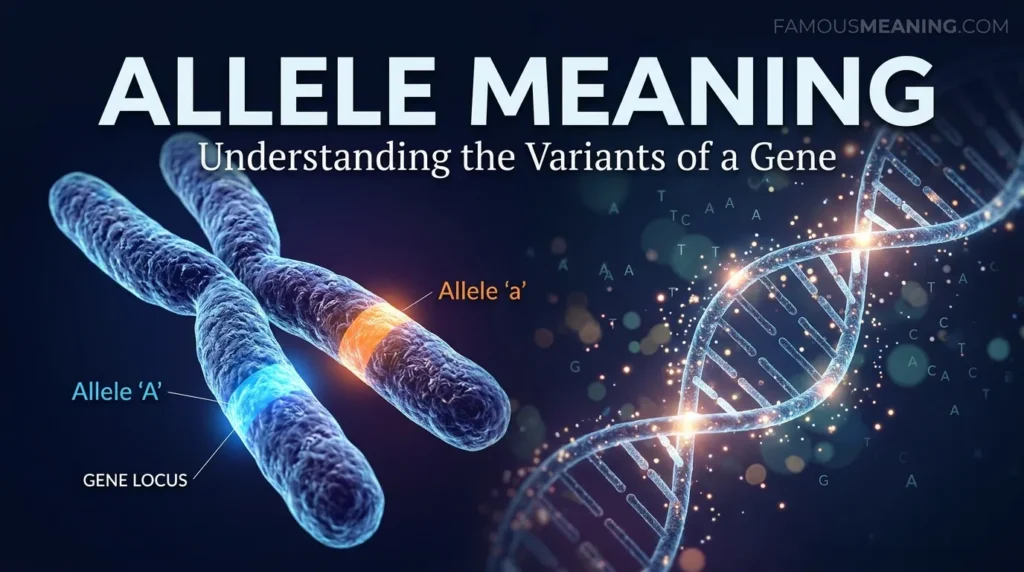
An allele is an alternative form of a gene. Genes are sections of DNA that contain instructions for biological functions and inherited characteristics. Different versions of the same gene are called alleles.
For example, a gene involved in determining a particular characteristic may have several possible versions. These versions can produce differences in how that characteristic appears.
In humans, chromosomes usually occur in pairs. For most genes on non-sex chromosomes, a person inherits one copy of a gene from each biological parent. The two inherited copies may have the same or different alleles.
Quick Definition
Allele: An alternative version of a gene.
Gene: A section of DNA that carries biological instructions.
Chromosome: A DNA-containing structure that carries genes.
Genotype: The genetic combination of alleles an individual has.
Phenotype: An observable characteristic influenced by genes and the environment.
What Does Allele Mean in Simple Words?
Think of a gene as a set of instructions and alleles as different versions of those instructions.
For example, imagine a gene with two versions represented by A and a. These letters are commonly used in basic genetics examples to represent different alleles.
A person might inherit:
AA: Two copies of one allele.
Aa: Two different alleles.
aa: Two copies of another allele.
These combinations are called genotypes.
What Is the Difference Between a Gene and an Allele?
A gene is a section of DNA, while an allele is a specific version of that gene.
For example, a gene may be involved in determining a particular trait, while its different alleles may contribute to variations in that trait.
The two terms are related, but they do not mean the same thing.
Gene | Allele |
|---|---|
A section of DNA | A version of a gene |
Carries biological instructions | Represents genetic variation |
Can have multiple alleles | Is one specific version |
Example: A gene involved in blood type | Example: A, B, or O allele |
What Does an Allele Usually Do?
Alleles influence how genes function and how inherited characteristics develop.
Depending on the gene, different alleles may:
Affect the production of a particular protein.
Influence physical characteristics.
Contribute to differences in blood type.
Affect how the body processes certain substances.
Increase or decrease the risk of particular inherited conditions.
Not every trait is controlled by a single gene. Many characteristics are influenced by several genes and environmental factors.
What Does Allele Mean in Genetics?
In genetics, alleles are important because they explain how genetic information passes from parents to children.
Most human body cells have two copies of each autosomal chromosome. As a result, people usually have two alleles for a gene located on an autosome, one inherited from each biological parent.
These alleles may be identical or different.
For example, consider a simplified genetic model in which:
A represents a dominant allele.
a represents a recessive allele.
The possible combinations are:
Genotype | Meaning |
|---|---|
AA | Homozygous dominant |
Aa | Heterozygous |
aa | Homozygous recessive |
This simple model helps students understand how inherited traits can be passed from one generation to another.
What Is a Dominant Allele?
A dominant allele is a version of a gene that can influence an observable trait when only one copy is present in a typical complete-dominance inheritance pattern.
For example, in a simplified plant-height experiment, T may represent an allele associated with tall plants, while t represents an allele associated with short plants.
Both TT and Tt plants would be tall in this simplified model.
What Is a Recessive Allele?
A recessive allele is a version of a gene whose associated trait is generally expressed only when two recessive copies are present in a simple complete-dominance model.
For example:
TT = Tall plant
Tt = Tall plant
tt = Short plant
The recessive characteristic appears in the tt combination because there is no dominant T allele.
What Is a Codominant Allele?
Codominance occurs when two different alleles are both fully expressed in an individual.
A common example is the human ABO blood group system.
A person who inherits an A allele and a B allele has blood type AB. Both alleles contribute to the blood type.
What Is an Incomplete Dominant Allele?
Incomplete dominance occurs when neither allele completely dominates the other. The heterozygous individual displays an intermediate characteristic.
For example, in certain snapdragon flowers:
Red flowers have two red-associated alleles.
White flowers have two white-associated alleles.
Pink flowers have one of each allele.
This produces an intermediate flower color.
What Does Allele Mean on Different Platforms?
Unlike internet abbreviations or texting slang, allele is a scientific biology term. Its basic meaning does not change between social media platforms or online communities.
However, you may encounter the word in different online settings.
Allele in Text Messages
If someone uses allele in a text message, they are most likely discussing biology, genetics, inherited characteristics, or a science assignment.
Example:
Person A: Do you understand what an allele is?
Person B: Yes, it’s a different version of a gene.
Allele on Snapchat
On Snapchat, allele is not a recognized platform-specific abbreviation. Someone might use it while sharing a biology lesson, homework question, or genetics-related content.
Allele on Instagram
On Instagram, the term may appear in educational posts, science reels, biology infographics, and genetics discussions.
Allele on TikTok
TikTok creators may explain alleles through short educational videos about DNA, inherited traits, dominant genes, and recessive genes.
Allele on Discord
On Discord, you may find the word in biology study groups, science communities, educational servers, or discussions about genetics.
Allele on Reddit
Reddit users may use allele when discussing genetic inheritance, DNA variations, blood groups, inherited conditions, and scientific research.
Allele on Dating Apps
Allele is not a common dating abbreviation or flirting expression. If you see it on a dating profile, it is probably being used in a scientific or educational context.
Origin and History of Allele
The word allele comes from the Greek word allelon, meaning “of one another” or “each other.”
The scientific term is connected to the idea that different forms of a gene occupy corresponding positions on paired chromosomes.
The history of the concept goes back to the work of Gregor Mendel, an Austrian scientist widely recognized for his experiments with pea plants.
How Did the Term Develop?
1860s: Gregor Mendel studied how characteristics were inherited through generations of pea plants.
1900: Mendel’s work became widely recognized after scientists independently rediscovered his findings.
Early 1900s: Geneticists developed terminology to describe inherited factors and variations.
Modern genetics: Scientists now use allele to describe different DNA sequences at a particular genomic location.
The term’s precise early usage and development are part of the history of genetics. It should not be confused with the discovery of DNA itself.
How People Actually Use Allele
The word allele is mainly used in scientific, educational, and medical discussions.
Most people encounter it while studying biology or reading about inherited characteristics.
Here are some common situations where you may see it.
When to Use the Word Allele
Use allele when discussing:
Different versions of a particular gene.
Genetic inheritance from parents.
Dominant and recessive characteristics.
DNA variation.
Blood group inheritance.
Genetic conditions and mutations.
Biology homework and scientific research.
When Not to Use Allele
Avoid using allele when you actually mean:
Gene: The DNA section that carries biological instructions.
Chromosome: The structure containing DNA and many genes.
DNA: The molecule that stores genetic information.
Trait: An observable or measurable characteristic.
Genotype: The combination of alleles an individual carries.
These words are related, but they have different scientific meanings.
Real Examples of Allele in Sentences
Here are 12 simple examples showing how the word allele is used in everyday educational and scientific conversations.
Example 1: Biology Homework
Person A: What is an allele?
Person B: It’s an alternative form of a gene.
Meaning: Person B is explaining the basic scientific definition.
Example 2: Genetics Class
Person A: How many alleles do humans usually inherit for an autosomal gene?
Person B: Two, one from each parent.
Meaning: The conversation is about genetic inheritance.
Example 3: Dominant Traits
Person A: What does a dominant allele mean?
Person B: It can influence a trait even when only one copy is present.
Meaning: They are discussing dominant inheritance.
Example 4: Recessive Traits
Person A: When does a recessive trait appear?
Person B: In a simple recessive model, when both alleles are recessive.
Meaning: The discussion explains recessive inheritance.
Example 5: Science Examination
Person A: I keep confusing genes and alleles.
Person B: Remember, a gene can have different versions called alleles.
Meaning: Person B is clarifying two genetics terms.
Example 6: Blood Groups
Person A: Why do some people have AB blood?
Person B: They inherit an A allele and a B allele.
Meaning: The conversation explains codominance.
Example 7: Family Inheritance
Person A: Can children inherit different alleles from their parents?
Person B: Yes, depending on which alleles each parent passes on.
Meaning: They are discussing how genetic variation is inherited.
Example 8: Study Group
Person A: What does Aa represent?
Person B: Two different alleles of the same gene.
Meaning: Aa represents a heterozygous genotype in a simple genetics model.
Example 9: Genetic Research
Person A: What causes genetic variation?
Person B: Differences in DNA sequences, including different alleles.
Meaning: They are discussing differences in genetic information.
Example 10: Biology Revision
Person A: Is an allele the same as a chromosome?
Person B: No, an allele is a version of a gene, while a chromosome carries many genes.
Meaning: The conversation explains the difference between two biological terms.
Example 11: Plant Experiment
Person A: Why are some flowers pink instead of red or white?
Person B: It can happen because of incomplete dominance between alleles.
Meaning: They are discussing how two alleles can produce an intermediate trait.
Example 12: Science Discussion
Person A: Can one gene have more than two alleles?
Person B: Yes, some genes have multiple possible alleles in a population.
Meaning: They are discussing multiple alleles.
Common Mistakes and Misunderstandings About Allele
Although allele is a simple genetics term, students often confuse it with other biological concepts.
1. Thinking an Allele and a Gene Are the Same
A gene is a section of DNA, while an allele is one version of that gene.
2. Thinking Every Person Has Only Two Possible Alleles
An individual usually carries two alleles for an autosomal gene, but a gene can have many different alleles across a population.
3. Thinking Dominant Means Better
Dominant does not mean stronger, healthier, or more beneficial. It describes how an allele influences a particular phenotype.
4. Thinking Recessive Means Rare
A recessive allele is not necessarily uncommon. Recessive describes its inheritance relationship, not how frequently it occurs.
5. Thinking Every Trait Has Only Two Alleles
Some genes have multiple alleles, and many human characteristics involve several genes working together.
6. Confusing Genotype With Phenotype
Genotype refers to the genetic combination an individual carries. Phenotype refers to an observable or measurable characteristic influenced by genetic and environmental factors.
Understanding these differences makes genetics much easier to study.
Similar Scientific Terms and Related Genetics Abbreviations
Understanding related genetics terms can make the meaning of allele much easier to remember.
Term | Meaning | Difference |
|---|---|---|
Gene | A section of DNA | An allele is a version of a gene |
DNA | Genetic material | Contains instructions for living organisms |
Chromosome | DNA-containing structure | Carries many genes |
Genotype | Genetic makeup | Describes allele combinations |
Phenotype | Observable characteristic | Results from genes and environmental factors |
Homozygous | Two identical alleles | Example: AA or aa |
Heterozygous | Two different alleles | Example: Aa |
Dominant | An allele expressed in a particular inheritance pattern | Can influence a trait with one copy |
Recessive | An allele whose effect may be masked | Often requires two copies for expression |
Mutation | A change in DNA sequence | Can create a new allele |
Locus | A specific position on a chromosome | Identifies where a gene or sequence is located |
Codominance | Both alleles are expressed | Example: AB blood type |
These terms are useful internal linking opportunities for biology and genetics articles. Separate articles about genotype meaning, phenotype meaning, dominant genes, recessive genes, and DNA meaning can help readers explore the subject further.
Is Allele Positive, Negative, or Neutral?
The word allele is scientifically neutral. It does not automatically describe something good or bad.
An allele simply refers to a particular version of a DNA sequence at a specific genomic location.
Its effect depends on the gene, the specific allele, and the biological characteristic being studied.
When Can an Allele Be Beneficial?
Some alleles may provide an advantage in a particular environment.
For example, certain genetic variants can help individuals resist particular infectious diseases.
When Can an Allele Be Harmful?
Some alleles can increase the risk of inherited conditions or affect normal protein function.
For example, certain variants in the HBB gene are associated with sickle cell disease.
Can an Allele Have No Harmful Effect?
Yes. Many genetic variations are harmless and contribute to normal differences between individuals.
An allele’s effect must be understood through its biological function and inheritance pattern rather than simply labeling it good or bad.
Should You Use the Word Allele?
Whether you should use the word allele depends on the subject you are discussing.
Use It If:
You are studying biology or genetics.
You are explaining inherited characteristics.
You are discussing dominant and recessive inheritance.
You are writing about DNA variations.
You are explaining blood group inheritance.
Avoid It If:
You are looking for a casual texting abbreviation.
You actually mean gene or chromosome.
You are discussing an unrelated social media expression.
You are unsure whether the scientific context supports its use.
Remember that allele is a technical scientific word, not a popular Gen Z slang expression.