
What Does “Amalgam” Mean?
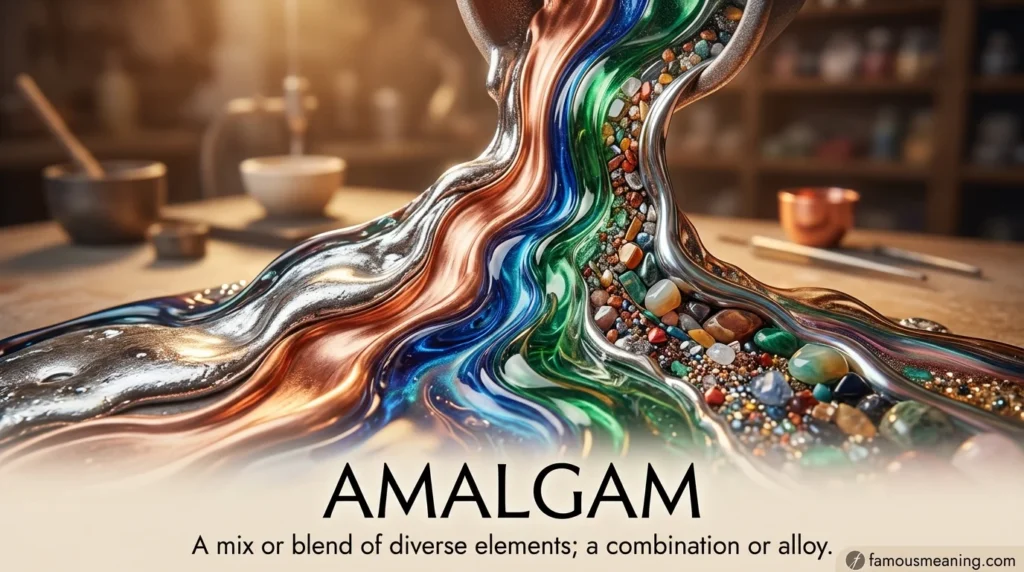
At its core, amalgam refers to a combination or mixture of different elements that have been brought together into a single whole.
The word can describe both physical mixtures and abstract combinations, making it versatile across many subjects.
Quick Definition
Amalgam (noun): A mixture, blend, or union of different things that together create something new or unified.
Simple Meaning
In simple English, amalgam means:
- A blend of different parts
- A combination of ideas
- A mixture of cultures
- A union of styles
- Different things joined together
Think of it as another way of saying “blend” or “combination,” often with a more formal tone.
Literal Meaning
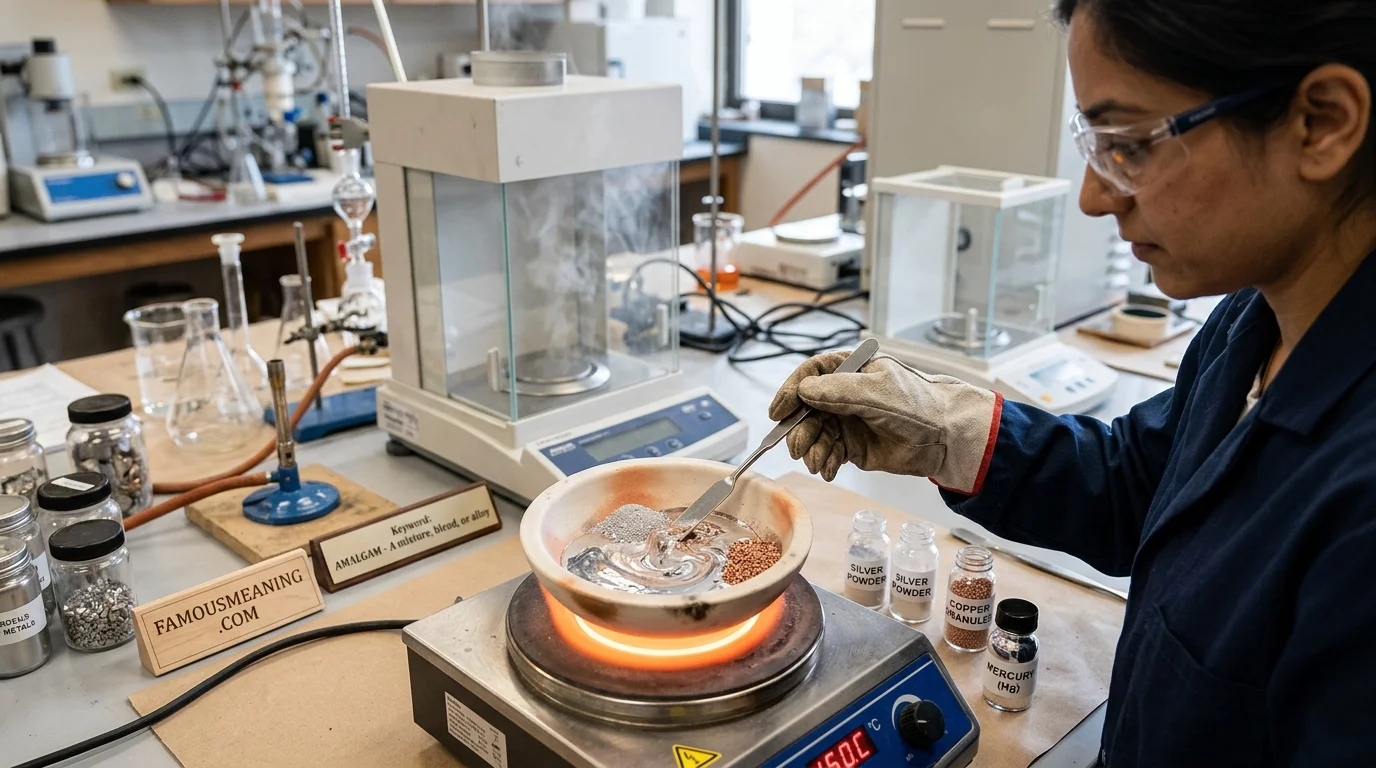
Originally, an amalgam referred to a metal alloy made by combining mercury with another metal, such as silver, gold, or tin.
For example:
- Dental fillings were traditionally made using a silver amalgam.
- Gold extraction once relied on mercury amalgams.
This scientific meaning is still used in chemistry, dentistry, and metallurgy.
Figurative Meaning
Today, the figurative meaning is much more common.
People use amalgam to describe:
- A mix of cultures
- A blend of traditions
- A combination of personalities
- Different artistic influences
- A mixture of business strategies
- A fusion of technologies
Examples
- The city’s culture is an amalgam of traditions from around the world.
- Her writing is an amalgam of history, fiction, and personal experience.
- The company created an amalgam of old and modern marketing techniques.
Pronunciation of Amalgam
Pronunciation:
uh-MAL-guhm
Phonetic spelling:
/əˈmælɡəm/
Pronunciation Tip
The stress falls on the second syllable:
uh-MAL-guhm
Not:
❌ AM-al-gam
Correct:
✅ uh-MAL-guhm
What Part of Speech Is “Amalgam”?
Amalgam is a noun.
It refers to the mixture or combination itself.
Examples:
- The museum displays an amalgam of ancient artifacts.
- His personality is an amalgam of confidence and humility.
Origin and History of “Amalgam”
The word amalgam has a fascinating history dating back several centuries.
It entered English through Medieval Latin and eventually traces back to Greek and Arabic influences related to metallurgy and chemistry.
Originally, it specifically described a mixture of mercury with another metal.
As the English language evolved, writers began using amalgam metaphorically to describe combinations beyond chemistry.
Today, it is widely used to describe:
- Diverse cultures
- Mixed traditions
- Combined ideas
- Creative works
- Business mergers
- Social influences
Although its scientific meaning remains important, the figurative use has become far more common in modern English.
Different Meanings of Amalgam in Various Contexts
One reason people search for the amalgam meaning is that its interpretation depends on the context.
Let’s explore the most common uses.
1. Amalgam in Everyday English
In everyday language, amalgam simply means a mixture.
Example:
“The neighborhood is an amalgam of old homes and modern apartments.”
Meaning:
The area combines traditional and contemporary buildings.
2. Amalgam in Literature
Authors frequently use amalgam to describe characters, themes, or storytelling styles.
Example:
“The novel is an amalgam of mystery and romance.”
Meaning:
The story blends two genres together.
3. Amalgam in Business
Businesses often combine ideas, technologies, or departments.
Example:
“The new company is an amalgam of two successful startups.”
Meaning:
Two organizations merged into one.
4. Amalgam in Culture
Cultural discussions often use the word.
Example:
“American cuisine is an amalgam of many global traditions.”
Meaning:
It developed from numerous cultural influences.
5. Amalgam in Science
Scientists still use the original technical definition.
Example:
“Mercury forms an amalgam with silver.”
Meaning:
The metals combine to create an alloy.
6. Amalgam in Dentistry
One of the most recognized scientific uses is dental amalgam.
Dental amalgam has traditionally been used to fill cavities because it is durable and long-lasting.
Although tooth-colored materials have become more popular, dental amalgam is still used in certain situations.
Common Uses of Amalgam
The word appears in many professional and everyday settings.
Education
Teachers describe subjects as:
“An amalgam of science and mathematics.”
Politics
Political systems may be:
“An amalgam of different governing philosophies.”
Music
A musician may create:
“An amalgam of jazz, hip-hop, and classical music.”
Food
Chefs often prepare:
“An amalgam of Asian and Mediterranean flavors.”
Fashion
Designers create:
“An amalgam of vintage and contemporary styles.”
Technology
Modern apps are often:
“An amalgam of artificial intelligence, cloud computing, and mobile technology.”
How People Actually Use “Amalgam”
Although amalgam is considered a formal word, it’s commonly used in articles, books, presentations, and professional conversations.
You’ll often see it when people want to emphasize that different elements have blended together into something meaningful.
Most people use amalgam when describing:
- Diverse communities
- Mixed cultural identities
- Creative projects
- Academic research
- Business partnerships
- Historical developments
- Artistic expression
- Technology innovations
For example:
- “The city’s architecture is an amalgam of colonial and modern influences.”
- “Her leadership style is an amalgam of empathy and discipline.”
- “The documentary presents an amalgam of interviews, historical footage, and expert analysis.”
In each case, the word highlights how separate components combine to create something richer than any single part alone.
Real Examples of “Amalgam” in Sentences
Here are practical examples that show how amalgam is used in everyday English.
Example 1
Sentence:
“The restaurant serves an amalgam of Mexican and Korean cuisine.”
Meaning:
The menu blends dishes and flavors from both cultures.
Example 2
Sentence:
“His leadership style is an amalgam of confidence and humility.”
Meaning:
His personality combines both qualities.
Example 3
Sentence:
“The city’s culture is an amalgam of traditions brought by immigrants.”
Meaning:
Many cultural influences have blended together.
Example 4
Sentence:
“The movie is an amalgam of comedy, drama, and suspense.”
Meaning:
It combines several genres into one story.
Example 5
Sentence:
“The research paper is an amalgam of previous studies and new discoveries.”
Meaning:
It brings together existing knowledge with original findings.
Example 6
Sentence:
“The museum showcases an amalgam of ancient and modern art.”
Meaning:
The collection includes works from different time periods.
Example 7
Sentence:
“The startup created an amalgam of innovative software and traditional customer service.”
Meaning:
It combines modern technology with conventional support.
Example 8
Sentence:
“The festival is an amalgam of music, food, and cultural performances.”
Meaning:
It features a rich mix of different attractions.
Example 9
Sentence:
“Her writing is an amalgam of personal memories and historical facts.”
Meaning:
She blends autobiography with history.
Example 10
Sentence:
“The curriculum is an amalgam of practical training and academic theory.”
Meaning:
Students learn through both hands-on experience and classroom instruction.
Why “Amalgam” Is a Useful Word
Expanding your vocabulary with words like amalgam allows you to express ideas more precisely than simply saying “mixture” or “combination.”
For instance:
- Instead of saying, “The city has many cultures,” you can say, “The city is an amalgam of cultures.”
- Instead of saying, “The product combines several technologies,” you can write, “The product is an amalgam of advanced technologies.”
Because it conveys the idea of different elements forming a unified whole, amalgam is especially effective in academic writing, journalism, business communication, and creative storytelling.
Common Mistakes and Misunderstandings About “Amalgam”
Although amalgam is a straightforward word once you know its meaning, it’s often confused with similar terms or used incorrectly. Here are some common mistakes to avoid.
Mistake 1: Thinking Amalgam Only Refers to Metals
Because the word originally described a mercury-based alloy, some people assume it can only be used in scientific contexts.
Incorrect:
- “Amalgam only refers to dental fillings.”
Correct:
- “The novel is an amalgam of history and fantasy.”
- “The city is an amalgam of many cultures.”
Today, the figurative meaning is far more common in everyday English.
Mistake 2: Using It as a Verb
Amalgam is a noun, not a verb.
Incorrect:
- “They amalgam the two companies.”
Correct:
- “They amalgamated the two companies.”
- “The new business is an amalgam of two successful firms.”
Mistake 3: Assuming It Means a Random Mixture
An amalgam usually suggests that different parts come together to create a meaningful or unified whole, not simply a random collection.
For example:
- A successful recipe can be an amalgam of flavors.
- A diverse city can be an amalgam of cultures.
The emphasis is on integration rather than disorder.
Mistake 4: Confusing It with “Fusion”
Although the words are similar, they aren’t always interchangeable.
- Amalgam emphasizes a blend of different elements.
- Fusion often highlights the process of joining or combining, especially in science, technology, or cuisine.
Amalgam vs. Similar Words
Many English learners wonder how amalgam differs from related words. Here’s a simple comparison.
| Word | Meaning | Best Used For |
|---|---|---|
| Amalgam | A unified blend of different elements | Formal writing, culture, ideas, business |
| Mixture | Two or more things combined | Everyday language |
| Blend | A smooth combination | Food, colors, styles, personalities |
| Combination | Things joined together | General use |
| Fusion | Joining separate elements into one | Science, food, technology, music |
| Composite | Something made from multiple parts | Engineering, art, design |
| Hybrid | A mix of two different types | Biology, vehicles, technology |
Which Word Should You Choose?
Use amalgam when you want to emphasize that different parts have come together to form a single, meaningful whole—especially in formal or descriptive writing.
Synonyms of Amalgam
If you want to avoid repeating the same word, these synonyms can help. Keep in mind that each has slightly different shades of meaning.
| Synonym | Meaning |
|---|---|
| Blend | A smooth mixture |
| Mixture | Things combined together |
| Combination | Two or more things joined |
| Fusion | A joining of separate elements |
| Union | The act of coming together |
| Composite | Something made from different parts |
| Integration | Combining into a unified whole |
| Merger | A joining of organizations or businesses |
| Mosaic | A collection of diverse elements |
| Patchwork | A combination of varied pieces |
Example
Instead of writing:
“The museum is an amalgam of cultures.”
You could also write:
- “The museum is a blend of cultures.”
- “The museum is a fusion of traditions.”
- “The museum represents a mosaic of cultures.”
Antonyms of Amalgam
Words with the opposite meaning include:
- Separation
- Division
- Isolation
- Segregation
- Split
- Partition
- Disunion
- Fragmentation
- Disconnect
- Individuality (depending on context)
These words describe things remaining separate instead of being combined.
Is “Amalgam” a Positive or Negative Word?
Amalgam is generally a neutral word. Whether it sounds positive or negative depends on the context.
Positive Examples
- An amalgam of creative ideas.
- An amalgam of cultures that enriches society.
- An amalgam of modern and traditional architecture.
Here, the combination is presented as beneficial.
Neutral Examples
- The report is an amalgam of several studies.
- The committee is an amalgam of different departments.
These simply describe a combination without expressing judgment.
Negative Examples
Occasionally, a writer may use amalgam to describe an undesirable mix.
For example:
- “The article became an amalgam of rumors and misinformation.”
In this case, the negative tone comes from the surrounding words, not from amalgam itself.
Should You Use “Amalgam”?
If you’re looking to expand your vocabulary, amalgam is an excellent word to know. It adds precision and sophistication without being overly complicated.
Use It When:
- You’re describing a blend of cultures.
- You’re writing about art, music, or literature.
- You’re discussing business mergers.
- You’re explaining a combination of ideas.
- You’re writing academic or professional content.
Avoid It When:
- You’re speaking to very young children who may not understand it.
- A simpler word like “mix” or “combination” communicates your point just as clearly.
- You’re writing in an extremely informal context where plain language is preferred.
Related Words and Internal Linking Opportunities
If you’re building an English vocabulary website or educational blog, these related topics naturally complement an article about amalgam.
| Related Word | Meaning | Difference |
|---|---|---|
| Synthesis | Combining ideas into a new whole | More academic |
| Integration | Joining separate parts together | Focuses on unity |
| Blend | Smooth mixture | More common in everyday English |
| Fusion | Joining elements | Often used in food, music, or science |
| Composite | Made from several materials | Technical contexts |
| Collaboration | Working together | Refers to people rather than objects |
| Diversity | Variety of different elements | Doesn’t necessarily imply combination |
| Unity | Being joined as one | Focuses on togetherness |
| Merger | Combining organizations | Business-specific |
| Alloy | A mixture of metals | Scientific and industrial use |
These terms make excellent internal linking opportunities for language-learning or dictionary-style websites.
Key Takeaways
Before you go, here are the main points to remember about amalgam:
- Amalgam means a combination or mixture that forms a unified whole.
- The word originally referred to a mercury-based metal alloy.
- Today, it’s most commonly used in a figurative sense.
- It often describes cultures, ideas, organizations, traditions, art, or technologies coming together.
- Amalgam is a noun, while amalgamate is the verb.
- The word is generally neutral and widely used in formal English.