

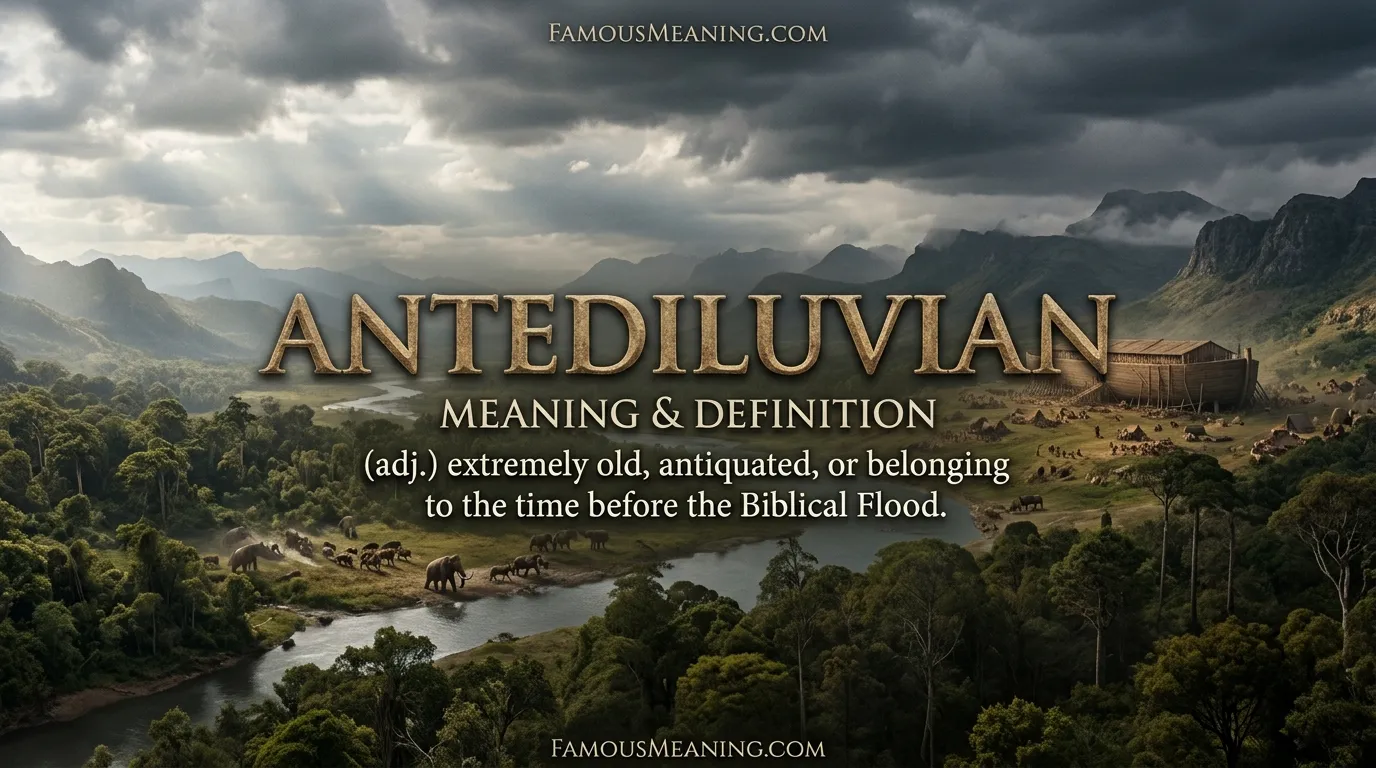
What Does Antediluvian Mean?
The basic meaning of antediluvian is before the Flood.
The word can describe people, events, objects, traditions, technology, or ideas.
Literal Meaning
In its original religious sense, antediluvian refers to the time before the biblical Flood.
For example:
“The story describes the antediluvian world.”
This means the world as it was understood to exist before the Flood of Noah.
Figurative Meaning
In everyday English, antediluvian can mean extremely old-fashioned or outdated.
For example:
“Their office still uses an antediluvian filing system.”
Here, the speaker is not talking about Noah’s Flood. They are saying the filing system is very old and outdated.
Antediluvian Word Origin
The word antediluvian comes from Latin.
It is formed from:
ante = before
diluvium = flood
So, its literal sense is:
“Before the Flood.”
The word entered English through religious and scholarly usage and was originally connected strongly with the biblical story of Noah and the Flood.
Over time, its meaning expanded beyond religion and became a useful adjective for describing anything considered extremely old-fashioned.
Antediluvian Meaning in the Bible
The biblical meaning of antediluvian is connected with the period before Noah’s Flood.
In the Book of Genesis, the Flood is described as a major event during the time of Noah. Therefore, biblical discussions may use the term antediluvian to describe people, events, or conditions associated with the world before that event.
What Is the Antediluvian Period?
The antediluvian period generally means the period between the creation of humanity and the biblical Flood.
The term is especially common in theological, historical, and literary discussions of Genesis.
For example:
“The genealogies describe several generations of the antediluvian world.”
Here, antediluvian means before the Flood.
Antediluvian Meaning in Modern English
Modern English often uses antediluvian figuratively.
When someone calls something antediluvian, they may mean:
Ancient
Extremely old
Old-fashioned
Outdated
Obsolete
Behind the times
For example:
“That antediluvian computer belongs in a museum.”
The speaker is humorously emphasizing that the computer is very old.
Examples of Antediluvian
Example 1: Technology
“The company still has an antediluvian computer system.”
Meaning: The computer system is extremely old-fashioned.
Example 2: Ideas
“His views on education seem antediluvian.”
Meaning: His ideas seem outdated or old-fashioned.
Example 3: Furniture
“They found an antediluvian sofa in the storage room.”
Meaning: The sofa is extremely old.
Example 4: Religious Context
“The story takes place in the antediluvian world.”
Meaning: The story refers to the world before the biblical Flood.
Example 5: Rules
“These antediluvian rules need to be updated.”
Meaning: The rules are very old-fashioned and outdated.
Antediluvian Synonyms
Depending on the context, several words can have a similar meaning.
| Synonym | Meaning |
|---|---|
| Ancient | Extremely old |
| Archaic | Very old-fashioned |
| Antiquated | Outdated or obsolete |
| Obsolete | No longer useful or current |
| Old-fashioned | Belonging to an earlier style |
| Outdated | No longer suitable for modern use |
| Primitive | Less developed or sophisticated |
| Antiquated | Extremely old and no longer practical |
| Prehistoric | Extremely old or from a very early period |
Not every synonym works in the biblical sense. For example, antediluvian specifically carries the idea of being before the Flood.
Antediluvian Antonyms
Words with opposite meanings include:
Modern
Contemporary
Current
New
Up-to-date
Advanced
Modernized
Cutting-edge
For example:
Antediluvian technology → extremely outdated technology
Modern technology → current and advanced technology
Antediluvian vs. Ancient
These words are related but not identical.
Ancient simply means very old.
Antediluvian can specifically mean before the biblical Flood, or figuratively something extremely old-fashioned.
For example:
“Ancient Egyptian civilization”
This refers to a historical civilization.
“Antediluvian traditions”
This can suggest traditions associated with a very ancient or biblical period, or simply traditions considered extremely old-fashioned.
Antediluvian vs. Antiquated
These words are closer in modern usage.
Antiquated means old-fashioned, outdated, or no longer useful.
Antediluvian can also mean old-fashioned, but it has the additional biblical meaning of before the Flood.
For example:
“An antiquated computer”
means an outdated computer.
“An antediluvian computer”
can humorously emphasize that the computer is absurdly old.
How to Pronounce Antediluvian
Antediluvian is commonly pronounced approximately as:
AN-tee-dih-LOO-vee-un
Its pronunciation may vary slightly depending on accent.
Breaking it into parts can make it easier:
an-te-di-lu-vi-an
Is Antediluvian a Positive or Negative Word?
The word itself is generally neutral, but its modern figurative use can have a negative or humorous tone.
Positive or Neutral
In a historical or religious context:
“The study examines antediluvian traditions.”
This is mostly neutral.
Negative
When describing outdated ideas:
“His antediluvian approach to technology is causing problems.”
Here, the word has a negative meaning because the approach is considered outdated.
Humorous
“This antediluvian printer takes ten minutes to print one page.”
Here, the speaker is using the word humorously to emphasize how old the printer is.
Antediluvian in Literature and Writing
Antediluvian is more common in formal, literary, historical, religious, or humorous writing than in everyday conversation.
Instead of saying:
“That system is extremely old.”
A writer might say:
“That system is positively antediluvian.”
This gives the sentence a more sophisticated or dramatic tone.
The word can also make writing sound witty because it compares something modern to a world supposedly existing before the biblical Flood.
Common Phrases With Antediluvian
Some useful combinations include:
Antediluvian World
Refers to the world before the biblical Flood.
Antediluvian Age
Refers to an extremely ancient period, particularly the biblical period before the Flood.
Antediluvian Society
Can refer to society before the Flood or, figuratively, an extremely old-fashioned society.
Antediluvian Ideas
Means ideas that are extremely old-fashioned or outdated.
Antediluvian Technology
Means technology that is extremely old or obsolete.
Common Mistakes About Antediluvian
Mistake 1: Thinking It Always Means “Ancient”
Although antediluvian can mean extremely old, its original meaning is more specific: before the Flood.
Mistake 2: Using It Only for Objects
The word can describe ideas, systems, traditions, beliefs, technology, people, and historical periods.
Mistake 3: Assuming It Always Has a Religious Meaning
In modern English, it is often used figuratively to describe something outdated.
Mistake 4: Confusing It With “Prehistoric”
Prehistoric generally refers to periods before written historical records.
Antediluvian specifically comes from the idea of the period before the Flood.
Related Words
| Word | Meaning |
|---|---|
| Antediluvian | Before the Flood; extremely old-fashioned |
| Diluvian | Related to a flood |
| Ancient | Very old |
| Archaic | Very old-fashioned |
| Antiquated | Outdated |
| Obsolete | No longer useful |
| Contemporary | Belonging to the present |
| Modern | Current or recent |
Is Antediluvian Still Used Today?
Yes. Although it is not one of the most common words in casual conversation, antediluvian is still used in modern English.
You may encounter it in:
Books
Newspapers
Academic writing
Religious discussions
Historical writing
Literary criticism
Humor
Discussions about outdated technology or ideas
Its unusual sound often makes it effective when a writer wants to strongly emphasize that something is extremely old-fashioned.
Should You Use the Word Antediluvian?
You can use antediluvian when you want to describe something as extremely old or outdated, especially in formal or humorous writing.
However, it may not be the best choice for very simple everyday communication.
Instead of:
“This is an antediluvian phone.”
You could simply say:
“This phone is extremely old.”
Use antediluvian when you want your writing to sound more descriptive, literary, or playful.
Positive, Negative, and Neutral Sentiment
| Example | Sentiment | Why |
|---|---|---|
| “The museum displays antediluvian history.” | 🟡 Neutral | Historical description |
| “His antediluvian ideas are frustrating.” | 🔴 Negative | Criticizes outdated ideas |
| “She loves reading about the antediluvian world.” | 🟢 Positive | Expresses interest |
| “That antediluvian computer barely works.” | 🔴 Negative | Criticizes old technology |
| “The book explores antediluvian traditions.” | 🟡 Neutral | Academic/historical context |
Overall, antediluvian has a neutral meaning in historical or biblical contexts but can sound negative or humorous when used to describe something outdated.