
What Does “Boondocking” Mean?
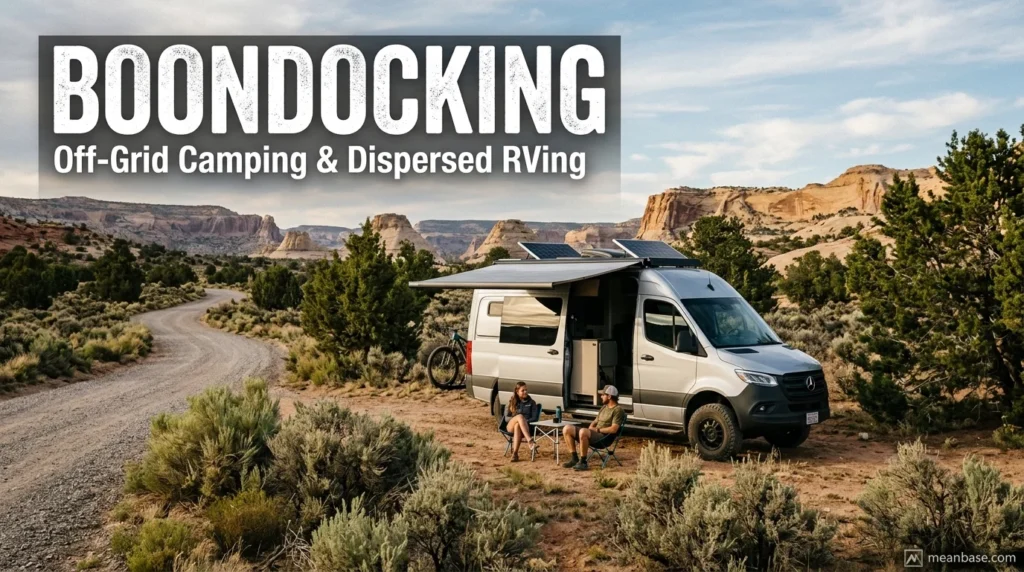
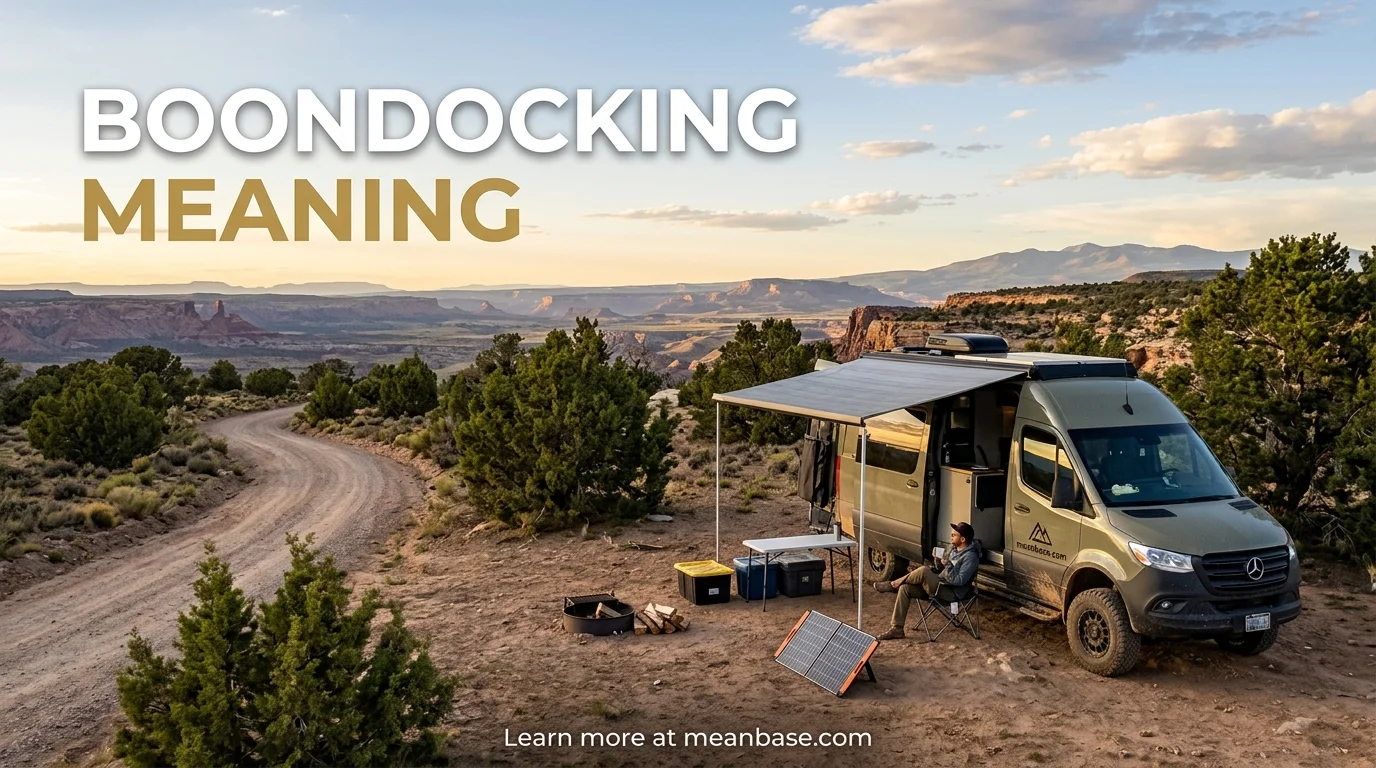
Boondocking means camping without standard RV hookups, usually away from developed campgrounds.
An RV campground may provide:
- Electrical hookups
- Fresh-water hookups
- Sewer connections
- Restrooms
- Showers
- Dump stations
- Wi-Fi
- Other campground facilities
When you are boondocking, you generally cannot depend on these services at your campsite.
Instead, you use the resources and systems available in your RV or vehicle.
For example, your RV might use:
- A freshwater tank
- A gray-water tank
- A black-water tank
- Solar panels
- Batteries
- A generator
- Propane
- Portable water containers
Boondocking in Simple English
In simple terms:
Boondocking = camping off-grid without normal campground hookups.
For example:
“We are boondocking in the desert for three nights.”
This usually means they are staying somewhere without standard electricity, water, and sewer hookups.
Why Is It Called Boondocking?
The word boondocks is an informal term for a remote or rural area.
The word is generally traced to the Philippine-American War, when American soldiers used a Tagalog word referring to mountains or remote areas. Over time, boondocks developed into an English term meaning a remote or isolated place.
Boondocking later became associated with recreational vehicle camping in remote or undeveloped areas.
The exact development of the modern RV usage is difficult to attribute to one individual or precise date, so claims about a single inventor of the term should be treated cautiously.
What Is Boondocking in an RV?
RV boondocking means staying in your recreational vehicle without relying on campground utility hookups.
An RV is designed to carry or store some of the resources you need.
For example, an RV may have a freshwater tank that provides water for:
- Drinking
- Cooking
- Washing dishes
- Showering
- Brushing teeth
Wastewater is stored in holding tanks until you can legally and safely dispose of it at an appropriate facility.
Electricity can come from:
- House batteries
- Solar panels
- A generator
- An inverter
- Other permitted power sources
Because your resources are limited, successful boondocking requires planning.
What Is Dry Camping?
Dry camping generally means camping without electrical, water, or sewer hookups.
The term can be used in several camping situations.
For example, you might dry camp:
- At a campground without hookups
- At a fairground
- At an event
- On private property
- In a remote area
Boondocking is often considered a form of dry camping, particularly when it takes place away from developed campgrounds.
Boondocking vs. Dry Camping
The terms are sometimes used interchangeably, but there can be a practical distinction.
Dry camping focuses primarily on the lack of hookups.
Boondocking often emphasizes camping away from developed campgrounds, frequently in remote or dispersed locations.
Therefore, every use of the terms may not be identical.
Where Can You Go Boondocking?
Where you can legally boondock depends on the country, state, landowner, agency, local regulations, and specific location.
In the United States, some RV travelers boondock on certain public lands where dispersed camping is allowed.
Possible locations can include:
- National forests
- Bureau of Land Management areas
- Certain wildlife-management areas
- Designated dispersed camping areas
- Private property with permission
- Some businesses or parking areas that explicitly permit overnight stays
However, public land does not automatically mean you can camp anywhere you want.
Rules can vary by location. Some areas may restrict:
- Camping duration
- Campfires
- Vehicle access
- Overnight parking
- Where vehicles can be parked
- Waste disposal
- Seasonal access
- Group size
Always check the current rules for the exact location before staying overnight.
Can You Boondock on Public Land?
Sometimes, yes.
Certain public lands permit dispersed camping, while others restrict camping to designated areas.
Before camping, check the responsible land-management agency’s current rules and any posted signs.
Do not assume that because someone posted a video showing boondocking in a particular location, the same activity is still legal there.
Rules can change because of:
- Fire danger
- Seasonal restrictions
- Environmental protection
- Road conditions
- Local management decisions
- Temporary closures
Can You Boondock for Free?
Sometimes, but not always.
One attraction of boondocking is that some legal dispersed camping areas may have no nightly campground fee.
However, boondocking can still involve costs.
You may spend money on:
- Fuel
- Propane
- Food
- Water
- Dump-station fees
- RV maintenance
- Solar equipment
- Batteries
- Generators
- Camping permits
- Parking fees
- Land-use permits
Therefore, boondocking is not necessarily completely free.
It can reduce accommodation expenses, but the total cost depends on how you travel and what equipment you already have.
How Does Boondocking Work?
Boondocking requires you to manage your own basic resources.
Water
Your freshwater tank gives you a limited supply.
Before leaving, you may fill the tank at a legal water source.
During the trip, conserve water by:
- Taking shorter showers
- Turning off the tap while brushing your teeth
- Using water-efficient methods for washing dishes
- Carrying additional approved water containers when appropriate
Never assume that water from an unknown natural source is safe to drink.
Electricity
Without an electrical hookup, you need another power source.
Common options include:
- RV batteries
- Solar panels
- Generators
- Inverters
Your available power determines how long you can operate appliances and electronics.
High-power appliances such as air conditioners, electric heaters, and some cooking appliances can consume substantial energy.
Waste
Your RV may have separate holding tanks for different types of wastewater.
You need to use appropriate dump stations or other legally permitted disposal facilities.
Never dump RV waste onto the ground or into waterways.
Proper waste management is one of the most important responsibilities of boondocking.
Essential Boondocking Equipment
The equipment you need depends on your RV, location, season, and trip length.
Freshwater Supplies
Consider carrying:
- A filled freshwater tank
- Food-grade water containers
- A safe drinking-water system
- A water filter if appropriate for your setup
Power Equipment
Many boondockers use:
- Deep-cycle batteries
- Solar panels
- Solar charge controllers
- Inverters
- Generators where permitted
The right setup depends on how much electricity you use.
Waste Management Equipment
You may need:
- Sewer hose
- Appropriate fittings
- Tank-treatment products
- Disposable gloves
- Access to legal dump facilities
Emergency Supplies
A good boondocking setup should also include:
- First-aid supplies
- Flashlights
- Extra food
- Extra drinking water
- Emergency communication equipment
- Basic tools
- Tire-repair supplies
- Fire extinguisher
Navigation
Remote locations may have limited cellular coverage.
Download maps before leaving and make sure you understand the route.
Depending on the location, an offline GPS system or other navigation method can be useful.
Boondocking Safety Tips
Boondocking can be enjoyable, but remote camping requires additional preparation.
Check the Weather
Weather can change quickly, particularly in mountainous, desert, coastal, and other exposed environments.
Check the forecast before leaving and understand the conditions expected during your stay.
Tell Someone Your Plans
If you are traveling somewhere remote, let someone you trust know:
- Where you are going
- When you expect to arrive
- How long you plan to stay
- When you expect to return
Keep Enough Water
Running out of water in a remote location can quickly become a serious problem.
Carry enough for your planned trip and consider having an emergency reserve.
Watch Your Battery Levels
Monitor your RV’s battery system rather than waiting until your power supply is nearly exhausted.
Be Careful With Fire
Campfire regulations vary by location and can change with fire conditions.
Follow local rules and restrictions. In areas with high fire danger, open fires may be prohibited.
Know Your Exit Route
Before settling into a remote campsite, know how you will leave.
Rain, snow, mud, flooding, fallen trees, or other conditions can make roads difficult or impossible to travel.
Avoid Overstaying
Many public lands have limits on how long you can stay in one location.
Follow the applicable regulations rather than assuming you can remain indefinitely.
Boondocking Etiquette
Responsible boondocking helps protect the places people visit.
A simple principle is:
Leave the area as you found it, or better.
Good boondocking etiquette includes:
- Pack out your trash.
- Dispose of wastewater properly.
- Respect wildlife.
- Keep noise under control.
- Follow campfire rules.
- Stay on permitted roads and camping areas.
- Respect private property.
- Avoid damaging vegetation.
- Follow posted regulations.
- Give other campers reasonable privacy.
Why Leave No Trace Matters
Remote areas may look untouched, but repeated camping can affect vegetation, soil, wildlife, and water resources.
Responsible camping reduces unnecessary environmental impact and helps keep areas available for future visitors.
Boondocking vs. Traditional Campground Camping
Traditional campgrounds and boondocking offer very different experiences.
| Feature | Boondocking | Traditional Campground |
|---|---|---|
| Electricity | Usually unavailable | Often available |
| Water hookup | Usually unavailable | Often available |
| Sewer hookup | Usually unavailable | Sometimes available |
| Privacy | Often greater | Often less |
| Facilities | Limited or none | Usually available |
| Planning | More important | Usually easier |
| Remote locations | Common | Less common |
| Cost | May be free or low-cost | Often has a nightly fee |
| Resource management | Essential | Less demanding |
Neither option is automatically better for everyone.
Boondocking may appeal to people who enjoy independence and remote settings, while traditional campgrounds may be more convenient for travelers who want reliable facilities.
Common Boondocking Mistakes
Mistake 1: Assuming Every Public Area Allows Camping
Public ownership does not automatically mean camping is permitted.
Always verify the rules for the specific property.
Mistake 2: Underestimating Water Use
It is easy to use more water than expected.
Track your consumption and plan accordingly.
Mistake 3: Forgetting About Waste
Your RV’s tanks have limited capacity.
Know your tank sizes and identify legal disposal options before they become necessary.
Mistake 4: Ignoring Cell Service
A remote campsite may have little or no cellular coverage.
Download important information before arriving.
Mistake 5: Arriving Without Checking Road Conditions
A location that looks easy to reach in a map application may have rough roads, low-clearance sections, mud, snow, or other hazards.
Mistake 6: Bringing Too Much Power-Hungry Equipment
Without hookups, every watt matters.
Understand your energy consumption before relying on large appliances.
Mistake 7: Ignoring Local Restrictions
Camping, fires, vehicle access, and length-of-stay rules can change.
Check current regulations before every trip.
How to Start Boondocking
If you are new to boondocking, you do not necessarily need to begin with a remote, week-long trip.
A gradual approach can make the experience easier.
Start With One Night
Try a short overnight trip somewhere relatively accessible.
This allows you to discover how quickly you use water, electricity, and other supplies.
Learn Your RV
Before going off-grid, understand:
- Your freshwater capacity
- Battery capacity
- Propane supply
- Waste-tank capacity
- Generator operation
- Solar system
- Tire equipment
- Emergency systems
Choose an Accessible Location
For your first trip, consider a location where you can leave easily if something goes wrong.
Test Your Equipment
Try using your RV without hookups at home or somewhere convenient before taking a remote trip.
You may discover problems with batteries, water pumps, appliances, or other systems before they become inconvenient in the wilderness.
Is Boondocking Difficult?
Boondocking can be more demanding than staying at a full-service campground because you have to manage your own resources.
However, the difficulty varies.
A one-night stay close to a town may be relatively simple.
A week-long trip in a remote location requires considerably more planning.
The biggest skills involve:
- Managing water
- Managing electricity
- Handling waste
- Navigation
- Weather awareness
- Vehicle preparation
- Understanding local regulations
As you gain experience, you can better estimate how much of each resource you need.