
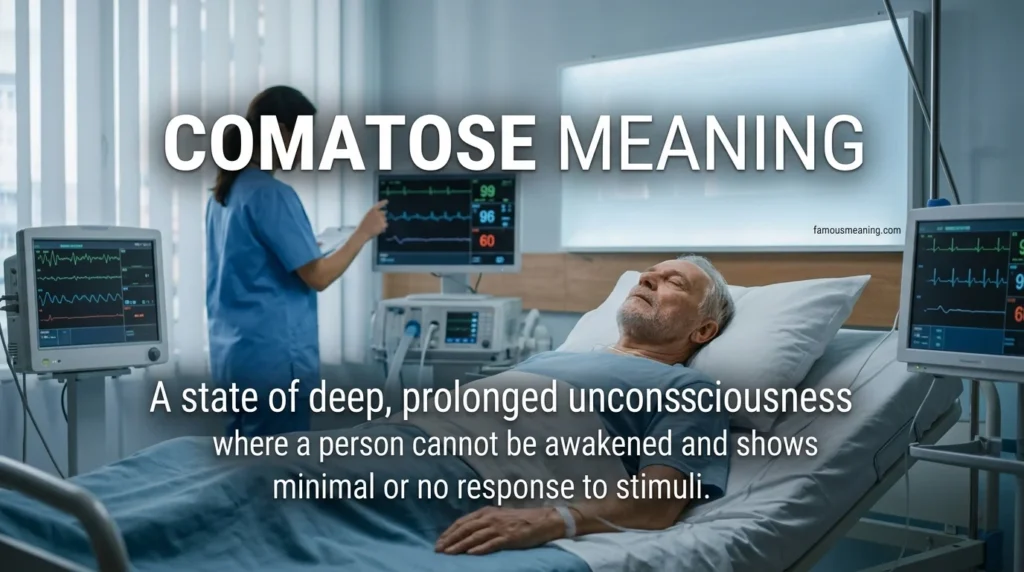

What Does “Comatose” Mean?
The word comatose is an adjective that means being in a coma or resembling the state of a coma.
Its most precise meaning is medical. A person described as comatose is in a state of profound unconsciousness and cannot simply be awakened as someone who is sleeping can.
Quick Definition
Comatose means being in a coma—a state of deep, prolonged unconsciousness where a person cannot be normally awakened or respond appropriately to their environment.
In casual language, however, the word can be used more loosely to describe someone who looks very sleepy, exhausted, or completely inactive.
What Does Comatose Mean in Medical Terms?
In medicine, comatose describes a person who is in a coma.
A coma is a serious state of impaired consciousness. Someone in a coma generally:
- Cannot be awakened normally
- Does not interact with their surroundings in a normal way
- Cannot follow ordinary commands
- Does not show normal conscious awareness
- May have limited or absent purposeful responses
A coma is not the same as ordinary sleep. During normal sleep, a person can generally be awakened and will eventually become alert. A person in a coma cannot simply be woken up by calling their name or shaking them gently.
The underlying cause of a coma can vary considerably, so the term comatose describes the person’s state of consciousness rather than explaining why it happened.
What Does Comatose Mean in Everyday Language?
Outside medical contexts, comatose is sometimes used figuratively.
For example:
“I was practically comatose after working all night.”
Here, the speaker usually does not mean they were literally in a coma. They mean they were extremely tired, sleepy, or barely functioning.
You may also hear it used humorously:
“After Thanksgiving dinner, everyone was comatose on the couch.”
Again, this is figurative. The people are probably just very full and sleepy.
What Tone Does “Comatose” Convey?
The tone depends heavily on context.
- Medical: serious, clinical, factual
- Everyday: descriptive
- Humorous: exaggerated or playful
- Figurative: suggests extreme tiredness or inactivity
- Dramatic: can emphasize how unresponsive someone appears
Because the literal meaning concerns a serious medical condition, it is important to recognize the context before treating the word as a joke.
Comatose Meaning in Different Contexts
Unlike internet abbreviations and texting slang, comatose generally keeps the same core meaning across platforms. What changes is whether it is being used literally or figuratively.
Comatose in Text Messages
In texts, someone may use “comatose” to exaggerate how tired they are.
Example:
“I got two hours of sleep. I’m basically comatose today.”
Meaning:
I’m extremely tired and barely functioning.
This is usually figurative rather than medical.
Comatose on Snapchat
On Snapchat, someone might use the term jokingly in a caption after staying up late, studying, traveling, or partying.
Example:
“Me after staying up until 4 a.m. 😵💫 Basically comatose.”
The meaning is essentially extremely sleepy or exhausted.
Comatose on Instagram
On Instagram, “comatose” may appear in captions, comments, memes, or humorous posts.
For example:
“Sunday afternoon = comatose mode.”
Here, it means someone is very sleepy, inactive, or relaxing heavily.
Comatose on TikTok
TikTok users may use “comatose” as exaggerated internet language to describe being exhausted.
For example:
“POV: You worked a double shift and are now comatose.”
The intended meaning is generally completely exhausted, not literally unconscious.
Comatose on Discord
Gamers and Discord users may use the word casually after a long gaming session.
“Bro has been gaming for 12 hours. He’s comatose.”
In this context, the speaker likely means the person is exhausted or barely responsive.
Comatose on Reddit
On Reddit, the word can appear in both serious and humorous discussions.
In a medical discussion, comatose can have its literal clinical meaning.
In casual discussions, it may be used figuratively:
“After that flight, I was comatose for the entire afternoon.”
The context tells you which meaning is intended.
Comatose on Dating Apps
The word is less common on dating apps, but someone could use it humorously when talking about being tired.
“Coffee first. I’m basically comatose before 9 a.m.”
This means very sleepy or not mentally alert.
Origin and History of “Comatose”
The word comatose is closely connected to the noun coma.
The word coma comes through Latin from Greek kōma, meaning “deep sleep.” The Greek term is associated with a state resembling deep sleep or unconsciousness.
The English adjective comatose developed from this terminology and came to describe someone who is in a coma or has the characteristics associated with coma.
This history explains why the word has a natural connection to sleep, unconsciousness, and lack of responsiveness.
However, being comatose is medically different from simply sleeping. The historical association with deep sleep should not be interpreted as meaning that a coma is ordinary sleep.
How People Actually Use “Comatose”
The safest way to understand comatose is to look at the context.
When “Comatose” Is Used Literally
In medical or serious contexts, it refers to a person who is actually in a coma.
Example:
“The patient remained comatose following the injury.”
Here, “comatose” has its literal medical meaning.
When “Comatose” Is Used Figuratively
In casual conversation, people often use it to exaggerate tiredness.
Example:
“After studying all night, I was completely comatose the next morning.”
This generally means:
I was incredibly tired and barely functioning.
When Not to Use “Comatose”
Avoid using the word casually when discussing a real person’s serious medical condition unless you understand the situation.
For example, saying:
“She’s comatose lol”
about someone who is actually in a coma can come across as insensitive or disrespectful.
If you’re talking about a real medical situation, use the term carefully and avoid treating a serious condition as a joke.
Real Examples of “Comatose” in Conversations
Here are examples showing how the word can work in different situations.
Example 1: Extreme Tiredness
Person A: Did you sleep last night?
Person B: Barely. I’m basically comatose.
Meaning: Person B is extremely tired.
Example 2: After a Long Workday
Person A: Want to go out tonight?
Person B: Nope. I’m comatose after work.
Meaning: Person B is exhausted and wants to rest.
Example 3: Studying
Person A: How was the exam?
Person B: Awful. I studied until 3 a.m. and was practically comatose during it.
Meaning: Person B was extremely tired and mentally drained.
Example 4: Gaming
Person A: You still online?
Person B: Barely. I’ve been gaming for 10 hours. I’m comatose.
Meaning: The speaker is extremely exhausted.
Example 5: Weekend Humor
Person A: What are you doing today?
Person B: Nothing. Couch. Snacks. Comatose mode.
Meaning: Person B plans to relax and do almost nothing.
Example 6: Travel
Person A: How was the flight?
Person B: Long. I got home and immediately went comatose.
Meaning: The speaker went straight to sleep or became extremely exhausted.
Example 7: Medical Context
Person A: How is he doing?
Person B: The doctors said he remains comatose.
Meaning: He remains in a coma.
Example 8: After a Big Meal
Person A: Dessert?
Person B: Absolutely not. I’m comatose after that dinner.
Meaning: The speaker is extremely full and sleepy.
Example 9: Funny Social Media Caption
“Me after five meetings before noon: comatose.”
Meaning: The person feels mentally exhausted.
Example 10: Sleep-Deprived Student
“Three assignments, two exams, and four hours of sleep. I’m officially comatose.”
Meaning: The student is jokingly saying they are completely exhausted.
Example 11: Serious News Context
“The report stated that the patient was comatose following the accident.”
Meaning: The person was in a coma.
Example 12: Casual Conversation
Person A: Why didn’t you answer my calls?
Person B: Sorry! I was comatose after work.
Meaning: Person B was deeply asleep or extremely tired.
Comatose vs. Unconscious: What’s the Difference?
These words are related, but they aren’t interchangeable in every situation.
Unconscious is a broad term for being unaware or not awake.
Comatose specifically describes a prolonged state of profound unconsciousness associated with coma.
Someone can briefly become unconscious and then wake up. A coma is a more sustained and serious disorder of consciousness.
Simple Comparison
| Term | Basic Meaning |
|---|---|
| Comatose | In a coma or resembling a coma |
| Unconscious | Not awake or aware |
| Asleep | In normal sleep |
| Drowsy | Sleepy and likely to fall asleep |
| Sedated | Given medication to reduce awareness or activity |
| Unresponsive | Not responding normally to stimuli |
These terms can overlap in some situations, but they should not automatically be treated as synonyms.
Comatose vs. Asleep: Are They the Same?
No.
This is one of the most important distinctions to understand.
A sleeping person can normally be awakened. They may respond to their name, movement, sound, or other stimulation and eventually become alert.
A person in a coma is not simply sleeping deeply. A coma involves a severe disturbance of consciousness, and the person cannot normally be awakened.
So while someone might casually say:
“I slept so deeply I was comatose.”
that is an exaggeration rather than a literal medical statement.
Common Mistakes and Misunderstandings About “Comatose”
Mistake 1: Thinking Comatose Means “Asleep”
A coma is not ordinary sleep. Although someone in a coma may appear to be sleeping, the underlying neurological state is very different.
Mistake 2: Assuming Comatose Always Means Someone Is Tired
In casual slang, it can mean extremely tired. But its primary medical meaning is much more serious.
Always consider the context.
Mistake 3: Using Comatose and Unconscious as Perfect Synonyms
The terms are related but have different levels of specificity. Comatose refers specifically to being in a coma.
Mistake 4: Assuming a Coma Has One Cause
A coma can result from different serious conditions or injuries. The word itself does not identify the cause.
Mistake 5: Treating the Medical Meaning as a Joke
Using “comatose” to mean tired can be harmless in casual contexts, but joking about someone who is genuinely in a coma may be insensitive.
Similar Words and Related Terms
| Word | Meaning | Difference |
| Unconscious | Not awake or aware | Broader than comatose |
| Coma | State of profound unconsciousness | The noun form |
| Comatose | Being in a coma | Adjective form |
| Unresponsive | Not responding normally | Doesn’t necessarily mean coma |
| Unaware | Not conscious of something | Can occur without unconsciousness |
| Drowsy | Sleepy or lethargic | Much less severe |
| Sleepy | Ready or likely to sleep | Normal state |
| Sedated | Consciousness reduced by medication | May be medically induced |
| Stuporous | Very difficult to awaken or respond | A distinct clinical state |
| Lethargic | Lacking energy or alertness | Usually less severe |
| Passed out | Became unconscious | Informal expression |
Is “Comatose” Positive, Negative, or Neutral?
The answer depends on how it is used.
Medical Meaning: Serious
When describing an actual coma, comatose is serious and clinical.
“The patient is comatose.”
This is not a positive or humorous statement.
Casual Meaning: Usually Neutral or Humorous
When someone says:
“I’m comatose after that workout.”
they’re usually exaggerating for effect.
The tone may be:
- Funny
- Dramatic
- Self-deprecating
- Casual
- Exaggerated
Emotional Context Matters
If you’re talking about a serious accident, illness, or medical emergency, use comatose literally and respectfully.
If you’re talking about being sleepy after a long day, it may be figurative.
Should You Use “Comatose”?
You can use comatose when the context is clear, but choose your wording carefully.
Use It If:
- You’re describing someone who is literally in a coma.
- You’re writing a medical or serious narrative.
- You’re using it clearly as an exaggerated metaphor for extreme tiredness.
- The audience understands the intended figurative meaning.
Avoid It If:
- You might confuse a casual statement with a medical one.
- You’re discussing someone’s real medical emergency in a joking way.
- A simpler word such as sleepy, exhausted, or unconscious communicates the idea more accurately.
If you simply mean someone is tired, exhausted or sleepy may be clearer than comatose.