

What Does Ethnocentrism Mean?
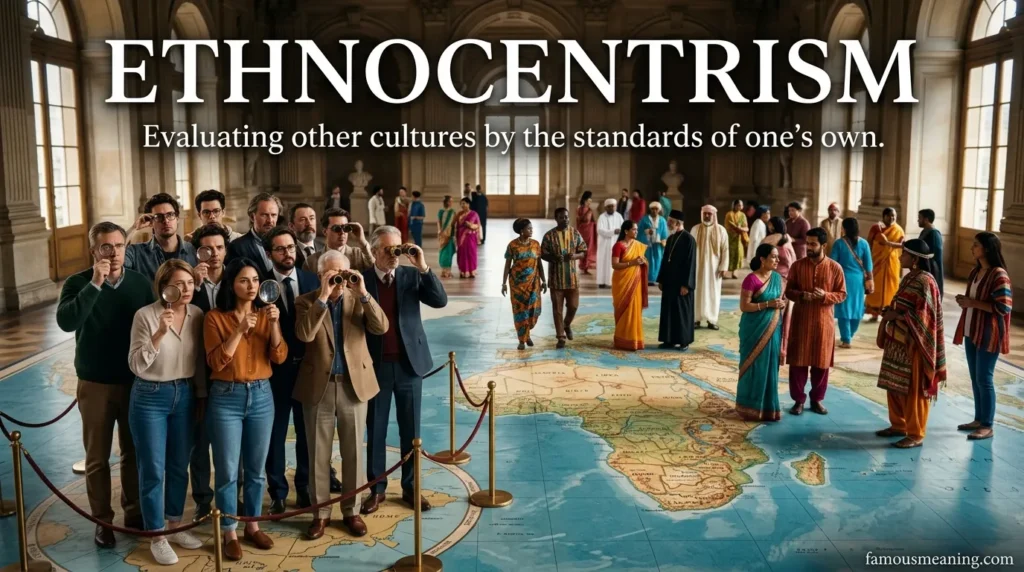
Ethnocentrism refers to the tendency to view your own culture as the standard for evaluating other cultures.
In simple words, it means thinking that the way your culture does things is the right way and that other cultures are strange, incorrect, or inferior.
For example, imagine someone who believes that people from other countries should follow their country’s food habits, clothing styles, and social traditions. This attitude may demonstrate ethnocentrism.
The word does not simply mean loving your culture or being proud of your traditions. It specifically involves judging other cultures through the standards of your own.
Quick Definition
Term | Meaning |
|---|---|
Ethnocentrism | Judging other cultures using your own cultural standards |
Part of speech | Noun |
Related adjective | Ethnocentric |
Field | Sociology and anthropology |
Common effect | Cultural misunderstanding and prejudice |
Origin and History of Ethnocentrism
The word ethnocentrism combines two elements:
Ethno: Related to a people, nation, or cultural group.
Centrism: The belief that something is at the center or most important.
The term is commonly associated with American sociologist William Graham Sumner. He introduced it in his 1906 book Folkways.
Sumner used the concept to describe the tendency of people to view their own group as the center of everything and judge other groups according to their own standards.
Today, ethnocentrism is an important concept in sociology and anthropology because it helps explain how cultural beliefs influence people’s attitudes toward others.
10 Examples of Ethnocentrism in Everyday Life
Ethnocentrism can appear in ordinary conversations, social interactions, workplaces, schools, and international relationships.
Here are ten simple examples.
No. | Example | Explanation |
|---|---|---|
1 | Someone says their country’s food is the only good food. | They judge other cuisines as inferior. |
2 | A person believes their language is better than every other language. | They consider their language superior. |
3 | Someone laughs at another country’s traditional clothing. | They judge another culture by their own standards. |
4 | A traveler considers unfamiliar customs uncivilized. | They fail to respect cultural differences. |
5 | A person believes everyone should celebrate the same festivals. | They expect other cultures to follow their traditions. |
6 | Someone thinks their country’s education system is always the best. | They assume their cultural system is superior. |
7 | A student makes fun of a classmate’s traditional food. | They judge unfamiliar cultural practices negatively. |
8 | A manager assumes employees from their own culture are more professional. | They show cultural bias. |
9 | Someone believes their country’s marriage traditions are the only correct ones. | They reject other cultural practices based on their own beliefs. |
10 | A person describes another society as backward because it has different customs. | They use their own culture as the standard for judgment. |
These examples show that ethnocentrism is not limited to one country, religion, or cultural group. It can occur in any society.
What Are the Main Causes of Ethnocentrism?
Several factors can contribute to ethnocentric attitudes.
1. Family and Upbringing
People often learn cultural values, traditions, and beliefs from their families. If they grow up hearing that their culture is better than others, they may develop ethnocentric attitudes.
2. Lack of Cultural Awareness
People who have limited exposure to other cultures may find unfamiliar traditions confusing or strange. Without learning about those traditions, they may judge them unfairly.
3. Social Conditioning
Schools, communities, media, and social groups can influence how people view their own culture and other cultural groups.
4. National Pride
Feeling proud of your country is not automatically ethnocentrism. However, when national pride turns into the belief that other countries and cultures are inferior, it can become ethnocentric.
5. Fear of Differences
Some people feel uncomfortable when they encounter unfamiliar languages, beliefs, customs, or lifestyles. This discomfort can lead to negative judgments.
6. Stereotypes and Prejudice
Negative assumptions about other cultural groups can encourage people to believe their own culture is better.
What Are the Effects of Ethnocentrism?
Ethnocentrism can influence relationships between individuals, communities, and nations.
1. Cultural Misunderstanding
People may misunderstand traditions or behaviors simply because they are unfamiliar with them.
2. Discrimination
Ethnocentric beliefs can contribute to unfair treatment of people from different cultural backgrounds.
3. Social Division
When groups believe their culture is superior, it can create separation, mistrust, and conflict.
4. Communication Problems
Cultural judgments can make it difficult for people to communicate openly and respectfully.
5. Reduced Cultural Learning
People who believe their culture is the best may be less willing to learn from other societies.
6. International Conflicts
Extreme ethnocentric attitudes can contribute to tensions between countries and cultural communities.
Ethnocentrism vs. Cultural Relativism: What’s the Difference?
Ethnocentrism and cultural relativism are two important concepts in anthropology and sociology. They describe different ways of understanding cultural differences.
Ethnocentrism | Cultural Relativism |
|---|---|
Judges other cultures using your own cultural standards. | Tries to understand cultures within their own context. |
May consider other traditions inferior. | Avoids automatically labeling unfamiliar traditions as inferior. |
Focuses on one’s own culture as the standard. | Focuses on understanding cultural differences. |
Can encourage prejudice. | Encourages cultural understanding. |
Example:
Ethnocentrism: “Their traditional clothing is strange because it is different from ours.”
Cultural relativism: “Their traditional clothing has cultural meaning, so I should understand its importance before judging it.”
Cultural relativism does not mean that every cultural practice must be accepted without criticism. It means understanding a practice in its cultural context before evaluating it.
What Is the Difference Between Ethnocentrism and Cultural Pride?
These two concepts are often confused, but they are not the same.
Cultural Pride
Cultural pride means appreciating your language, traditions, history, food, and identity.
For example:
“I’m proud of my country’s traditions and cultural heritage.”
This is a positive expression of cultural appreciation.
Ethnocentrism
Ethnocentrism occurs when someone believes their culture is superior and uses it to judge other cultures.
For example:
“My country’s traditions are better than everyone else’s, and other cultures should follow them.”
The important difference is that cultural pride appreciates your own culture, while ethnocentrism can involve looking down on other cultures.
How Can We Avoid Ethnocentrism?
Developing cultural awareness can help people avoid unfair judgments.
Here are some practical ways:
Learn about other cultures: Explore different traditions, languages, and lifestyles.
Respect differences: Understand that people may have different ways of living.
Avoid stereotypes: Do not judge an entire cultural group based on limited information.
Listen to others: Give people an opportunity to explain their beliefs and traditions.
Travel and interact: Meeting people from different backgrounds can increase cultural understanding.
Stay open-minded: Remember that unfamiliar does not automatically mean wrong.
Question your assumptions: Think about whether your judgments are based on facts or personal cultural expectations.
Is Ethnocentrism Positive or Negative?
Ethnocentrism generally has a negative meaning, especially when it involves believing that other cultures are inferior.
However, the concept can be discussed academically without necessarily describing a person’s behavior as intentionally harmful.
For example:
Negative: Someone refuses to respect another culture because they believe their own is superior.
Neutral academic use: A sociology student studies ethnocentrism to understand cultural behavior.
It is also important to remember that cultural pride and ethnocentrism are different. Appreciating your own traditions does not automatically mean you look down on others.
Common Misunderstandings About Ethnocentrism
1. Thinking Ethnocentrism Means Loving Your Culture
This is incorrect. Loving and appreciating your culture is cultural pride. Ethnocentrism involves judging other cultures through your own cultural standards.
2. Assuming Only Certain Countries Are Ethnocentric
Ethnocentrism can occur in any country or cultural group. It is not limited to a particular nationality or society.
3. Confusing Ethnocentrism With Racism
The concepts can overlap, but they are not identical. Ethnocentrism involves cultural superiority and cultural judgment, while racism involves prejudice or discrimination based on perceived racial categories.
4. Thinking Cultural Relativism Means Accepting Everything
Cultural relativism encourages understanding cultural practices in context. It does not require people to ignore human rights or ethical concerns.