
What Does “Muggles” Mean?
The word Muggles is the plural form of Muggle.
Quick Definition
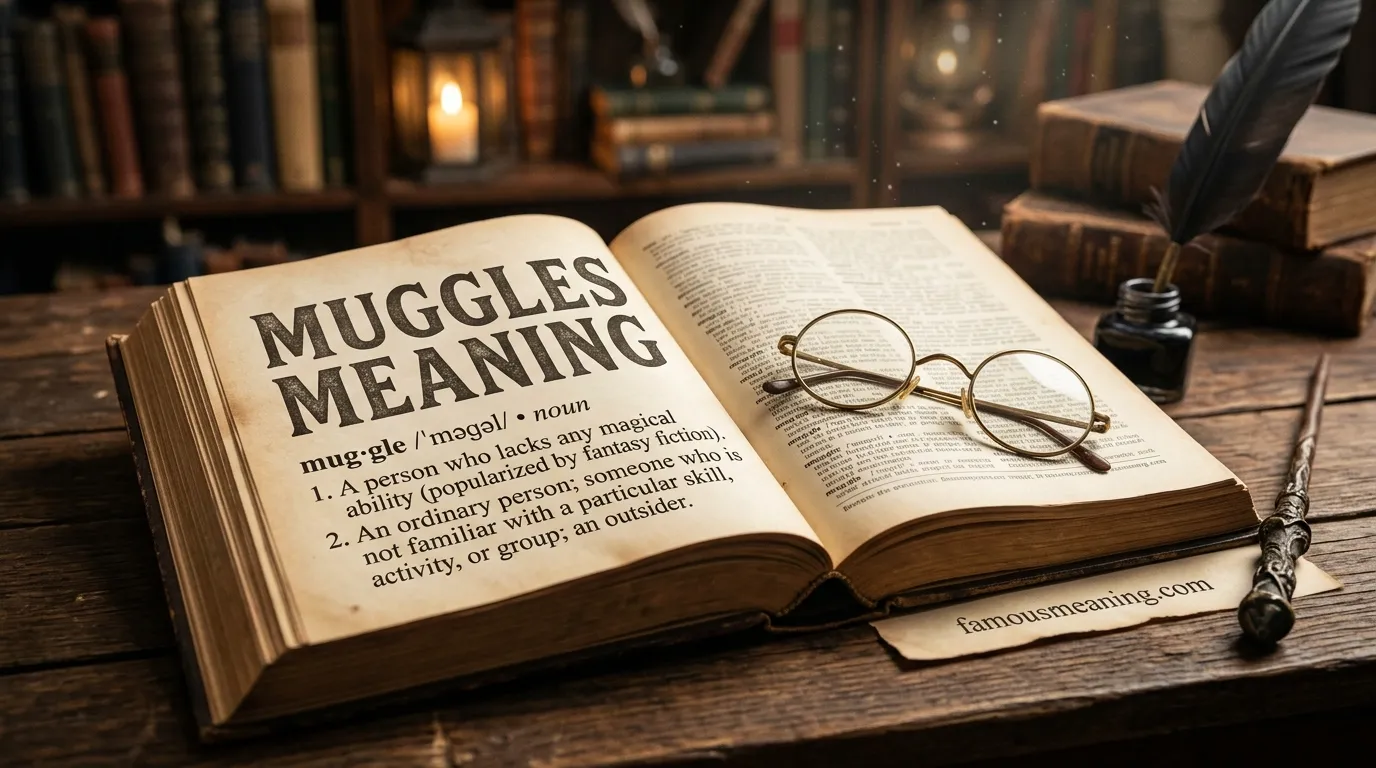
Muggle: A person without magical abilities in the Harry Potter universe. More generally, someone who isn’t familiar with a specific hobby, skill, fandom, or area of expertise.
What Does “Muggle” Mean in Harry Potter?
In the Harry Potter books and films, Muggles are ordinary humans who cannot perform magic and are generally unaware of the hidden magical world.
Examples of Muggles include:
- Harry Potter’s relatives, the Dursleys.
- Most non-magical neighbors.
- Ordinary citizens living outside the wizarding world.
Although Muggles lack magical abilities, they play an important role throughout the series.
Modern Slang Meaning
Outside the Harry Potter universe, Muggle has developed a broader slang meaning.
People often use it jokingly to describe someone who:
- Doesn’t understand a hobby.
- Is new to a subject.
- Isn’t part of a particular community.
- Lacks specialized knowledge.
- Doesn’t follow a fandom.
For example:
- “I’m a total coffee Muggle—I can’t tell the difference between espresso and cappuccino.”
- “Don’t ask me about coding. I’m a complete tech Muggle.”
In these examples, the speaker isn’t saying they lack intelligence. They’re simply admitting they’re inexperienced in that area.
What Tone Does It Convey?
Depending on the situation, Muggle usually sounds:
- Friendly
- Playful
- Self-deprecating
- Humorous
- Lighthearted
It rarely carries a negative meaning unless someone deliberately uses it to mock another person’s lack of knowledge.
What Does “Muggles” Mean on Different Platforms?
Text Messages
In text conversations, Muggle often means someone who isn’t familiar with a topic.
Example:
Friend: Which camera lens should I buy?
You: I’m a photography Muggle—you should ask someone else.
Snapchat
On Snapchat, users sometimes refer to non-fans of a popular trend or hobby as Muggles.
Example:
“Trying to explain anime to my Muggle friends.”
Instagram creators often use the term in captions about hobbies.
Examples include:
- Coffee Muggle
- Fitness Muggle
- Fashion Muggle
- Wine Muggle
- Plant Muggle
The phrase usually means they’re beginners or not experts.
TikTok
TikTok creators frequently use Muggle in humorous videos.
Examples:
- “Only Potterheads will understand this.”
- “Muggles watching this be like…”
It creates an “insider versus outsider” joke without being overly serious.
Discord
Gaming communities sometimes refer to newcomers as Muggles when they don’t understand game mechanics or community jokes.
Example:
“Don’t worry—every veteran player started as a Muggle.”
On Reddit, the word appears in fandom discussions, technology communities, coffee forums, and hobby-based subreddits to describe newcomers or non-experts.
Dating Apps
Although less common, someone may jokingly write:
“I’m a travel Muggle looking for someone who can plan amazing vacations.”
The phrase adds humor while admitting limited experience.
Origin and History of “Muggle”
The word Muggle became famous through the Harry Potter books written by J.K. Rowling.
When the first novel, Harry Potter and the Philosopher’s Stone, was published in 1997, readers were introduced to a magical world hidden alongside ordinary society. In that world, Muggles were people born without magical abilities.
As the Harry Potter franchise grew into one of the world’s most successful book and film series, the word entered popular culture.
Today, many English speakers recognize Muggle even if they have never read the books or watched the movies.
Over time, internet users adopted the term as playful slang to describe anyone unfamiliar with a particular interest, profession, or fandom.
Although there are earlier historical uses of the word “muggle” in unrelated contexts, its modern meaning is overwhelmingly associated with the Harry Potter universe.
How People Actually Use “Muggle”
While Muggle started as a fictional term, it’s now part of everyday language for many people. You’ll often hear it in casual conversations, online communities, and social media posts when someone wants to admit they’re new to a topic or describe a person who isn’t part of a particular group.
In most cases, the word is used with humor rather than criticism.
Common Situations Where People Say “Muggle”
People often use Muggle when talking about:
- Learning a new hobby
- Joining a fandom
- Trying new technology
- Exploring specialty coffee
- Getting into photography
- Playing complex video games
- Learning a new language
- Discovering books or movies
For example:
- “I’m a gardening Muggle. Every plant I buy dies.”
- “He’s a coding Muggle, so keep the explanation simple.”
- “As a wine Muggle, I just choose the bottle with the nicest label.”
Using the term this way helps make conversations more relaxed and approachable.
Real Examples of “Muggle” in Conversations
Example 1
Person A: Which Harry Potter house are you in?
Person B: I’m a Muggle—I haven’t read the books yet.
Meaning: The speaker isn’t familiar with the series.
Example 2
Person A: Which espresso machine should I buy?
Person B: I’m a coffee Muggle.
Meaning: They don’t know much about coffee.
Example 3
Person A: Can you build a gaming PC?
Person B: Nope. Total tech Muggle.
Meaning: They aren’t knowledgeable about computers.
Example 4
Person A: Why are you watching that tutorial?
Person B: Because I’m a photography Muggle.
Meaning: They’re learning photography.
Example 5
Person A: Have you played every Zelda game?
Person B: I’m still a gaming Muggle.
Meaning: They’re new to gaming.
Example 6
Person A: Why don’t you understand the meme?
Person B: I’m just a Marvel Muggle.
Meaning: They aren’t familiar with Marvel movies.
Example 7
Person A: How do you brew pour-over coffee?
Person B: You’re asking the wrong person—I’m a coffee Muggle.
Meaning: They lack experience.
Example 8
Person A: Which camera settings should I use?
Person B: I’m still a photography Muggle.
Meaning: Beginner photographer.
Example 9
Person A: Have you seen all the Star Wars movies?
Person B: Nope. Complete Star Wars Muggle.
Meaning: Not part of the fandom.
Example 10
Person A: Can you explain cryptocurrency?
Person B: I’m a crypto Muggle myself.
Meaning: Limited knowledge.
Example 11
Person A: Which hiking boots should I buy?
Person B: I’m an outdoor Muggle.
Meaning: Inexperienced with hiking.
Example 12
Person A: Can you recommend a telescope?
Person B: Astronomy Muggle here.
Meaning: Beginner.
Example 13
Person A: Which guitar should I learn first?
Person B: Music Muggle—I wish I knew.
Example 14
Person A: Is this expensive wine good?
Person B: I’m a wine Muggle.
Example 15
Person A: Which coding language is easiest?
Person B: I’m still a programming Muggle.
Common Mistakes and Misunderstandings
Although Muggle is widely recognized, it’s sometimes misunderstood.
Mistake 1: Thinking It Only Means “Non-Magical”
In the Harry Potter universe, that’s correct.
In everyday speech, however, Muggle often refers to someone who is unfamiliar with a hobby or area of expertise.
Mistake 2: Using It as an Insult
Most people use Muggle playfully.
Calling yourself a Muggle is common and usually self-deprecating rather than negative.
Mistake 3: Assuming Everyone Understands the Reference
While many people recognize the term because of Harry Potter’s popularity, not everyone is familiar with it. In formal or professional settings, using words like “beginner,” “newcomer,” or “non-expert” may be clearer.
Similar Words and Related Expressions
| Term | Meaning | Difference |
|---|---|---|
| Muggle | Someone without magical abilities or specialized knowledge | Original Harry Potter term |
| Beginner | Someone new to a skill | Neutral and universal |
| Newbie | A newcomer | Informal internet slang |
| Novice | Someone with little experience | More formal |
| Amateur | Non-professional | Focuses on experience level |
| Rookie | Beginner, especially in sports or work | Common in U.S. English |
| Layperson | Someone without expert knowledge | Formal and professional |
| Outsider | Someone not part of a group | Broader meaning |
| Non-expert | Someone without specialized knowledge | Neutral |
| Noob | Inexperienced person | Internet slang that can be teasing |
Is “Muggle” Positive, Negative, or Neutral?
The word Muggle is generally neutral to positive.
Positive
- Used humorously among friends.
- Makes beginners feel included.
- Encourages learning without embarrassment.
Neutral
- Simply describes someone who lacks specialized knowledge.
Negative
In rare situations, someone might use Muggle to mock another person’s lack of expertise. However, this isn’t the most common usage.
Should You Use “Muggle”?
You can use Muggle if:
- You’re talking with Harry Potter fans.
- You’re joking about being new to a hobby.
- Your audience understands the reference.
- You’re speaking casually.
Avoid using it if:
- You’re writing formal or academic content.
- Your audience may not recognize the Harry Potter reference.
- You need a more precise term like “beginner” or “non-expert.”