
What Does Perishable Mean?
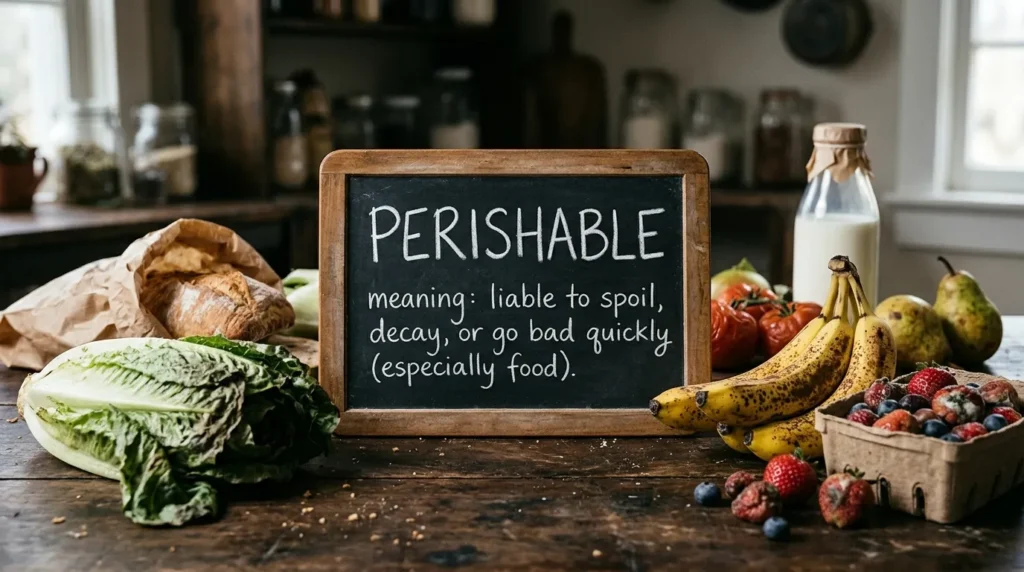
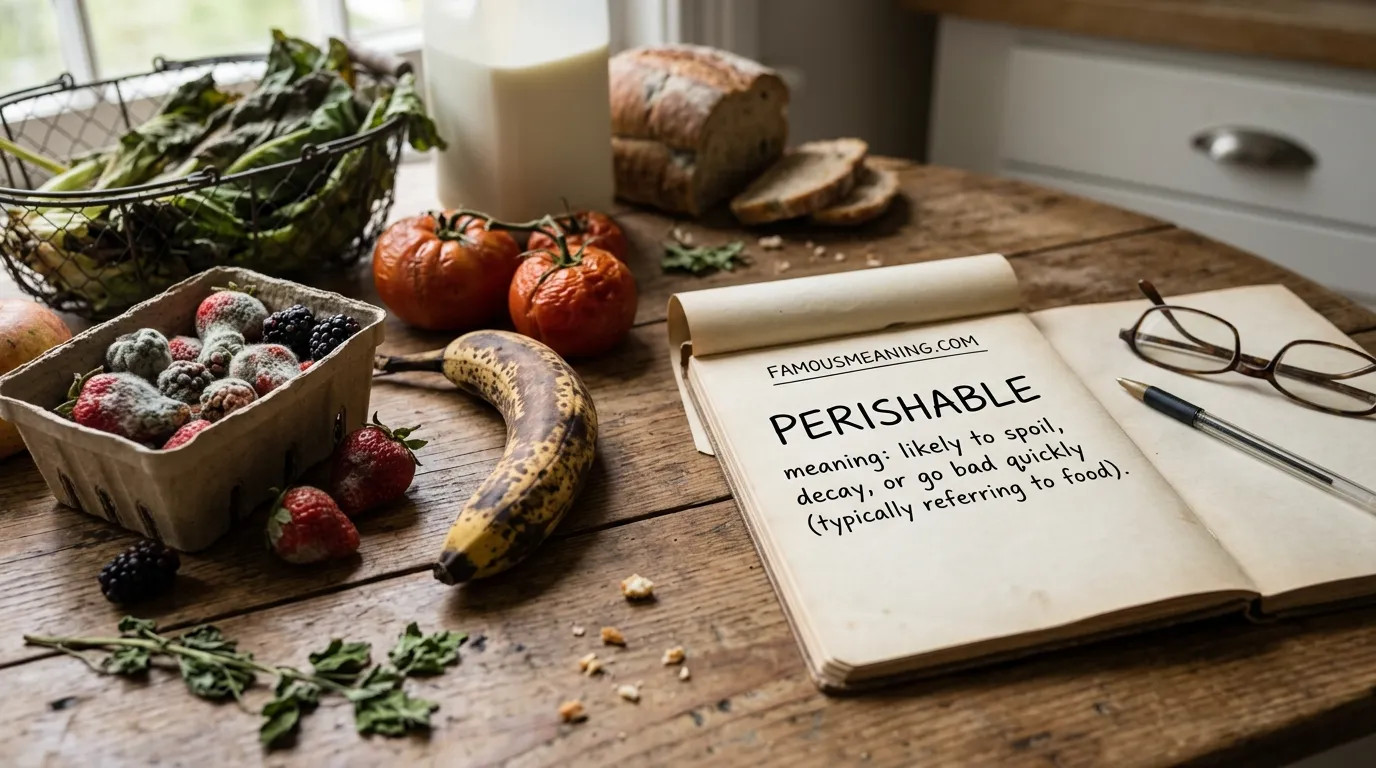
Perishable is an adjective that describes something likely to spoil, decay, deteriorate, or lose its usefulness within a relatively short period.
The word is commonly used for food, but it can also describe flowers, biological samples, certain medicines, and other temperature-sensitive or time-sensitive products.
For example:
Fresh fish is perishable because it can spoil quickly.
Strawberries are perishable because they can develop mold and deteriorate.
Fresh flowers are perishable because they wilt over time.
Some medicines and laboratory samples require specific storage conditions to remain usable.
In simple terms, perishable means something that does not stay fresh or usable indefinitely.
Perishable Meaning in Simple Words
In simple English, perishable means something that can go bad or spoil, especially if it is not used or stored properly.
Imagine buying fresh chicken from a grocery store. If you leave it at room temperature for too long, harmful bacteria may grow, making it unsafe to eat. Chicken is therefore a perishable food.
Similarly, a bouquet of fresh roses may look beautiful when purchased, but it will eventually wilt. The flowers are perishable because their quality declines over time.
The word often reminds people to use, refrigerate, freeze, or handle certain items appropriately.
7 Common Examples of Perishable Items
1. Fresh Fruits
Many fruits, including strawberries, peaches, grapes, and bananas, are perishable. They can soften, develop mold, or deteriorate as they ripen.
Some fruits last longer than others, depending on their variety, ripeness, and storage conditions.
2. Fresh Vegetables
Leafy greens, mushrooms, broccoli, and other fresh vegetables can wilt, lose quality, or spoil over time.
Proper refrigeration and suitable storage can help extend their freshness.
3. Meat and Poultry
Fresh beef, chicken, turkey, and other raw meats are highly perishable. They require careful temperature control because harmful bacteria can multiply when they are stored improperly.
Always follow food-safety guidance for refrigeration, freezing, and cooking.
4. Fish and Seafood
Fresh fish, shrimp, and other seafood are perishable and can deteriorate quickly if they are not kept cold.
Proper handling is especially important for maintaining quality and reducing food-safety risks.
5. Dairy Products
Milk, cream, yogurt, and many soft cheeses require refrigeration. Their shelf life depends on the product, packaging, processing, and storage conditions.
Not every dairy product has the same storage requirements, so check the label.
6. Fresh Flowers
Roses, tulips, lilies, and other cut flowers gradually wilt and lose their freshness. Clean water, suitable temperatures, and proper care can help them last longer.
7. Prepared Meals and Leftovers
Cooked rice, soups, casseroles, and other prepared foods can become unsafe if left at room temperature for too long.
Refrigerate leftovers promptly and follow recommended storage times.
Perishable vs. Nonperishable Meaning
The words perishable and nonperishable describe two different levels of storage stability.
| Feature | Perishable | Nonperishable |
|---|---|---|
| Meaning | Can spoil or deteriorate relatively quickly | Can generally be stored for a long time under suitable conditions |
| Storage | Often requires refrigeration or other special conditions | Often suitable for pantry or shelf storage |
| Examples | Fresh meat, milk, berries | Dried beans, rice, canned vegetables |
| Shelf life | Usually shorter | Often longer |
| Main concern | Spoilage and deterioration | Expiration, quality changes, or damage over time |
A nonperishable item does not last forever. Canned foods, dry goods, and other shelf-stable products can still lose quality or become unsuitable for use.
The important difference is that nonperishable items generally remain usable longer under their recommended storage conditions.
What Does Perishable Mean on Food Labels?
When you see the word perishable on food packaging, it generally means the product can spoil or deteriorate and may require careful handling or refrigeration.
For example, a package might say “Keep refrigerated” or “Perishable: keep cold.” These instructions help consumers store the product safely.
The word itself does not tell you the exact expiration date or how long a product can remain outside the refrigerator. Those details depend on the food and its handling requirements.
Why Perishable Labels Matter
Perishable labels are important because they can help you:
Recognize products that need special storage.
Reduce the risk of food spoilage.
Protect food quality during transportation.
Avoid wasting food by using it at the appropriate time.
Follow the manufacturer’s storage instructions.
Always read the complete label rather than relying on the word perishable alone.
What Does Perishable Mean in Shipping?
In shipping and delivery, perishable describes goods that can spoil, deteriorate, or lose quality during transportation.
Examples include fresh groceries, seafood, flowers, certain medicines, and temperature-sensitive biological materials.
These products may require insulated packaging, refrigeration, frozen transport, or expedited delivery.
For example, a box labeled “Perishable” may contain fresh food that needs to reach its destination quickly and remain within a safe temperature range.
The precise shipping requirements depend on the item. A package label does not automatically guarantee that the contents are being kept at the correct temperature.
How to Store Perishable Foods Safely
Proper storage helps preserve food quality and reduce the risk of foodborne illness.
Refrigerate Promptly
Keep foods that require refrigeration at a safe temperature. In general, refrigerators should be set at 40°F (4°C) or below.
Perishable food should not be left at room temperature for extended periods.
Freeze Foods When Appropriate
Freezing can help preserve many perishable foods for longer periods. However, the quality and storage requirements vary depending on the item.
Use appropriate packaging to protect food from freezer burn and follow reliable freezing and thawing guidance.
Follow Storage Instructions
Check product labels for refrigeration requirements, use-by dates, and handling instructions. Different foods can have different storage needs.
Avoid Cross-Contamination
Keep raw meat and seafood separate from ready-to-eat foods. Use clean utensils, cutting boards, and surfaces when preparing meals.
Check for Signs of Spoilage
Unusual odors, mold, texture changes, or damaged packaging may indicate that a food product has deteriorated. However, harmful bacteria do not always cause visible or noticeable changes, so never rely on appearance or smell alone to determine whether food is safe.
Perishable Meaning in a Sentence
Here are some examples showing how to use perishable correctly.
“Milk is a perishable product, so put it in the refrigerator.”
“The delivery company specializes in transporting perishable foods.”
“We bought fresh strawberries, but they are perishable and should be eaten soon.”
“The restaurant carefully stores perishable ingredients.”
“Fresh flowers are perishable, even when they receive proper care.”
“The package was marked perishable to alert the delivery team.”
“Our emergency food supplies include both perishable and nonperishable items.”
“The laboratory uses special containers to transport perishable biological samples.”
“Because the fish is perishable, it must remain properly chilled.”
“The store donated its excess perishable groceries to a local food bank.”
These sentences show that the word can describe food, flowers, shipping items, and other products that deteriorate over time.
Perishable Synonyms and Antonyms
Understanding synonyms and antonyms can help you use perishable more accurately.
Synonyms of Perishable
Depending on the context, similar words include:
Spoilable: Likely to spoil.
Degradable: Capable of breaking down or deteriorating.
Short-lived: Lasting for a limited period.
Deteriorating: Losing quality or condition.
Frail: Easily damaged or weakened, in certain contexts.
These words are not always interchangeable. For example, short-lived describes limited duration generally, while perishable often refers to goods that spoil or deteriorate.
Antonyms of Perishable
Common opposites include:
Nonperishable: Able to be stored for a comparatively long time.
Shelf-stable: Designed to remain safe and usable without refrigeration until opened, when stored correctly.
Durable: Able to withstand use or last over time.
Long-lasting: Remaining useful or in good condition for an extended period.
The best antonym depends on the sentence. For food-storage contexts, nonperishable is usually the most direct opposite.
Perishable Meaning in Business and Retail
In business, perishable goods are products that can lose value because they spoil, deteriorate, or become less desirable over time.
Grocery stores, restaurants, farms, and delivery companies must manage these products carefully.
For example, a supermarket may use inventory systems to track expiration dates and sell older stock before newer stock. Restaurants may plan ingredient purchases around expected customer demand to avoid waste.
Perishable inventory can create several business challenges:
Short selling windows.
Storage and transportation costs.
Temperature-control requirements.
Food waste and product loss.
The need for careful inventory planning.
Managing perishable goods effectively can help businesses reduce waste, protect product quality, and improve customer satisfaction.