

What Does Planet Mean?
A planet is a celestial body that orbits a star, has sufficient gravity to maintain a nearly round shape, and satisfies additional classification requirements. Under the International Astronomical Union’s definition, a planet in our solar system must also have cleared most other objects from its orbital neighborhood.
In simple terms, a planet is a large world in space that travels around a star. Earth is an example because it revolves around the Sun.
Planets can be rocky, like Earth and Mars, or primarily made of gases and other volatile materials, like Jupiter and Saturn.
Planet Meaning in Simple Words
In simple language, a planet is a world in space that moves around a star.
For example:
Earth is a planet because it orbits the Sun.
Mars is a planet known for its reddish appearance.
Jupiter is the largest planet in our solar system.
Neptune is a distant planet with powerful winds.
Scientific Definition of a Planet
Astronomers generally classify an object in our solar system as a planet when it meets three main conditions:
It orbits the Sun.
Its own gravity makes it nearly round.
It has cleared most other objects from the neighborhood around its orbit.
The third condition does not mean a planet must have a completely empty orbit. Instead, it means the planet is gravitationally dominant in its orbital region.
Objects that meet some but not all of these requirements may be classified as dwarf planets or other types of celestial bodies.
7 Fascinating Facts About Planets
1. Our Solar System Has Eight Planets
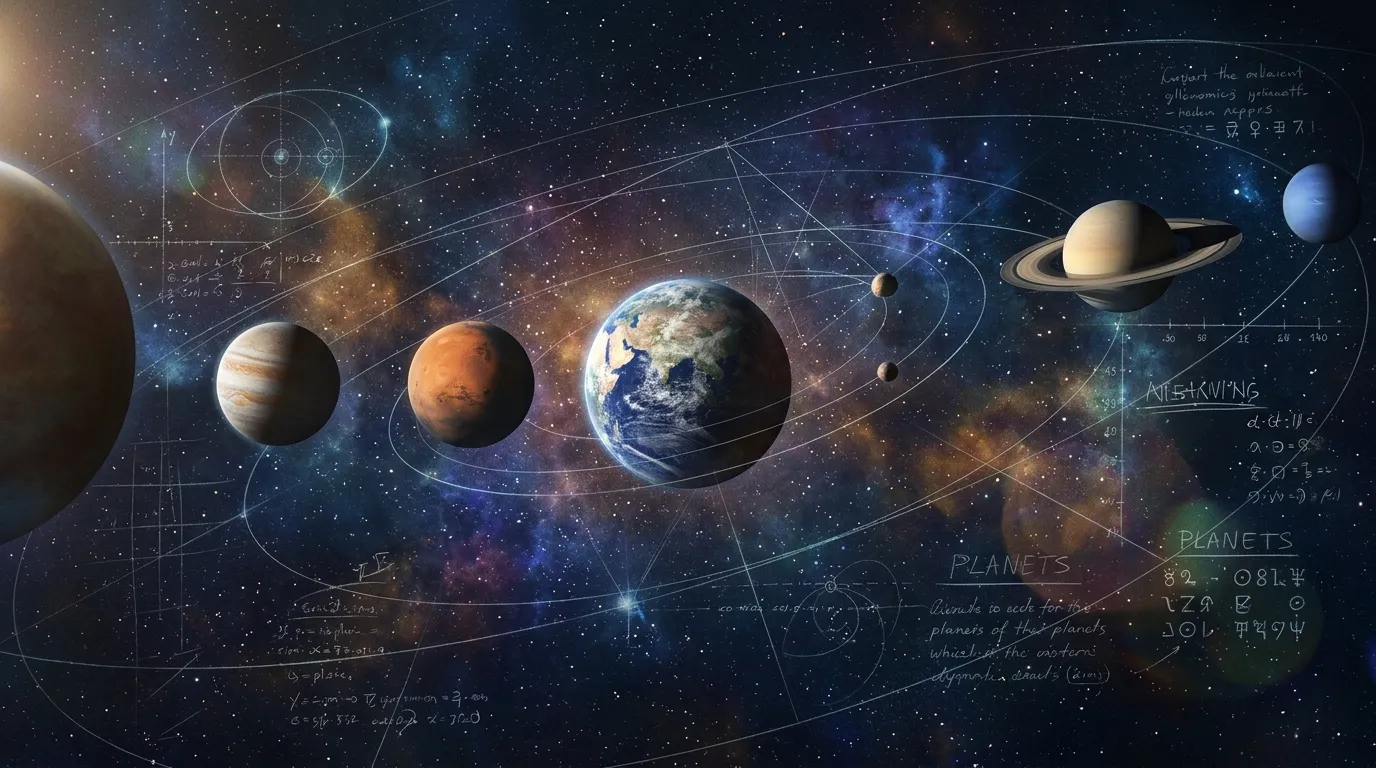
There are eight officially recognized planets in our solar system. Listed outward from the Sun, they are:
Mercury
Venus
Earth
Mars
Jupiter
Saturn
Uranus
Neptune
The first four are called terrestrial planets because they have solid, rocky surfaces. Jupiter and Saturn are gas giants, while Uranus and Neptune are commonly described as ice giants.
Pluto was once taught as the ninth planet, but in 2006 it was reclassified as a dwarf planet under the International Astronomical Union’s definition.
2. Planets Can Be Rocky or Giant Worlds
Not every planet looks like Earth. Scientists group the eight planets in our solar system according to their physical characteristics.
Terrestrial planets: Mercury, Venus, Earth, and Mars have rocky compositions and solid surfaces.
Gas giants: Jupiter and Saturn consist largely of hydrogen and helium. They do not have solid surfaces like Earth.
Ice giants: Uranus and Neptune contain substantial amounts of materials such as water, ammonia, and methane in their interiors, alongside other components.
These categories help astronomers compare the structure, atmosphere, and formation of different worlds.
3. Earth Is the Only Planet Known to Support Life
Earth is the only planet currently known to support life. It has liquid water on its surface, a protective atmosphere, and environmental conditions that allow a wide variety of organisms to survive.
Scientists continue to study Mars and the icy moons of the outer solar system for evidence of past or present life. Researchers also investigate distant planets orbiting other stars to determine whether some might have conditions suitable for life.
However, the possibility of life elsewhere remains a scientific question rather than a confirmed discovery.
4. Some Planets Have Rings
Saturn is famous for its spectacular rings, but it is not the only planet with them. Jupiter, Uranus, and Neptune also have ring systems.
These rings are made of particles that can include ice, rock, and dust. Saturn’s rings are particularly bright and extensive, making them easy to observe through suitable telescopes.
Planetary rings are different from moons because they consist of many small particles orbiting a planet rather than one large natural satellite.
5. Planets Orbit Stars
A key characteristic of a planet is its orbit around a star. Earth orbits the Sun once approximately every 365.25 days, which defines the length of a year in our calendar.
Other planets take different amounts of time to complete their orbits. Mercury takes about 88 Earth days, while Neptune takes approximately 165 Earth years.
Scientists have also discovered thousands of exoplanets, which are planets outside our solar system that orbit other stars.
6. Not Every Planet Has the Same Length of Day
A planet’s day depends on how quickly it rotates on its axis. Different planets rotate at different rates.
For example, Jupiter completes one rotation in roughly 10 hours, making its day much shorter than Earth’s. Venus rotates extremely slowly, and its rotation is retrograde, meaning it spins in the opposite direction to most planets in our solar system.
These differences show that planetary motion can be much more varied than everyday experience on Earth might suggest.
7. Pluto Is Classified as a Dwarf Planet
Pluto is a well-known example of a dwarf planet. It orbits the Sun and is nearly round, but it has not cleared its orbital neighborhood in the way required by the official definition of a planet.
Dwarf planets include Pluto, Ceres, Eris, Haumea, and Makemake, among other possible candidates.
Although Pluto is not classified as one of the eight planets, it remains an important object in astronomy and a fascinating part of the outer solar system.
Different Types of Planets
Planets can be categorized in several ways, including their composition, size, and location.
Terrestrial Planets
Terrestrial planets are rocky worlds with solid surfaces. The four terrestrial planets in our solar system are Mercury, Venus, Earth, and Mars.
They are generally smaller and denser than the giant planets. Their surfaces may contain mountains, valleys, craters, plains, and volcanoes.
Earth is the most familiar terrestrial planet because it supports life and has extensive liquid water on its surface.
Gas Giants
Gas giants are large planets composed primarily of hydrogen and helium.
Jupiter is the largest planet in our solar system, while Saturn is known for its prominent ring system. Both have deep atmospheres and complex weather patterns.
Although scientists often call them gas giants, these planets may contain dense interiors and do not have clearly defined solid surfaces like terrestrial planets.
Ice Giants
Uranus and Neptune are classified as ice giants. Their interiors contain substantial quantities of substances such as water, ammonia, and methane, alongside hydrogen and helium.
Uranus is notable for its extreme axial tilt, which makes it appear to rotate almost on its side. Neptune is known for its deep blue appearance and very fast atmospheric winds.
Dwarf Planets
Dwarf planets orbit the Sun and are nearly round because of their gravity, but they have not cleared their orbital neighborhoods.
Pluto is the best-known example. Ceres, located in the asteroid belt between Mars and Jupiter, is another recognized dwarf planet.
Dwarf planets are not simply small planets under the official classification. Their orbital characteristics are also important.
Exoplanets
An exoplanet is a planet that orbits a star outside our solar system.
Some exoplanets are rocky, some are gas giants, and others have characteristics that do not closely match any of the planets in our solar system.
Studying exoplanets helps scientists understand how planetary systems form and whether Earth-like environments might exist elsewhere.
Planet Meaning in Different Contexts
The word planet is used most often in astronomy, but its meaning can vary slightly depending on the context.
Planet Meaning in Science
In science, a planet is a celestial object classified according to its orbital behavior, shape, and gravitational influence.
Example: “Astronomers are studying the atmosphere of a distant planet.”
Here, the word refers to a specific object in space that scientists investigate.
Planet Meaning in Everyday Conversation
In everyday speech, people often use planet to refer to any major world in space.
Example: “Mars is the planet I would most like to visit.”
This usage is straightforward and common in schoolwork, conversations, and educational materials.
Planet Meaning in Environmental Discussions
The word planet is also used as a way to refer to Earth and its natural environment.
Example: “We should protect our planet for future generations.”
In this sentence, our planet means Earth, including its ecosystems, atmosphere, oceans, and living organisms.
This is a figurative or broader everyday use of the term, not a different astronomical definition.
Planet Meaning in Fiction and Fantasy
In science fiction, fantasy, and video games, a planet may be presented as the home of an alien civilization, a setting for an adventure, or a destination for space travel.
Example: “The explorers discovered a mysterious planet beyond the galaxy.”
Fictional stories may use the word loosely, sometimes describing imaginary worlds that do not fit the scientific definition exactly.
Planet vs. Star vs. Moon
A planet, a star, and a moon are different types of astronomical objects. Understanding the differences makes the meaning of planet easier to remember.
| Feature | Planet | Star | Moon |
|---|---|---|---|
| Basic meaning | A celestial body orbiting a star | A hot object that produces energy through nuclear fusion | A natural satellite orbiting a planet or another body |
| Produces its own light? | Usually reflects starlight | Yes | Usually reflects sunlight |
| Example | Earth | The Sun | Earth’s Moon |
| Typical role | Orbits a star | Can be the central object in a planetary system | Orbits a planet or another celestial body |
A planet does not normally generate visible light through nuclear fusion like a star. Instead, it reflects light from its host star.
A moon, on the other hand, is a natural satellite. Earth’s Moon orbits Earth, while Earth orbits the Sun.
Planet vs. Dwarf Planet
Planets and dwarf planets share some characteristics, but they differ in one important classification requirement.
| Feature | Planet | Dwarf Planet |
|---|---|---|
| Orbits the Sun in our solar system | Yes | Yes |
| Nearly round because of gravity | Yes | Yes |
| Has cleared its orbital neighborhood | Yes, under the official definition | No |
| Example | Earth | Pluto |
Both types of objects are scientifically interesting. The distinction is based on their orbital neighborhoods and gravitational dominance, not simply on whether an object is large or small.
Examples of the Word Planet in Sentences
Learning the word through examples can help you understand how to use it naturally.
Earth is the only planet currently known to support life.
Jupiter is the largest planet in our solar system.
Scientists discovered a planet orbiting a distant star.
Mars is often studied as a possible location for future human exploration.
Saturn is famous for its beautiful rings.
Neptune is much farther from the Sun than Earth is.
Pluto is classified as a dwarf planet.
The documentary explained how a planet forms from material around a young star.
Astronomers use telescopes to study the atmospheres of other planets.
We should take care of our planet and its natural resources.
These examples show that planet can appear in scientific writing, school assignments, ordinary conversations, and environmental discussions.
Synonyms and Related Words for Planet
The word planet has no perfect synonym in astronomy because it describes a specific category of celestial object. However, several related terms may be useful depending on the sentence.
Celestial body: A general term for a natural object in space.
World: An informal term often used to describe a planet or another place with its own environment.
Celestial object: A broad expression for an object found in space.
Exoplanet: A planet that orbits a star outside our solar system.
Dwarf planet: An object that meets some planetary criteria but has not cleared its orbital neighborhood.
Terrestrial planet: A rocky planet such as Earth or Mars.
Gas giant: A large planet composed primarily of hydrogen and helium.
Ice giant: A planet such as Uranus or Neptune with substantial quantities of volatile materials in its interior.
Remember that these words are related to planet, but they are not all interchangeable. For example, a moon is a celestial body, but it is not classified as a planet.
Why Are Planets Important?
Planets are important because they help scientists understand the formation and evolution of the universe.
They Help Explain How Solar Systems Form
Planets form from material surrounding young stars. By studying planets at different stages of development, astronomers can investigate how dust and gas gather into larger objects and eventually form planetary systems.
They Help Scientists Search for Life
Earth provides the only confirmed example of a world that supports life. Studying other planets and exoplanets helps scientists identify environments that might have suitable temperatures, chemistry, and liquid water.
A planet located in its star’s habitable zone may receive an appropriate amount of energy for liquid water under certain atmospheric conditions. However, being in this zone does not guarantee that a planet is habitable.
They Reveal the Diversity of the Universe
Planets vary enormously in size, composition, temperature, and atmosphere. Some are small and rocky, while others are enormous and extremely hot or cold.
This diversity challenges scientists to refine their understanding of how planets form and change over time.
They Inspire Education and Exploration
Planets encourage curiosity about space, physics, geology, chemistry, and the possibility of life beyond Earth.
Missions to Mars, spacecraft observations of Jupiter and Saturn, and telescopic studies of exoplanets all contribute to scientific knowledge and technological development.
Common Misconceptions About Planets
Every Round Object in Space Is a Planet
This is incorrect. Many objects, including dwarf planets and some moons, are nearly round because of their gravity. Being round alone does not make an object a planet under the official solar-system definition.
Pluto Is One of the Eight Planets
Pluto was historically called the ninth planet, but it has been classified as a dwarf planet since 2006.
Planets Produce Their Own Light Like Stars
Planets generally shine by reflecting light from a star. Stars produce energy through nuclear fusion in their interiors.
All Planets Have Solid Surfaces
Not all planets have solid surfaces like Earth. Jupiter and Saturn are gas giants with deep atmospheres and no clearly defined solid surface accessible in the ordinary sense.
All Planets Have Moons
Some planets have many known moons, while others have none currently known. In our solar system, Mercury and Venus have no natural moons.