
What Does “Ravenous” Mean?
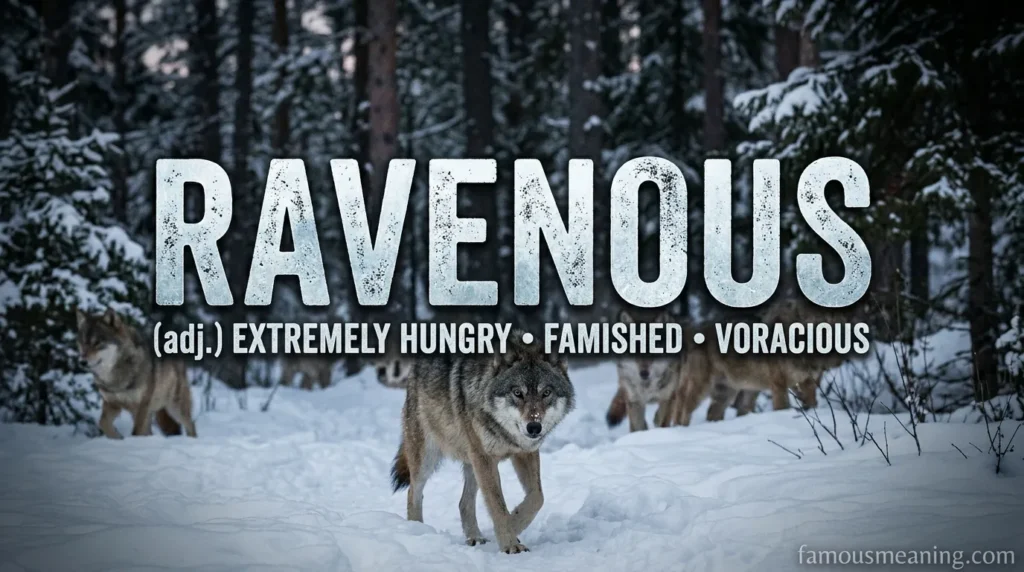
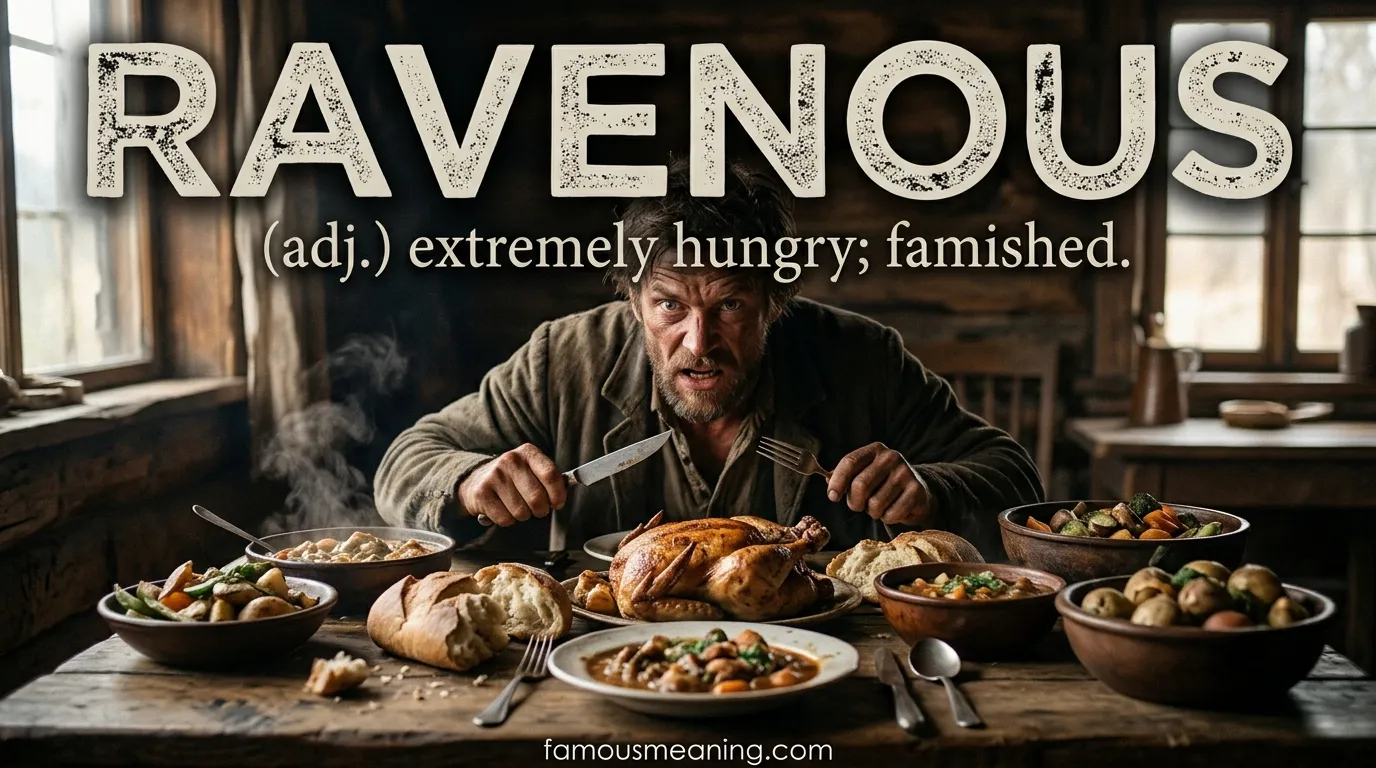
Ravenous is an adjective that describes extreme hunger or an intense desire for something.
It is stronger than simply saying hungry. When someone is ravenous, they feel an overwhelming need to eat or want something very badly.
For example:
“I’m ravenous after that long workout.”
This means the person is extremely hungry after exercising.
The word can also describe strong emotional or mental desires.
Example:
“He has a ravenous appetite for success.”
This means he has an extremely strong desire to achieve his goals.
Quick Definition
Ravenous (adjective): Extremely hungry or having an intense, almost uncontrollable desire for something.
What It Usually Means in Everyday Language
In simple English, ravenous means:
Extremely hungry.
Very eager to eat.
Having a powerful craving.
Wanting something intensely.
Having an overwhelming desire for an experience or achievement.
Examples:
“I’m ravenous. Let’s get some food.”
“The children were ravenous after playing outside.”
“She has a ravenous curiosity about the world.”
What Tone Does Ravenous Convey?
Ravenous is an expressive word that usually adds intensity to a sentence.
Its tone depends on the context:
Casual: “I’m ravenous. I need a burger!”
Funny: “He became ravenous when he saw the pizza.”
Serious: “The refugees were ravenous after days without enough food.”
Ambitious: “She has a ravenous desire to succeed.”
Literary: “The creature had a ravenous appetite.”
The word is not automatically rude or negative. It simply emphasizes how strong someone’s hunger or desire is.
What Does Ravenous Mean on Different Platforms?
Ravenous is a standard English vocabulary word, not an internet abbreviation or Gen Z slang term. However, people may use it differently depending on the platform and conversation.
Ravenous in Text Messages
In texting, ravenous usually means extremely hungry.
Example:
Person A: “Are you ready for dinner?”
Person B: “Yes! I’m absolutely ravenous.”
Meaning: The person is very hungry and excited to eat.
Ravenous on Snapchat
On Snapchat, people may use ravenous in captions or messages about food.
Example:
“Just got home after a long day. Ravenous!”
Meaning: The person is extremely hungry.
Ravenous on Instagram
On Instagram, ravenous may appear in food captions, restaurant reviews, or lifestyle posts.
Example:
“Ravenous after exploring the city all day!”
Meaning: The person is very hungry after spending the day exploring.
Ravenous on TikTok
On TikTok, the word may appear in food challenges, cooking videos, restaurant reviews, and humorous clips.
Example:
“POV: You’re ravenous and someone brings you your favorite meal.”
Meaning: The person is extremely hungry and excited to eat.
Ravenous on Discord
On Discord, gamers might use ravenous when talking about being hungry during long gaming sessions.
Example:
“I’ve been gaming for six hours. I’m ravenous!”
Meaning: The person is extremely hungry after playing for a long time.
Ravenous on Reddit
Reddit users may use ravenous in discussions about food, fitness, dieting, books, and personal experiences.
Example:
“I always feel ravenous after my morning run.”
Meaning: The person experiences extreme hunger after exercising.
Ravenous on Dating Apps
On dating apps, ravenous can describe strong desires or cravings, but its meaning depends on the conversation.
Example:
“I’m ravenous for good conversations and new experiences.”
Meaning: The person has a strong desire to meet people and enjoy meaningful conversations.
In romantic or suggestive contexts, it can sometimes express intense physical attraction or desire.
Origin and History of Ravenous
The word ravenous has an interesting history connected to the idea of greedily consuming or devouring something.
It comes from the Middle English word ravinous, which was influenced by Old French ravineux. These forms are related to words associated with seizing, plundering, and consuming.
The word is also connected to the Latin rapina, meaning robbery or plunder, through its historical linguistic development.
Over time, ravenous became strongly associated with extreme hunger and an overwhelming appetite.
Today, it is commonly used in both literal and figurative situations.
For example:
Literal: “The hungry travelers were ravenous.”
Figurative: “He has a ravenous thirst for knowledge.”
The word has maintained its connection with intense desire throughout its history.
How People Actually Use Ravenous
People use ravenous when they want to express a much stronger feeling than ordinary hunger or desire.
It makes sentences more descriptive and helps readers understand the intensity of an emotion or physical need.
When to Use Ravenous
Use ravenous when:
You are extremely hungry.
You have not eaten for several hours.
You want to describe someone’s powerful appetite.
Someone has an intense desire for knowledge.
You want to describe a strong ambition or craving.
You are writing creatively and want expressive language.
Examples:
“I’m ravenous after school.”
“The players were ravenous after the match.”
“She has a ravenous curiosity about science.”
“He has a ravenous desire for success.”
When Not to Use Ravenous
Avoid using ravenous when:
You are only slightly hungry.
You simply want a small snack.
You have an ordinary interest in something.
You want to describe a mild preference.
For example:
“I could eat a little snack.”
This does not necessarily mean you are ravenous.
However:
“I haven’t eaten all day, and I’m ravenous.”
This correctly expresses extreme hunger.
Is Ravenous a Formal or Casual Word?
Ravenous works in both formal and casual English.
You can use it in:
Everyday conversations.
Text messages.
Food reviews.
Creative writing.
Books and novels.
Academic descriptions.
Social media captions.
It is more expressive than the simple word hungry, making it useful when you want to emphasize intensity.
Real Examples of Ravenous in Sentences
Here are 15 practical examples showing how to use ravenous naturally.
1. I’m absolutely ravenous after working all day.
Meaning: I am extremely hungry after a long day of work.
2. The children were ravenous after playing football.
Meaning: The children were very hungry after playing.
3. She had a ravenous appetite and finished two plates of food.
Meaning: She was extremely hungry and ate a large amount.
4. We arrived at the restaurant ravenous.
Meaning: We were extremely hungry when we reached the restaurant.
5. He is ravenous for success.
Meaning: He has a very strong desire to become successful.
6. The travelers were ravenous after their long journey.
Meaning: They were extremely hungry after traveling.
7. My dog becomes ravenous whenever I open the food container.
Meaning: The dog gets extremely eager to eat.
8. She has a ravenous curiosity about different cultures.
Meaning: She is extremely eager to learn about different cultures.
9. After skipping breakfast and lunch, I was ravenous.
Meaning: I became extremely hungry because I had not eaten.
10. The audience had a ravenous appetite for more information.
Meaning: The audience strongly wanted additional information.
11. He developed a ravenous passion for reading.
Meaning: He became extremely enthusiastic about reading.
12. The team was ravenous for victory.
Meaning: The team desperately wanted to win.
13. I felt ravenous when the smell of fresh pizza reached my room.
Meaning: The smell made me feel extremely hungry.
14. The young artist had a ravenous desire to improve her skills.
Meaning: She was extremely motivated to become better at her art.
15. After the exhausting hike, everyone was ravenous.
Meaning: Everyone was extremely hungry after walking for a long time.
Common Mistakes and Misunderstandings
Although ravenous is easy to understand, people sometimes confuse it with other words.
Confusing Ravenous With Ordinary Hunger
Ravenous means extremely hungry, not just a little hungry.
Incorrect: “I’m ravenous, but I don’t really feel like eating.”
This is not necessarily incorrect, but the sentence may sound unusual without additional context.
Better: “I’m a little hungry, but I don’t feel like eating much.”
Thinking Ravenous Only Describes Food
Ravenous can describe non-food desires too.
For example:
“She has a ravenous thirst for knowledge.”
This does not mean she wants to drink something. It means she strongly wants to learn.
Confusing Ravenous With Greedy
Both words can describe an excessive appetite or desire, but they are not identical.
Ravenous: Extremely hungry or intensely eager for something.
Greedy: Wanting more than is fair, reasonable, or necessary.
Ravenous often describes a feeling, while greedy can suggest selfish behavior.
Assuming Ravenous Is Always Negative
Ravenous is not always negative.
It can describe a positive desire, such as a ravenous curiosity or appetite for learning.
Using Ravenous for Mild Interest
Ravenous expresses intensity. It is not suitable for describing ordinary interest.
For example, “I’m ravenous for knowledge” suggests a very strong desire to learn, not simply enjoying a subject.
Similar Slang Terms and Related Words
Several English words have meanings similar to ravenous. However, each one expresses a slightly different level or type of hunger and desire.
Word | Meaning | Difference |
|---|---|---|
Famished | Extremely hungry | Commonly refers to physical hunger |
Starving | Very hungry | More common in everyday speech |
Voracious | Having an enormous appetite or desire | Also describes eagerness for learning or reading |
Insatiable | Impossible to satisfy | Describes a desire that never seems fulfilled |
Greedy | Wanting more than necessary | Often has a negative meaning |
Hungry | Needing or wanting food | General and less intense |
Peckish | Slightly hungry | Much milder than ravenous |
Gluttonous | Eating excessively | Often suggests overindulgence |
Eager | Very interested or excited | Does not necessarily involve hunger |
Avid | Extremely enthusiastic or interested | Often describes strong interests or hobbies |
Craving | A strong desire for something | Usually focuses on wanting something specific |
Voraciously | In an extremely eager or hungry manner | Adverb form related to voracious |
Ravenous vs. Famished
Both words describe extreme hunger.
Ravenous: Extremely hungry, often suggesting a powerful appetite.
Famished: Very hungry, especially after going without food.
Example:
“I’m ravenous after the gym.”
“I’m famished because I skipped lunch.”
Ravenous vs. Voracious
These words are closely related, but their usage is slightly different.
Ravenous: Often emphasizes extreme hunger or an intense desire.
Voracious: Often describes someone with a very large appetite or an extremely strong interest in something.
Example:
“She was ravenous after the long journey.”
“He is a voracious reader.”
Ravenous vs. Insatiable
Ravenous describes an intense hunger or desire, while insatiable describes a desire that cannot easily be satisfied.
Example:
“I’m ravenous after skipping breakfast.”
“She has an insatiable curiosity about the universe.”
Is Ravenous Positive, Negative, or Neutral?
Ravenous is generally a neutral word, but its emotional meaning depends on how it is used.
Positive Meaning
Ravenous can describe enthusiasm, motivation, and a strong desire to achieve something.
Example:
“She has a ravenous appetite for learning.”
This suggests that she is extremely eager to gain knowledge.
Negative Meaning
It can sometimes describe excessive hunger, greed, or an uncontrolled desire.
Example:
“The ravenous animal destroyed everything in search of food.”
Here, the word creates a more intense and potentially threatening impression.
Neutral Meaning
When describing physical hunger, ravenous is usually neutral.
Example:
“I’m ravenous after my workout.”
It simply means the person is extremely hungry.
Should You Use the Word Ravenous?
Yes! Ravenous is a useful word when you want to express extreme hunger or an intense desire for something.
Use It If:
You want to describe being extremely hungry.
You are talking about a strong appetite.
You want to describe someone’s passion for learning.
You are discussing intense ambition.
You want to make your writing more expressive.
Avoid It If:
You are only slightly hungry.
You want to describe a mild interest.
You are discussing an ordinary preference.
You need a simple word for a basic conversation.
Writing tip: Use ravenous when you want to emphasize intensity. It is much stronger than simply saying hungry or interested.