

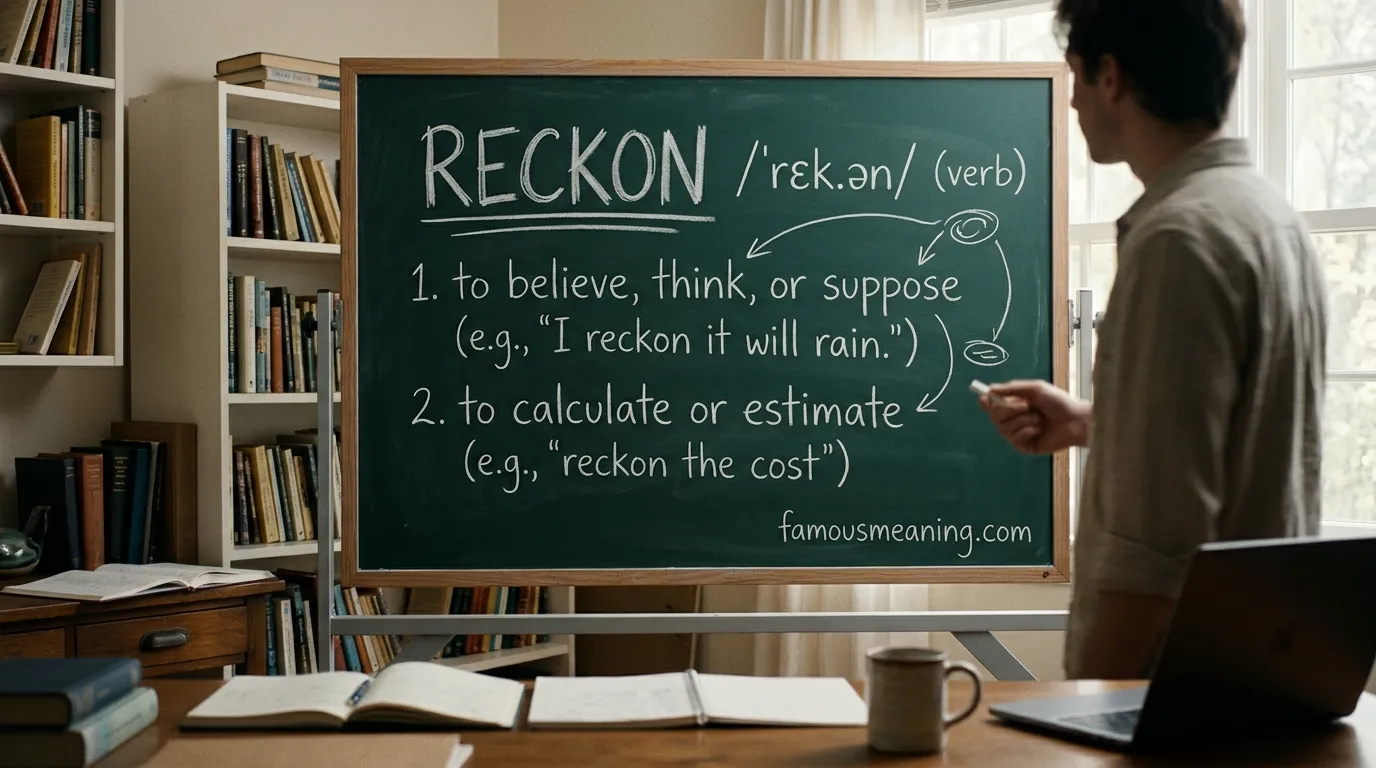
What Does “Reckon” Mean?
The meaning of reckon depends on the situation.
Quick Definition
Reckon (verb):
- To think
- To believe
- To suppose
- To estimate
- To calculate
- To consider
Meaning 1: To Think or Believe
This is the most common modern meaning.
When someone says:
“I reckon it’ll rain later.”
They simply mean:
“I think it’ll rain later.”
Examples:
- I reckon she’s right.
- We reckon the meeting will finish early.
- Do you reckon they’ll win?
Meaning 2: To Estimate or Calculate
Reckon can also mean making a calculation or estimate.
Examples:
- I reckon the trip will take three hours.
- They reckon the repairs will cost about $500.
- Experts reckon prices may continue to rise.
Here, the word means making an informed estimate rather than an exact calculation.
Meaning 3: To Consider or Regard
Sometimes reckon describes how people view someone or something.
Examples:
- She’s widely reckoned to be the best singer in the group.
- The restaurant is reckoned among the city’s finest.
In these cases, reckon means consider or regard.
Meaning 4: To Expect or Suppose
Native speakers also use reckon to make predictions.
Examples:
- Do you reckon they’ll arrive soon?
- I reckon he’ll call tonight.
- We reckon everything will be ready tomorrow.
Pronunciation
The word is pronounced:
REK-ən
It sounds like:
REK-un
The stress falls on the first syllable.
What Tone Does It Convey?
Depending on the sentence, reckon can sound:
- Casual
- Friendly
- Conversational
- Confident
- Informal
In British and Australian English, it’s an everyday word that sounds completely natural.
What Does “Reckon” Mean in Different English Dialects?
British English
In British English, reckon commonly means think, believe, or suppose.
Examples:
- I reckon it’s going to snow.
- What do you reckon?
These expressions are part of everyday conversation.
Australian English
Australians use reckon very frequently.
You’ll often hear:
- I reckon so.
- Reckon we’ll be there soon?
- What do you reckon?
It sounds natural and informal.
American English
In the United States, reckon is less common in standard speech but remains popular in the South and some rural areas.
Example:
- I reckon we’ll head home after dinner.
Although it may sound regional, it’s still widely understood.
Business and News Writing
Journalists often use reckon when reporting estimates or expert opinions.
Examples:
- Analysts reckon inflation will slow next year.
- Economists reckon unemployment may decline.
Here, reckon means estimate based on available evidence.
Origin and History of “Reckon”
The word reckon has been part of the English language for centuries. It originally referred to counting, calculating, or keeping track of numbers. Over time, its meaning expanded to include estimating, forming an opinion, and considering something to be true.
Today, while the original idea of calculation still appears in some contexts, the word is far more commonly used to express thoughts, beliefs, predictions, or opinions.
Because of its long history, reckon appears in classic literature, newspapers, conversations, and modern media across many English-speaking countries.
How People Actually Use “Reckon”
Native speakers use reckon in many everyday situations.
Expressing an Opinion
- I reckon you’re right.
- I reckon it’ll be okay.
- I reckon we should leave now.
Making a Prediction
- I reckon it’ll rain tomorrow.
- We reckon sales will increase.
- Do you reckon they’ll finish on time?
Estimating
- I reckon the drive takes about two hours.
- She reckons dinner will be ready in thirty minutes.
Asking Someone’s Opinion
One of the most common questions is:
“What do you reckon?”
This simply means:
“What do you think?”
It’s especially common in casual conversations among friends, family members, and coworkers.
What Does “Reckon” Mean on Social Media?
Although reckon isn’t internet slang, it’s frequently used in captions, comments, and online discussions.
Examples:
- “I reckon this is the best movie of the year.”
- “Do you reckon this trend will last?”
- “I reckon that’s a fair point.”
On platforms like TikTok, Instagram, X, Reddit, and Facebook, the meaning remains the same—it simply expresses an opinion, belief, or estimate in a conversational way.
Real Examples of “Reckon” in Conversations
One of the best ways to understand reckon is to see how native speakers use it in everyday situations.
Example 1
Person A: Do you think it’ll rain today?
Person B: I reckon it will.
Meaning: I think it will.
Example 2
Person A: How long will the trip take?
Person B: I reckon about three hours.
Meaning: An estimate.
Example 3
Person A: Should we leave now?
Person B: Yeah, I reckon so.
Meaning: I agree.
Example 4
Person A: Who’s the best player on the team?
Person B: She’s widely reckoned to be the best.
Meaning: She’s generally considered the best.
Example 5
Person A: Will they arrive on time?
Person B: I reckon they’ll be here soon.
Meaning: A prediction or expectation.
Example 6
Person A: What do you think about the proposal?
Person B: I reckon it’s a good idea.
Meaning: Personal opinion.
Example 7
Person A: Is this restaurant worth visiting?
Person B: I reckon it is.
Meaning: Personal belief.
Example 8
Person A: How much will the repairs cost?
Person B: I reckon around $1,000.
Meaning: Estimated amount.
Example 9
Person A: Do you think she’ll accept the offer?
Person B: I reckon she will.
Meaning: Expectation.
Example 10
Person A: What do you reckon about the new movie?
Person B: It was better than I expected.
Meaning: Asking for an opinion.
Example 11
Person A: Are we taking the right road?
Person B: I reckon so.
Meaning: I believe so.
Example 12
Person A: Why is everyone talking about him?
Person B: He’s reckoned to be one of the best chefs in town.
Meaning: He’s considered highly skilled.
Example 13
Person A: Will prices go down soon?
Person B: Economists reckon they might.
Meaning: Experts estimate or predict.
Example 14
Person A: What do you reckon we should do next?
Person B: Let’s wait until tomorrow.
Meaning: Asking for advice or a viewpoint.
Example 15
Person A: Is this a difficult exam?
Person B: I reckon it’s manageable if you study.
Meaning: Personal judgment.
Common Phrases and Expressions with “Reckon”
The word reckon appears in many everyday expressions.
I Reckon
Meaning: I think or believe.
Example:
“I reckon you’re right.”
What Do You Reckon?
Meaning: What do you think?
Example:
“What do you reckon about this plan?”
Reckon So
Meaning: Think so or agree.
Example:
“Do you think they’ll come?”
“I reckon so.”
Be Reckoned With
Meaning: To be respected, feared, or taken seriously.
Example:
“Their team is a force to be reckoned with.”
This is one of the most common idiomatic uses of the word.
Widely Reckoned
Meaning: Generally considered.
Example:
“She’s widely reckoned to be an expert.”
Common Mistakes and Misunderstandings
Mistake 1: Thinking Reckon Only Means “Think”
While “think” is the most common meaning, reckon can also mean:
- Estimate
- Calculate
- Consider
- Regard
- Expect
Understanding context is important.
Mistake 2: Assuming It’s Old-Fashioned
Although some Americans associate reckon with older speech, it’s still widely used today, especially in British and Australian English.
Mistake 3: Using It in Very Formal Writing
In formal academic or professional writing, alternatives like:
- believe
- estimate
- consider
- conclude
may sound more appropriate.
Synonyms and Antonyms
| Word | Meaning | Relationship |
|---|---|---|
| Think | Form an opinion | Synonym |
| Believe | Accept as true | Synonym |
| Suppose | Assume something | Synonym |
| Estimate | Calculate approximately | Synonym |
| Consider | Regard as | Synonym |
| Judge | Form an opinion | Related |
| Doubt | Question something | Antonym |
| Disbelieve | Refuse to accept | Antonym |
| Ignore | Fail to consider | Antonym |
| Reject | Refuse to accept | Antonym |
Is “Reckon” Formal or Informal?
Reckon is generally considered informal to neutral.
Informal Use
Most commonly found in:
- Everyday conversations
- Social media
- Text messages
- Casual interviews
Example:
“I reckon it’ll be fine.”
Neutral Use
Often appears in:
- Newspapers
- News reports
- Public commentary
Example:
“Analysts reckon the market will recover.”
Formal Alternatives
In highly formal writing, people often choose:
- believe
- estimate
- conclude
- determine
- consider
instead of reckon.
Should You Use “Reckon”?
Use reckon if:
- You’re speaking casually.
- You’re writing conversational content.
- You want natural British or Australian English.
- You’re expressing an opinion or estimate.
Avoid using it if:
- You’re writing highly formal documents.
- Your audience expects academic language.
- A more precise verb is needed.