
What Does “Shed” Mean?
Shed can function mainly as a noun or a verb.
As a noun, it usually means a small building used for storage or shelter. As a verb, it can mean to lose, remove, release, or spread something, depending on the context.
Quick Definition
Shed (noun): A small building used for storing tools, equipment, bicycles, or other items.
Shed (verb): To lose, remove, release, or give off something.
Examples:
- “The tools are in the shed.”
- “The dog sheds a lot of hair.”
- “She shed a few tears.”
- “The tree shed its leaves.”
- “The lamp shed light on the table.”
What Does Shed Mean as a Noun?
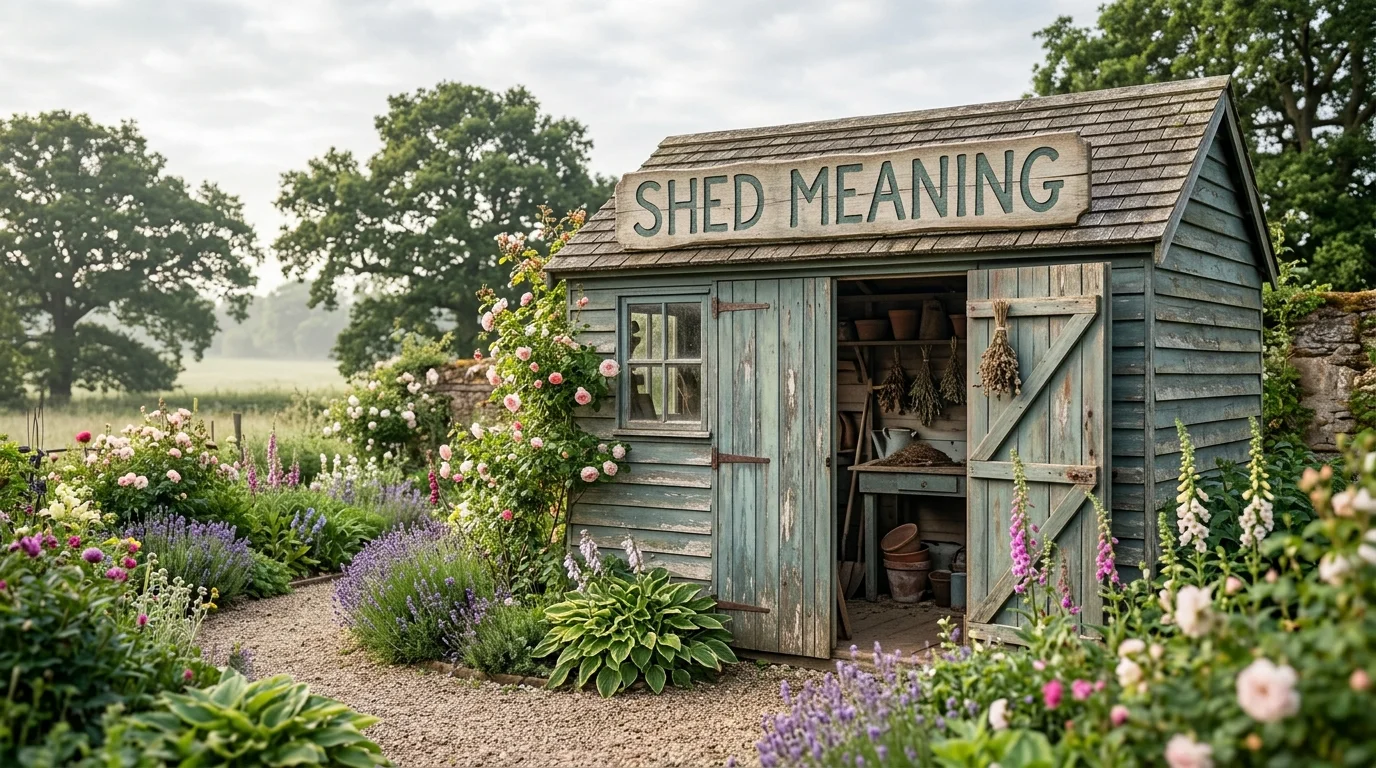
As a noun, a shed is usually a simple structure used for storage or shelter. A typical backyard shed might contain gardening tools, lawn equipment, bicycles, boxes, or other belongings. Cambridge and Oxford both describe a shed as a small, simple building commonly used for keeping things.
Common types include:
- Garden shed
- Tool shed
- Storage shed
- Bike shed
- Woodshed
- Potting shed
- Engine shed
In some varieties of English, shed can also refer to a larger industrial or agricultural building.
What Does Shed Mean as a Verb?
As a verb, shed commonly means to get rid of something or allow something to fall away.
For example:
“The snake shed its skin.”
Here, the snake naturally lost its old skin.
Another example:
“She shed her jacket.”
Here, she removed the jacket.
The verb can also describe releasing tears or blood, spreading light, or getting rid of something unwanted.
What Tone Does “Shed” Convey?
The tone depends entirely on context.
- Neutral: “The tree shed its leaves.”
- Practical: “Put the tools in the shed.”
- Emotional: “She shed tears.”
- Positive: “He shed his fear and became more confident.”
- Figurative: “The company shed unnecessary costs.”
- Scientific: “The animal sheds its skin.”
Unlike slang, shed is a standard English word used in everyday, professional, literary, and scientific contexts.
Shed Meaning in Different Contexts
The meaning of shed becomes clearer when you see how it works in different situations.
Shed Meaning in Everyday Conversation
In everyday English, shed often means losing or getting rid of something.
“My cat sheds everywhere.”
This means the cat loses hair or fur.
You may also hear:
“I need to shed some weight.”
This means the person wants to lose weight.
Shed Meaning in Nature
Animals and plants naturally shed things.
Examples include:
- Dogs shed fur.
- Cats shed hair.
- Snakes shed skin.
- Birds shed feathers.
- Trees shed leaves.
Cambridge specifically defines this use as losing hair, leaves, or skin, or causing these materials to fall away.
Shed Meaning in Business
In business or economics, shed can mean get rid of or reduce something, especially jobs, employees, branches, or costs.
For example:
“The company plans to shed 200 jobs.”
This means the company plans to eliminate 200 jobs. Cambridge’s Business English definition includes this use for reducing jobs, employees, or other business resources.
Shed Meaning in Emotional Contexts
You can also shed something metaphorically.
“She shed her old fears.”
This means she let go of or got rid of her fears.
Similarly:
“He finally shed his insecurity.”
The idea is that the person removed something emotionally or psychologically burdensome.
Shed Meaning in Science
In scientific or biological contexts, shed can describe an organism releasing something from its body.
For example:
“The snake sheds its skin.”
In specialized medical or biological usage, the verb can also describe releasing certain viruses or bacteria from a body or cell into the environment.
What Does “Shed” Mean in Text Messages?
Shed is not normally a texting abbreviation or internet slang term. If you see it in a text, its meaning usually comes from ordinary English.
For example:
“My dog sheds so much 😭”
Meaning:
My dog loses a lot of fur.
Or:
“I need to shed some weight.”
Meaning:
I want to lose some weight.
The surrounding sentence usually makes the intended meaning obvious.
Common Phrases With “Shed”
Several common English expressions use the word shed.
Shed Light on Something
“Shed light on” means to help explain something or make something easier to understand.
Example:
“The investigation shed light on what happened.”
Meaning:
The investigation helped explain what happened.
The expression is based on the literal idea of light making something visible. Cambridge lists shed light on something as an established idiom.
Shed Tears
Shed tears means to cry or produce tears.
Example:
“She shed tears during the movie.”
Meaning:
She cried during the movie.
Shed Blood
Shed blood means to cause blood to flow, often in connection with violence, injury, or sacrifice.
Example:
“The battle caused many people to shed blood.”
Shed Weight
Shed weight means lose weight.
Example:
“He hopes to shed a few pounds before summer.”
This is a common figurative use of the word.
Shed a Layer
To shed a layer means to remove a piece of clothing.
Example:
“It got warm, so I shed my jacket.”
This use is related to the basic idea of removing or getting rid of something.
What Does “Shed Light” Mean?
Shed light can have a literal or figurative meaning.
Literal Meaning
“The flashlight shed light on the path.”
This means the flashlight cast or spread light over the path.
Figurative Meaning
“The new evidence shed light on the mystery.”
This means the evidence helped explain the mystery.
The figurative expression is extremely common in English and is useful when something provides new information or understanding.
What Does “Shedding” Mean?
Shedding is the present participle or gerund form of shed.
It commonly refers to the process of losing or releasing something.
Examples:
“My dog is shedding.”
Meaning:
My dog is losing its fur.
“The tree is shedding its leaves.”
Meaning:
The tree is naturally dropping its leaves.
“She is shedding old habits.”
Meaning:
She is getting rid of old habits.
The form is shed → shedding, while the past tense and past participle remain shed.
Is “Shed” a Verb or a Noun?
It can be both.
Shed as a Noun
“The bike is in the shed.”
Here, shed is a noun because it names a building.
Shed as a Verb
“The dog sheds its fur.”
Here, shed is a verb because it describes an action.
Shed as an Adjective?
In standard modern English, shed is primarily used as a noun and verb. In compounds such as shed roof or phrases involving a shed, it can appear within noun phrases, but it is not generally treated as a basic adjective in the same way as words such as large or green.
Real Examples of “Shed” in Conversations
Example 1: Storage Building
Person A: Where’s the lawn mower?
Person B: It’s in the shed.
Meaning: The lawn mower is inside the small storage building.
Example 2: Pet Hair
Person A: Why is there fur everywhere?
Person B: My dog sheds a lot.
Meaning: The dog naturally loses a lot of fur.
Example 3: Tree Leaves
Person A: Why are there so many leaves on the ground?
Person B: The trees have started shedding their leaves.
Meaning: The trees are naturally dropping their leaves.
Example 4: Clothing
Person A: It’s getting warm.
Person B: Yeah, I’m going to shed this jacket.
Meaning: The speaker is going to remove the jacket.
Example 5: Weight
Person A: How’s your fitness plan going?
Person B: Pretty well. I’ve shed a few pounds.
Meaning: The person has lost some weight.
Example 6: Tears
Person A: Was she upset?
Person B: Yes, she shed a few tears.
Meaning: She cried or became tearful.
Example 7: Emotional Growth
Person A: You seem much more confident now.
Person B: I’ve finally shed a lot of my self-doubt.
Meaning: The person has let go of much of their self-doubt.
Example 8: Business
Person A: Why is the company restructuring?
Person B: It’s trying to shed unnecessary costs.
Meaning: The company is trying to eliminate or reduce unnecessary expenses.
Example 9: Explanation
Person A: Did the report explain the problem?
Person B: Yes. It shed a lot of light on the situation.
Meaning: The report helped make the situation clearer.
Example 10: Snake
Person A: What happened to the snake’s skin?
Person B: The snake shed it.
Meaning: The snake naturally removed its old skin.
Example 11: Casual Text
Person A: Your cat leaves fur everywhere.
Person B: I know 😂 She sheds like crazy.
Meaning: The cat loses a lot of fur.
Example 12: Garden
Person A: Where should I keep these gardening tools?
Person B: Put them in the shed.
Meaning: Store them in the garden storage building.
Shed vs. Shedding: What’s the Difference?
Shed is the base form and can also be the past tense.
Shedding is the -ing form.
Examples:
- “My dog sheds hair.”
- “My dog is shedding hair.”
- “My dog shed a lot of hair yesterday.”
One unusual feature of shed is that its past tense and past participle remain shed, rather than becoming a form such as “shedded.” Cambridge lists shed as the past tense and past participle and shedding as the present participle.
Shed vs. Shred: What’s the Difference?
These words are easy to confuse because they sound somewhat similar.
Shed means to lose, remove, release, or spread something.
“The tree shed its leaves.”
Shred means to cut or tear something into small pieces.
“She shredded the paper.”
So:
Shed = lose/remove/release
Shred = cut/tear into pieces
Shed vs. She’d: What’s the Difference?
Shed and she’d are completely different.
Shed is a noun or verb.
“The tools are in the shed.”
She’d is a contraction of she had or she would.
“She’d already left.”
The apostrophe is important because she’d represents two words.
Common Mistakes and Misunderstandings About “Shed”
Mistake 1: Thinking Shed Only Means a Building
Many learners first encounter shed as a small storage building, but the verb has several important meanings.
Mistake 2: Saying “Shedded”
The standard past tense is shed, not “shedded.”
Correct:
“The dog shed its fur.”
Incorrect:
“The dog shedded its fur.”
Mistake 3: Confusing Shed With Shred
Remember:
- Shed = lose, remove, release, or spread
- Shred = tear or cut into pieces
Mistake 4: Assuming “Shed Light” Means Literally Using a Lamp
It can be literal, but shed light on something is very often figurative.
“The investigation shed light on the problem.”
This means it helped explain the problem.
Mistake 5: Assuming “Shed” Always Means Loss
Sometimes shed can mean remove something intentionally, such as clothing.
“He shed his coat.”
It can also mean spread or give off, as in:
“The lamp shed light.”
So context matters.
Similar Words and Related Terms
| Word | Meaning | Difference |
|---|---|---|
| Lose | No longer have something | Broadest meaning |
| Remove | Take something away | Usually intentional |
| Discard | Get rid of something | Often intentional |
| Drop | Let something fall | Focuses on falling |
| Release | Let something out | Often used with liquids, emotions, or gases |
| Cast off | Throw away or remove | Often figurative or literary |
| Slough off | Get rid of something unwanted | Often used figuratively or biologically |
| Exfoliate | Remove dead skin cells | More specific |
| Molt | Lose and replace skin, feathers, or an outer covering | Usually used for animals |
| Storage building | Building for keeping items | Related to shed as a noun |
Is “Shed” Positive, Negative, or Neutral?
Shed is generally neutral.
Its emotional tone depends on what is being shed.
Positive
“She shed her fear and became more confident.”
Here, getting rid of fear is positive.
Negative
“The company shed hundreds of jobs.”
Here, shedding jobs can be associated with layoffs and may have a negative impact on workers.
Neutral
“The trees shed their leaves every autumn.”
This is simply a natural process.
Therefore, shed itself is neither inherently positive nor negative.
Should You Use “Shed”?
Yes. Shed is a very common and useful English word, especially when you want to describe losing, removing, releasing, or spreading something.
Use It If:
- You’re describing an animal losing fur.
- You’re talking about trees losing leaves.
- You’re describing removing clothing.
- You’re talking about losing weight.
- You’re describing tears or blood.
- You’re explaining how something makes information clearer.
- You’re referring to a small storage building.
Avoid It If:
- A simpler word would be clearer for a beginner.
- You’re unsure whether the context calls for shed, shred, or she’d.
- You’re writing about a medical or technical subject where a more precise term is required.