

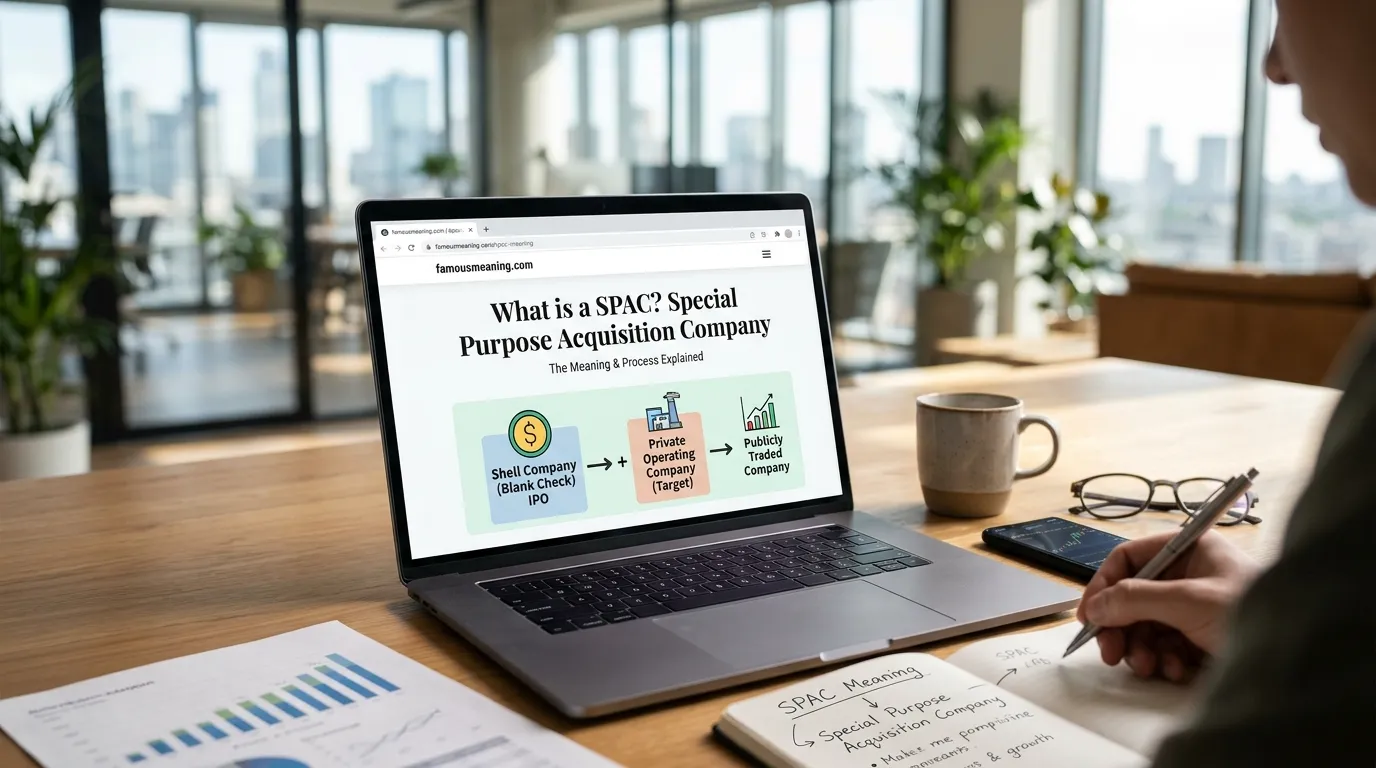
What Does SPAC Mean?
SPAC stands for Special Purpose Acquisition Company.
A SPAC is a publicly traded company formed to raise money through an initial public offering (IPO) and use that money to acquire or merge with an existing private company.
Unlike a traditional company, a SPAC usually has no significant commercial operations when it launches. Its primary purpose is to find a suitable business combination within a specified period.
Simple definition: A SPAC is a company created to raise investment money and use it to take another business public through a merger or acquisition.
For example, a group of investors may establish a SPAC, raise money from the public, and later merge with a privately owned technology company. After the transaction, the private company becomes publicly traded.
7 Essential Facts About SPACs
1. SPAC Means Special Purpose Acquisition Company
The full form of SPAC explains its main purpose.
Special purpose: Created for a specific objective.
Acquisition: Buying or combining with another company.
Company: A legal business entity.
The structure allows sponsors to raise capital before selecting the private business they eventually intend to acquire.
2. SPACs Are Also Called Blank-Check Companies
A SPAC is often called a blank-check company because investors initially provide money without knowing exactly which operating company the SPAC will acquire.
Investors generally evaluate the SPAC’s management team, sponsor reputation, proposed investment strategy, and deal terms.
The target company is identified later through the acquisition process.
3. SPACs Raise Money Through an IPO
SPACs typically raise capital by selling securities to investors through an initial public offering.
The money raised is generally placed in a trust account while the SPAC searches for a suitable acquisition target.
The trust structure is intended to protect the IPO proceeds until a business combination is completed or the SPAC is liquidated according to its governing documents.
4. SPACs Must Find an Acquisition Target
After going public, a SPAC searches for a private company to acquire or merge with.
The SPAC usually has a limited period to complete a business combination. The specific deadline depends on its governing documents and any approved extensions.
If the SPAC cannot complete a qualifying transaction within the permitted period, it may have to liquidate and return the applicable trust funds to public shareholders.
5. A SPAC Merger Can Take a Private Company Public
One major reason businesses consider SPAC mergers is that the transaction can provide an alternative route to becoming publicly traded.
In a typical transaction, the SPAC combines with a private operating company. The private company’s shareholders receive shares or other consideration under the merger agreement.
Once the transaction is completed, the combined business generally operates as a publicly traded company.
6. SPAC Investments Have Potential Risks
Although SPACs can offer investment opportunities, they also carry significant risks.
These may include:
Uncertain acquisition targets.
Overvaluation of the target business.
Conflicts of interest involving sponsors.
Share dilution from warrants or other securities.
Failure to complete a business combination.
Volatile share prices after a merger.
Limited financial history for some target companies.
Investors should examine the transaction documents and financial information rather than relying only on promotional claims.
7. SPACs Have Both Supporters and Critics
Supporters argue that SPACs can provide private companies with another route to public markets and give investors access to potential growth opportunities.
Critics point to sponsor incentives, transaction costs, valuation uncertainty, and the possibility that public shareholders may experience losses.
The quality of a SPAC depends on its management, target business, transaction terms, financial condition, and long-term performance.
How Does a SPAC Work?
A SPAC generally follows several stages, from formation to a completed business combination.
Step 1: Formation
A sponsor or management group establishes a SPAC with the goal of acquiring or merging with an existing business.
Step 2: Initial Public Offering
The SPAC raises money from public investors through an IPO.
The proceeds are generally deposited into a trust account while the company searches for an acquisition target.
Step 3: Searching for a Target Company
The SPAC’s management team evaluates potential private businesses.
It may consider factors such as:
Revenue and profitability.
Market opportunities.
Growth potential.
Management experience.
Competitive position.
Business valuation.
Step 4: Announcing a Business Combination
Once a target is selected, the SPAC announces a proposed merger or acquisition.
The companies disclose important information about the transaction, including its financial terms and relevant risks.
Step 5: Shareholder Approval and Redemption
Depending on the transaction structure and applicable requirements, shareholders may vote on the proposed business combination.
Public shareholders generally have redemption rights under the SPAC’s governing documents, allowing eligible investors to redeem their shares for their applicable portion of the trust account instead of remaining invested in the combined company.
Step 6: Completing the Merger
If the transaction satisfies the required conditions, the merger is completed.
The private company becomes part of the publicly traded combined business, and its shares may trade under a new ticker symbol.
SPAC vs. Traditional IPO: What Is the Difference?
A SPAC merger and a traditional IPO are different methods of entering the public stock market.
| SPAC Merger | Traditional IPO |
|---|---|
| A private company merges with an existing SPAC | A private company sells shares directly to the public |
| The SPAC raises money before identifying its target | The operating company raises money through its own IPO |
| Sponsors play an important role | The company works with investment banks and other advisers |
| Investors initially buy shares in the SPAC | Investors buy shares in the operating company |
| The process involves a business combination | The process involves a public offering |
Neither method guarantees a successful public-market outcome. Investors should evaluate the specific company, disclosures, valuation, and transaction structure.
Advantages of SPACs
SPACs can offer several potential benefits to businesses and investors.
Alternative Route to Public Markets
A SPAC merger gives a private business another potential way to become publicly traded without using the traditional IPO process.
Experienced Sponsors
Some SPACs are led by sponsors with experience in finance, business management, or a particular industry.
Their expertise may help identify acquisition opportunities and evaluate potential targets.
Access to Public Capital
After completing a merger, the combined company may have access to public equity markets and a broader investor base.
Potential Investment Opportunities
Investors may gain exposure to businesses that are preparing to enter the public market through a SPAC transaction.
However, potential opportunities should always be considered alongside the associated risks.
Disadvantages and Risks of SPACs
SPACs are not risk-free investments. Their structure can create challenges for both public investors and the companies involved.
Uncertain Acquisition Target
At the time of the SPAC’s IPO, investors may not know which company will eventually be acquired.
This makes it difficult to evaluate the future operating business.
Sponsor Conflicts of Interest
SPAC sponsors may have financial incentives that differ from those of public shareholders.
For example, sponsor compensation and ownership arrangements can influence decisions about completing a transaction.
Share Dilution
Warrants, sponsor shares, additional fundraising, and other securities may dilute the ownership percentage of existing shareholders.
Business Valuation Challenges
A proposed target may be valued aggressively, especially when investors are excited about a particular industry or growth opportunity.
An inflated valuation can affect the combined company’s stock price.
Post-Merger Volatility
A company’s share price may change significantly after the merger. Investors may lose money if the business performs poorly or market expectations decline.
SPAC Examples and Notable Transactions
Several well-known businesses have entered public markets through SPAC mergers.
Examples include:
Virgin Galactic: The spaceflight company became publicly traded through a merger with Social Capital Hedosophia in 2019.
DraftKings: The sports and entertainment company completed a business combination involving Diamond Eagle Acquisition Corp. in 2020.
Lucid Motors: The electric vehicle manufacturer merged with Churchill Capital Corp IV in 2021.
These examples demonstrate how SPAC mergers have been used in different industries. They do not guarantee that future SPAC transactions will produce similar results.
SPAC Meaning in Different Contexts
Although SPAC is most commonly associated with finance and investing, the abbreviation may appear in other specialized contexts.
| Context | Meaning |
|---|---|
| Finance | Special Purpose Acquisition Company |
| Stock market | A publicly traded blank-check company |
| Business | A vehicle used to acquire or merge with another company |
| Investing | An alternative route for a private company to enter public markets |
If you encounter SPAC in a specialized document outside finance, check the surrounding context because abbreviations can have different meanings across industries.
industries
industries
industries
industries