
What Does “Spin Off” Mean?
Quick Definition
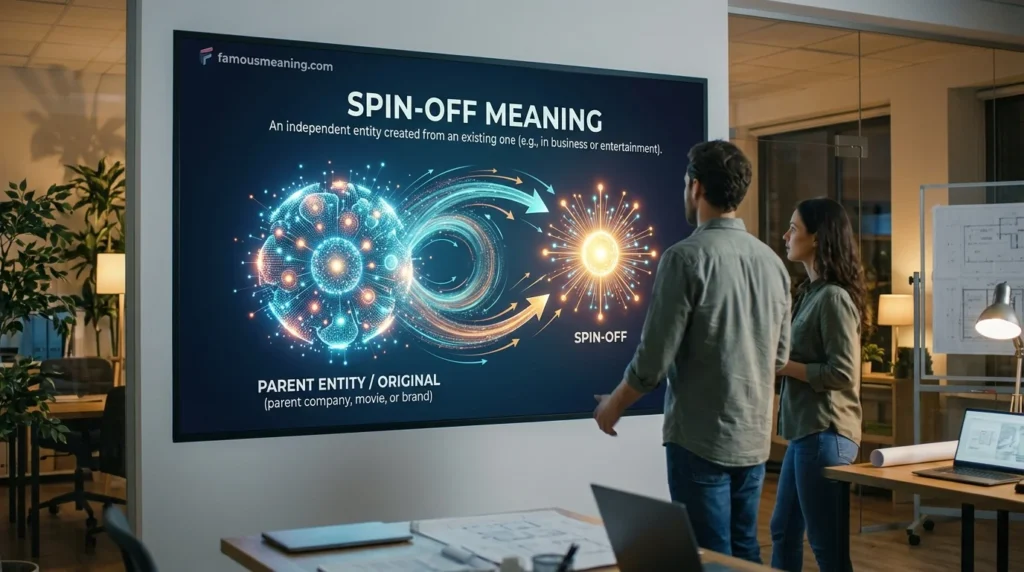
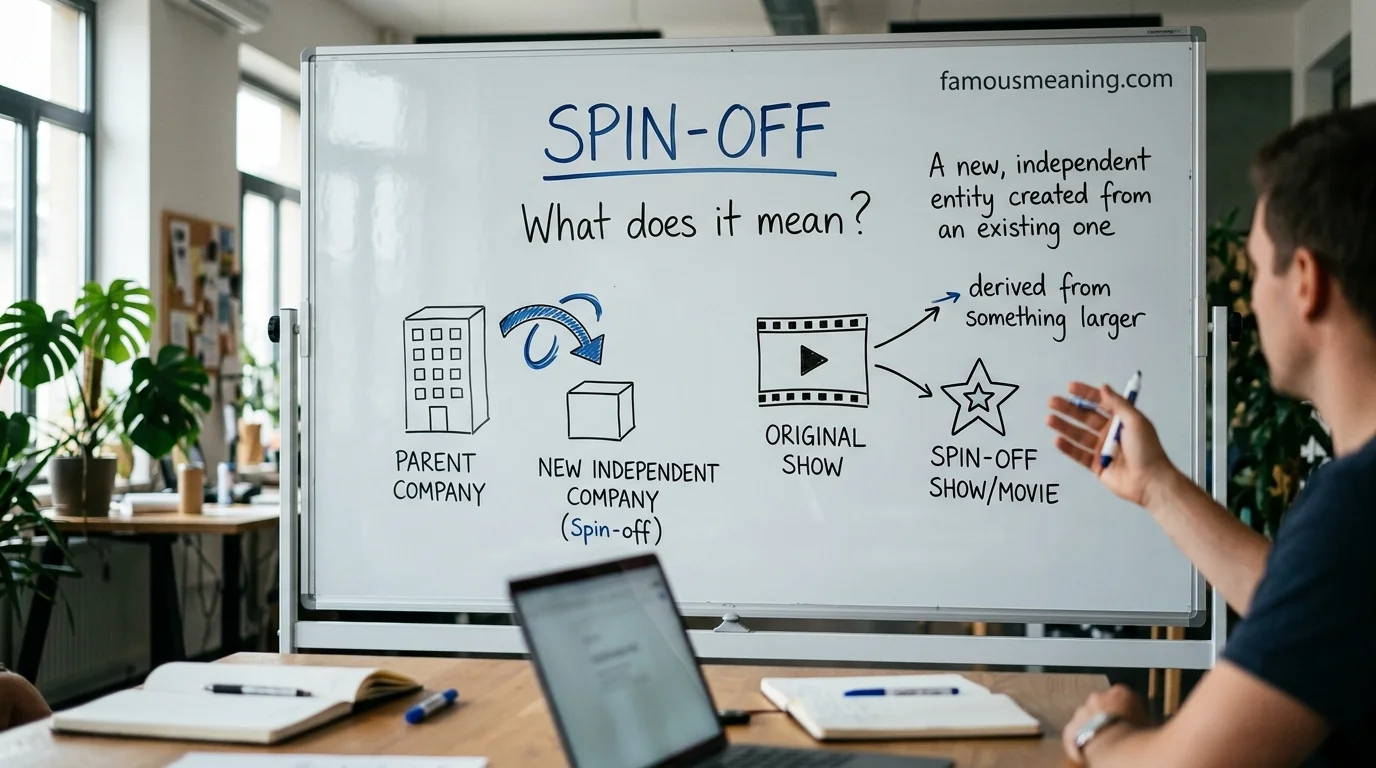
A spin off is a new product, business, project, TV series, movie, or result that originates from an existing one while becoming separate or independent.
Literal Meaning
The verb spin means to turn or rotate, while off suggests moving away or separating.
Together, spin off literally suggests something separating from the original source while remaining connected to its origins.
Most Common Meaning
Today, people commonly use spin off to describe:
- A new company created from a larger business
- A TV series based on an existing show
- A movie featuring characters from another film
- A new product developed from existing technology
- An indirect result of an event or decision
What Does Spin Off Mean in Different Contexts?
Everyday English
In daily conversation, a spin off is often an unexpected benefit or result.
Example:
“One spin-off of learning coding was that I became interested in cybersecurity.”
Business
In business, a spin-off occurs when a parent company separates part of its operations into a new independent company.
Businesses may create spin-offs to:
- Focus on core operations
- Increase shareholder value
- Allow separate management
- Pursue different growth strategies
Television
A TV spin-off is a new series based on an existing show.
Examples include:
- A supporting character getting their own series
- A story continuing in another location
- A prequel or sequel focused on different characters
Movies
Film studios often produce spin-off movies featuring popular characters from successful franchises.
Technology
Companies may create spin-off technologies or products that evolve from existing research and innovations.
Education
Researchers sometimes describe discoveries or inventions as spin-offs from larger research projects.
Origin and History of Spin Off
Where Did the Phrase Come From?
The phrase spin off originally referred to something that spun away from a larger rotating object.
Over time, English speakers began using it figuratively to describe anything that separates from an original source while maintaining a connection.
Evolution of the Term
The phrase gained popularity in the 20th century, especially in:
- Business journalism
- Corporate finance
- Television
- Film
- Technology
- Scientific research
Today, spin off is recognized worldwide.
How People Actually Use Spin Off
Most people use spin off when talking about something new that develops from something familiar.
You’ll often hear it in conversations about:
- Favorite TV characters getting their own show
- Companies restructuring
- New product lines
- Research discoveries
- Business expansion
- Creative projects
It’s generally a neutral or positive expression.
Real Examples of Spin Off in Conversations
Example 1
Person A: Did you hear about the new superhero series?
Person B: It’s actually a spin-off of the original show.
Meaning: The new series is based on an existing one.
Example 2
Person A: Why did the company split into two?
Person B: They created a spin-off company.
Meaning: A new independent business was formed.
Example 3
Person A: How did you become interested in photography?
Person B: It was a spin-off from my graphic design hobby.
Meaning: One interest naturally led to another.
Example 4
Person A: Is this movie connected to the first one?
Person B: Yes, it’s a spin-off featuring one of the supporting characters.
Meaning: The film expands the original story.
Example 5
Person A: The research project produced several new inventions.
Person B: Those were valuable spin-offs.
Meaning: Additional useful outcomes.
Example 6
Person A: Why is everyone talking about that new startup?
Person B: It started as a spin-off from a major tech company.
Meaning: The business originated from another company.
Example 7
Person A: Did your side project become successful?
Person B: It started as a spin-off from my main business.
Meaning: The new project grew from the original one.
Example 8
Person A: Is this book related to the first novel?
Person B: It’s a spin-off focusing on another character.
Meaning: The story expands the original universe.
Example 9
Person A: The conference created unexpected opportunities.
Person B: Those networking connections were great spin-offs.
Meaning: Positive secondary results.
Example 10
Person A: Why is the company launching another brand?
Person B: It’s a spin-off targeting younger customers.
Meaning: A new business developed from the existing company.
Common Mistakes and Misunderstandings
Mistake 1: Every Sequel Is a Spin-Off
Not true.
A sequel continues the main story, while a spin-off usually focuses on different characters, themes, or parts of the original world.
Mistake 2: A Spin-Off Is Completely Unrelated
False.
A spin-off always has some connection to its original source.
Mistake 3: Spin-Off Only Refers to TV Shows
No.
The phrase is widely used in:
- Business
- Finance
- Technology
- Education
- Science
- Movies
- Books
- Everyday conversation
Similar Words and Related Expressions
| Term | Meaning | Difference |
|---|---|---|
| Sequel | Continues the original story | Same storyline |
| Prequel | Story set before the original | Earlier timeline |
| Franchise | Collection of related works | Larger series |
| Derivative | Based on another work | Broader term |
| Startup | Newly formed business | Doesn’t have to come from another company |
| Subsidiary | Company owned by another company | Usually remains under the parent company |
| Branch | Extension of an organization | Not independent |
| Expansion | Growth of an existing project | Doesn’t necessarily separate |
| Offshoot | Something that develops from another | Very similar meaning |
| Follow-up | Comes after an earlier work | Not always a spin-off |
Internal linking opportunities: sequel meaning, prequel meaning, franchise meaning, startup meaning, subsidiary meaning.
Is Spin Off Positive, Negative, or Neutral?
The phrase spin off is usually neutral.
Positive Uses
- New business opportunities
- Successful TV series
- Innovative products
- Career growth
- Creative expansion
Neutral Uses
- Corporate restructuring
- Academic research
- Business strategy
Negative Uses
Occasionally, someone may use the phrase negatively if the spin-off fails or creates confusion, but the expression itself isn’t inherently negative.
Should You Use “Spin Off”?
Use It If
- You’re describing a new project that developed from another.
- You’re discussing business restructuring.
- You’re talking about TV shows or movies connected to existing ones.
- You’re referring to secondary outcomes or unexpected benefits.
Avoid It If
- The new item has no connection to an original source.
- You’re describing a direct sequel rather than a related but separate work.
- A simpler word like “result” or “new company” would make your meaning clearer for your audience.