
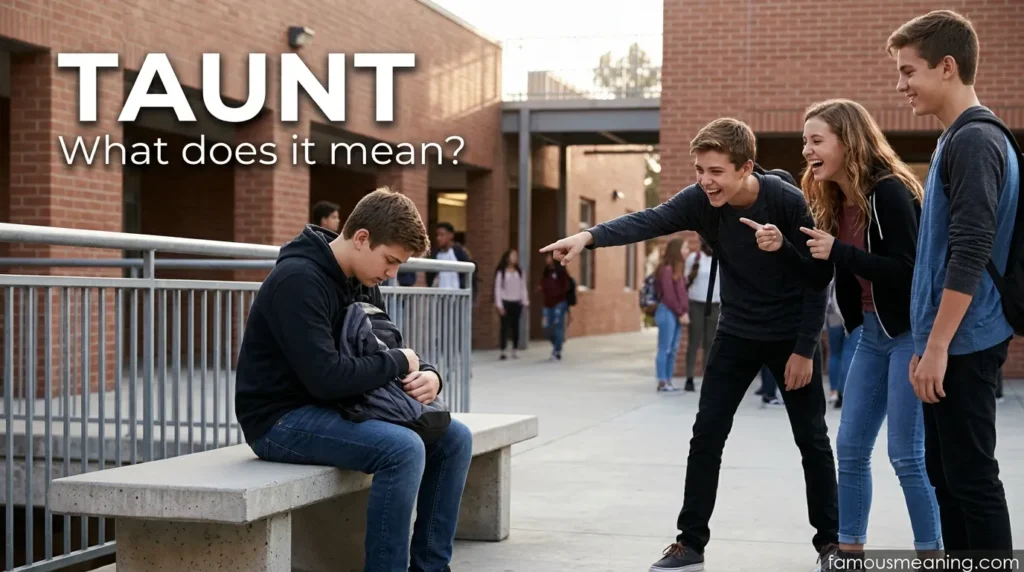

What Does Taunt Mean?
A taunt is a remark or action intended to provoke, ridicule, embarrass, or upset another person. As a verb, to taunt means to mock or challenge someone in a way that is meant to irritate or hurt them.
For example, if one player repeatedly tells an opposing player that they are going to lose, the player may be taunting their opponent.
Simple definition: A taunt is a mocking or provocative statement or action designed to get a reaction from someone.
Taunt as a Noun
As a noun, taunt refers to the insulting or provocative remark itself.
Examples:
His taunt upset the opposing team.
She ignored the cruel taunt from her classmate.
The athlete responded calmly to the crowd’s taunts.
Taunt as a Verb
As a verb, taunt describes the act of provoking or mocking someone.
Examples:
The children taunted him about his mistake.
The opposing fans taunted the visiting team.
She refused to taunt her competitor after winning the race.
What Is the Origin of the Word Taunt?
The word taunt entered English through earlier European language forms, including French. It has long been associated with mocking, reproaching, and provoking another person.
Today, the word commonly describes speech or behavior intended to make someone feel embarrassed, angry, or inferior. Its meaning can range from competitive banter to cruel verbal harassment, depending on the context and the intention behind it.
7 Powerful Facts About the Meaning of Taunt
1. A Taunt Is Usually Intended to Provoke
A defining feature of a taunt is the intention to get a reaction. Someone may want another person to become angry, lose confidence, or respond emotionally.
Example: “You’re afraid to compete against me,” he said, taunting his rival.
The statement is designed to challenge the other person’s confidence rather than simply communicate information.
2. Taunting Can Happen in Sports
Taunting is common in discussions about competitive sports. Athletes or spectators may use provocative words, gestures, or celebrations to unsettle an opponent.
Example: The player taunted his rival after scoring the winning goal.
Sports taunting may sometimes be viewed as competitive banter, but it can also cross the line into unsportsmanlike or abusive behavior.
3. Taunting Can Be Hurtful
Not every taunt is harmless. Repeatedly mocking someone’s appearance, abilities, background, or mistakes can cause embarrassment and emotional distress.
Example: His classmates taunted him about his presentation, making him reluctant to speak in public again.
The impact depends on the words used, the relationship between the people involved, and whether the behavior continues despite objections.
4. Taunting Is Different From Friendly Teasing
Teasing can be affectionate or playful when everyone involved enjoys the interaction. Taunting is generally more provocative and often has the purpose of upsetting or challenging someone.
For example:
Friendly teasing: A friend jokes about your obsession with coffee, and you both laugh.
Taunting: Someone repeatedly mocks your interests to embarrass you in front of others.
The same words can have different effects depending on tone, intent, and context.
5. Taunting Can Occur Online
Social media, gaming platforms, and online communities provide opportunities for people to taunt others through comments, messages, memes, or voice chat.
Example: Other players taunted him in the game chat after his team lost.
Online taunting can become cyberbullying when it involves repeated targeting, harassment, humiliation, or other harmful behavior.
6. Taunt Can Be Used as a Noun or Verb
The word works in two main grammatical forms.
Noun: “The taunt made her angry.”
Verb: “They continued to taunt their opponents.”
Recognizing these forms makes it easier to use the word correctly in writing and conversation.
7. Ignoring a Taunt Can Prevent Escalation
People sometimes taunt others because they want an emotional response. Remaining calm, setting a clear boundary, or walking away can prevent an argument from escalating.
Example: Instead of responding to the insult, he ignored the taunt and continued working.
Ignoring a taunt is not always the right response, particularly when threats or persistent harassment are involved. In those situations, seeking support or reporting the behavior may be more appropriate.
Taunt Meaning in Different Contexts
The meaning of taunt can become more specific depending on where and how the word is used.
Taunt Meaning in Everyday Conversation
In everyday conversation, a taunt is a remark intended to make another person feel foolish, angry, embarrassed, or challenged.
Example: “You can’t do it!” was the taunt that motivated her to prove everyone wrong.
Taunt Meaning in School
At school, taunting may involve mocking a student’s grades, appearance, clothing, abilities, or mistakes.
Example: The teacher intervened when students began taunting a classmate.
Repeated or targeted taunting can be a form of bullying and should not be dismissed as harmless joking.
Taunt Meaning in Gaming
In video games, a taunt can refer to a gesture, animation, voice line, or action used to provoke an opponent. Some games include built-in taunt animations that players can activate during a match.
Example: The player used a taunt animation after winning the round.
In gaming, taunting may be part of the game’s mechanics or competitive culture, but personal insults and harassment can still be harmful.
Taunt Meaning in Relationships
In relationships, taunting may occur during arguments when one person deliberately makes fun of the other person’s insecurities or mistakes.
Example: He taunted her about an old mistake instead of discussing the disagreement respectfully.
Repeatedly using personal vulnerabilities to hurt someone can damage trust and communication.
Taunt Meaning in Literature
In books, poems, and stories, a taunt is often used to reveal hostility, arrogance, cruelty, rivalry, or a character’s attempt to provoke another person.
Example: The villain taunted the hero by reminding him of his earlier failure.
Writers use taunting dialogue to create tension, develop conflict, and show relationships between characters.
Taunt Examples in Sentences
Here are examples showing how taunt is used in different situations.
The opposing team tried to taunt the goalkeeper before the penalty kick.
She refused to respond when her classmates taunted her.
His taunt made the argument even more heated.
The crowd continued to taunt the visiting players.
He regretted taunting his friend about the failed exam.
The villain taunted the hero throughout the final scene.
Online users began to taunt the player after the defeat.
The coach warned the athletes not to taunt their opponents.
She treated the insult as a taunt and chose not to react.
The children were told that taunting others was unacceptable.
These examples demonstrate that taunt can describe a spoken insult, a repeated action, or a deliberate attempt to provoke someone.
Taunt Synonyms
Synonyms are words that have similar meanings. The best synonym for taunt depends on the situation.
| Synonym | Meaning |
|---|---|
| Mock | Make fun of someone or something |
| Tease | Make jokes about someone, playfully or hurtfully |
| Ridicule | Make someone appear foolish through criticism or mockery |
| Jeer | Shout mocking or insulting remarks |
| Goad | Provoke someone into taking action or reacting |
| Provoke | Deliberately cause a reaction |
| Deride | Express contempt or ridicule |
| Insult | Speak or act in a way that offends someone |
| Heckle | Interrupt or challenge someone with mocking comments |
| Torment | Cause someone repeated distress or suffering |
Although these words overlap, they are not always interchangeable. For example, goad emphasizes provoking a reaction, while ridicule emphasizes making someone appear foolish.
Taunt Antonyms
Antonyms are words with opposite or contrasting meanings.
| Antonym | Meaning |
|---|---|
| Encourage | Give someone confidence or support |
| Praise | Express approval or admiration |
| Compliment | Say something positive about someone |
| Comfort | Help someone feel less upset |
| Support | Provide help, encouragement, or assistance |
| Reassure | Help someone feel confident or less worried |
| Respect | Treat someone with consideration and dignity |
For example, taunting a teammate after a mistake is the opposite of encouraging them to improve.
Taunt vs. Tease vs. Mock vs. Bully
These words are related, but each has a slightly different meaning.
| Word | Main meaning | Typical tone |
|---|---|---|
| Taunt | Provoke or insult someone deliberately | Often hostile |
| Tease | Joke about someone or playfully provoke them | Playful or hurtful |
| Mock | Imitate or ridicule someone to make them seem foolish | Often disrespectful |
| Bully | Repeatedly target or intimidate someone through harmful behavior | Aggressive or controlling |
Example of taunting: “You’ll never win against me!”
Example of teasing: “You really do love your morning coffee!”
Example of mocking: Repeating someone’s words in an exaggerated voice to make them look foolish.
Example of bullying: Repeatedly humiliating a classmate, threatening them, or excluding them to cause distress.
The main difference is intent and behavior. Taunting often aims to provoke a reaction, while bullying can involve a broader pattern of intimidation or harm. A single taunt does not automatically establish bullying, although it can be part of it.
How to Use Taunt Correctly
Follow these simple guidelines to use taunt naturally in English.
Use Taunt When Someone Tries to Provoke Another Person
Correct: “The fans taunted the opposing team.”
This sentence indicates that the fans attempted to irritate or unsettle the players.
Use Taunt as a Noun for the Remark Itself
Correct: “His taunt was unnecessary.”
Here, taunt refers to the provocative comment rather than the act of making it.
Use Taunting as an Adjective or Verb Form
Examples:
“She ignored his taunting remarks.”
“They were taunting the opposing players.”
“The taunting continued after the match.”
Avoid Confusing Taunt With Praise
A compliment is intended to express admiration, while a taunt usually involves mockery or provocation.
For example, “You did an excellent job” is praise, not a taunt—unless it is delivered sarcastically in a context that clearly communicates mockery.
Is Taunting Always Negative?
Taunting usually carries a negative meaning because it involves provoking or mocking someone. However, its seriousness varies by situation.
In some sports, games, or friendly competitions, people may engage in lighthearted taunting as part of playful rivalry. When everyone understands the joke and feels comfortable, the interaction may be treated as banter.
However, taunting becomes more concerning when it targets someone’s insecurities, continues after they ask for it to stop, involves threats, or is intended to humiliate them.
The key distinction is context: playful banter may be mutual, while harmful taunting is often unwanted and designed to upset or undermine another person.