
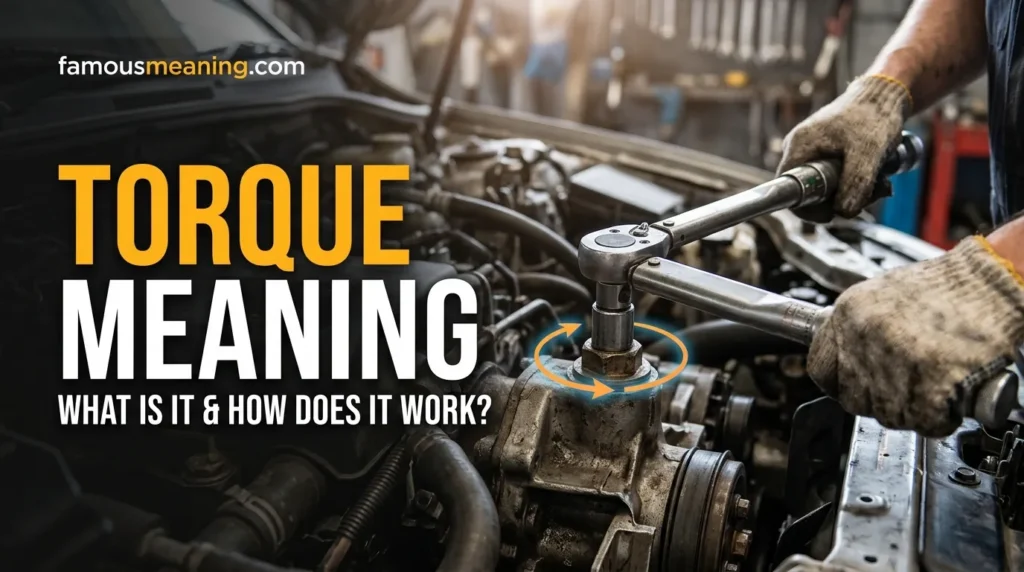

What Is Torque in Simple Words?
Imagine trying to open a door.
If you push the door close to the hinges, it may be difficult to open. But if you push the door near the handle, it is much easier.
Why?
Because the handle is farther from the point where the door rotates. The greater distance allows your force to create a greater turning effect.
That turning effect is called torque.
Easy Example of Torque
Think about using a screwdriver.
When you twist the screwdriver, your hand applies a force that causes the screwdriver to rotate. The turning effect produced by your force is torque.
Other simple examples include:
Turning a key
Opening a door
Using a wrench
Pedaling a bicycle
Turning a steering wheel
Opening a jar
Using scissors
Torque Formula
The basic formula for torque is:
τ = rF sin(θ)
Here:
τ = torque
r = distance from the axis of rotation
F = applied force
θ = angle between the force and the lever arm
When the force is applied at a right angle, the formula becomes:
τ = rF
This is because sin(90°) = 1.
Simple Torque Calculation
Suppose you apply a force of 10 N to a wrench that is 0.5 meters long, and the force is applied at a right angle.
Torque = 0.5 × 10
Torque = 5 N·m
So, the turning effect is 5 newton-meters.
What Is the SI Unit of Torque?
The SI unit of torque is the newton-meter (N·m).
A newton is the SI unit of force, while a meter represents the distance from the rotation point.
For example, if a force of 10 N acts at a perpendicular distance of 2 m from a pivot:
Torque = 10 × 2 = 20 N·m
Is N·m the Same as Joule?
Torque and energy can both be expressed using dimensions involving newtons and meters, but they represent different physical quantities.
Torque: N·m
Energy: Joule (J)
A joule measures energy or work, while N·m in the context of torque describes a rotational effect.
What Is the Difference Between Torque and Force?
Force and torque are closely related, but they are not the same.
| Force | Torque |
|---|---|
| A push or pull | Turning effect of a force |
| Can cause linear motion | Causes or tends to cause rotation |
| Measured in Newtons | Measured in N·m |
| Example: pushing a box | Example: turning a wrench |
Force in Simple Words
Force changes an object’s motion.
Torque in Simple Words
Torque changes or tends to change an object’s rotational motion.
This is why a force can exist without producing much torque if it is applied directly through the axis of rotation.
What Factors Affect Torque?
Three main factors determine torque:
1. Amount of Force
A greater force can produce greater torque if the distance and angle remain the same.
For example, pushing a door harder generally produces a greater turning effect.
2. Distance From the Axis
The farther the force is applied from the rotation point, the greater the torque.
This is why a long wrench can make it easier to turn a tight bolt.
3. Angle of the Force
The angle at which force is applied also affects torque.
The greatest torque occurs when the force is applied perpendicular to the lever arm, at 90 degrees.
Why Does a Longer Wrench Produce More Torque?
A longer wrench gives your force a greater distance from the bolt.
Suppose you apply the same force to two wrenches:
Short wrench: 0.2 m
Long wrench: 0.5 m
The longer wrench produces more torque because the distance from the rotation point is greater.
This is a basic example of how lever arms make work easier.
Torque in Cars
The word torque is especially common when people talk about cars.
In an automobile, engine torque refers to the rotational force produced by the engine.
The engine produces rotational motion that is transferred through the drivetrain to the wheels.
Why Is Torque Important in a Car?
Torque is useful when a vehicle needs to:
Start moving
Climb a hill
Carry a heavy load
Tow a trailer
Accelerate from low speeds
A vehicle with strong torque can be particularly useful for heavy-duty work and towing.
Torque vs Horsepower
Torque and horsepower are related, but they describe different things.
Torque describes rotational force.
Horsepower describes the rate at which work can be done.
A simple way to remember this is:
Torque is the twisting force, while horsepower is a measure of how quickly that work can be delivered.
What Is Torque in an Engine?
An engine creates torque when combustion inside the engine causes the crankshaft to rotate.
The crankshaft transfers this rotational force through the transmission and drivetrain.
The amount of torque available can vary depending on:
Engine design
Engine speed
Gear selection
Air and fuel delivery
Turbocharging or other technologies
This is why car specifications often list both torque and horsepower.
What Is Torque in an Electric Motor?
Electric motors also produce torque.
When electricity creates a magnetic interaction inside the motor, the motor’s components rotate. That rotational force is torque.
Electric motors are often known for delivering strong torque at low speeds, which is one reason electric vehicles can feel quick when starting from a stop.
Types of Torque
Torque can be described in several ways depending on the situation.
Static Torque
Static torque occurs when a force creates a turning effect but the object does not necessarily rotate.
For example, a person may apply force to a wrench while a bolt remains stationary because it is tightly secured.
Dynamic Torque
Dynamic torque occurs when the applied torque contributes to rotational motion.
A rotating motor shaft is an example.
Positive Torque
Positive torque generally refers to torque acting in a chosen direction of rotation.
Negative Torque
Negative torque acts in the opposite rotational direction according to the chosen sign convention.
The terms positive and negative depend on which direction has been defined as positive.
Torque in Everyday Life
You use torque more often than you may realize.
Opening a Door
The hinges act as the rotation point. Pushing the door near the handle creates a turning effect around the hinges.
Using a Wrench
The bolt acts as the axis. Your force on the wrench creates torque that turns the bolt.
Riding a Bicycle
When you push the pedals, your force creates torque around the bicycle’s crank.
Turning a Steering Wheel
Your hands apply forces at a distance from the center of the steering wheel, producing torque.
Opening a Bottle
Twisting a bottle cap involves rotational force around the cap’s center.
Using Scissors
Your fingers apply forces to the handles, creating torque around the scissors’ central pivot.
Torque and the Lever Arm
The lever arm is the perpendicular distance between the axis of rotation and the line of action of the force.
It is important because torque depends strongly on this distance.
A larger effective lever arm generally means greater torque for the same force.
Simple Lever Arm Example
Imagine two people trying to turn the same bolt.
One uses a short wrench, while the other uses a longer wrench.
If both apply the same force, the person using the longer wrench can produce more torque.
This is one reason tools are designed with specific lengths.
Torque and Rotation
Torque is closely connected with rotational motion.
In rotational mechanics, torque plays a role similar to the role that force plays in straight-line motion.
For example:
Force → associated with linear acceleration
Torque → associated with angular acceleration
The greater the net torque on an object, the greater its tendency to change its rotational motion, depending on the object’s rotational inertia.
Balanced Torque
An object can experience torque without rotating if the torques acting in opposite directions balance each other.
For example, imagine a balanced seesaw.
If the clockwise torque equals the counterclockwise torque, the seesaw can remain balanced.
Torque Equilibrium
For rotational equilibrium:
Net torque = 0
This means the total turning effects balance each other.
Torque in Machines
Torque is important in many machines and mechanical systems.
It appears in:
Engines
Motors
Gears
Pumps
Wind turbines
Drills
Conveyor systems
Industrial equipment
Robotics
Engineers calculate torque to determine whether a machine can safely perform a particular task.
Torque in Gears
Gears can be used to change torque and rotational speed.
A gear system can increase torque while reducing rotational speed, or increase speed while reducing torque, depending on the gear arrangement.
This is why gears are important in:
Cars
Bicycles
Clocks
Power tools
Industrial machines
Why Do Lower Gears Provide More Torque?
In a vehicle, lower gears provide a mechanical advantage that allows the engine’s torque to be multiplied at the wheels.
This helps when starting, climbing steep roads, or carrying heavy loads.
Common Mistakes About Torque
Understanding torque is easier when you avoid a few common mistakes.
Mistake 1: Thinking Torque Is Just Force
Torque is not simply force. It depends on force, distance, and angle.
Mistake 2: Ignoring the Distance
Applying a force farther from the axis can create more torque.
Mistake 3: Forgetting the Angle
The direction of the applied force matters.
A force applied perpendicular to the lever arm produces maximum torque for a given force and distance.
Mistake 4: Thinking More Torque Always Means More Speed
Torque and speed are different concepts.
A machine can have high torque while rotating slowly.
Mistake 5: Confusing Torque With Energy
Torque and energy can both involve N·m dimensions, but they describe different physical quantities.
Torque vs Power
Torque and power are often discussed together, especially in automotive engineering.
| Torque | Power |
|---|---|
| Turning force | Rate of doing work |
| Measured in N·m | Often measured in watts or horsepower |
| Important for rotational force | Important for how quickly work is performed |
| Helps explain pulling ability | Helps describe performance over time |
Neither one completely replaces the other.
Positive, Negative, or Neutral Meaning of Torque
If you are asking about the general meaning of the word torque, it is a neutral technical term.
It does not have a positive or negative emotional meaning.
| Type | Meaning |
|---|---|
| Positive | No emotional meaning |
| Negative | No emotional meaning |
| Neutral | Technical term describing rotational effect |
In physics, however, torque can be called positive or negative depending on its direction relative to a chosen coordinate system.
Should You Use the Word Torque?
Yes, if you are talking about physics, engineering, vehicles, machines, tools, or rotational motion.
For example:
Correct: “This engine produces high torque.”
Correct: “The wrench applies torque to the bolt.”
Correct: “Torque causes the shaft to rotate.”
The word is not normally used as casual internet slang.
Related Terms to Torque
| Term | Meaning |
|---|---|
| Force | A push or pull |
| Rotation | Movement around an axis |
| Moment | Another term often used for torque |
| Lever arm | Perpendicular distance from the rotation axis |
| Angular velocity | Rate of rotational motion |
| Angular acceleration | Change in angular velocity |
| Power | Rate of doing work |
| Horsepower | A unit of power |
| Gear ratio | Relationship between gear sizes or speeds |
| Newton | SI unit of force |
Torque Meaning in One Sentence
Torque is the turning or twisting effect produced by a force around an axis or pivot.